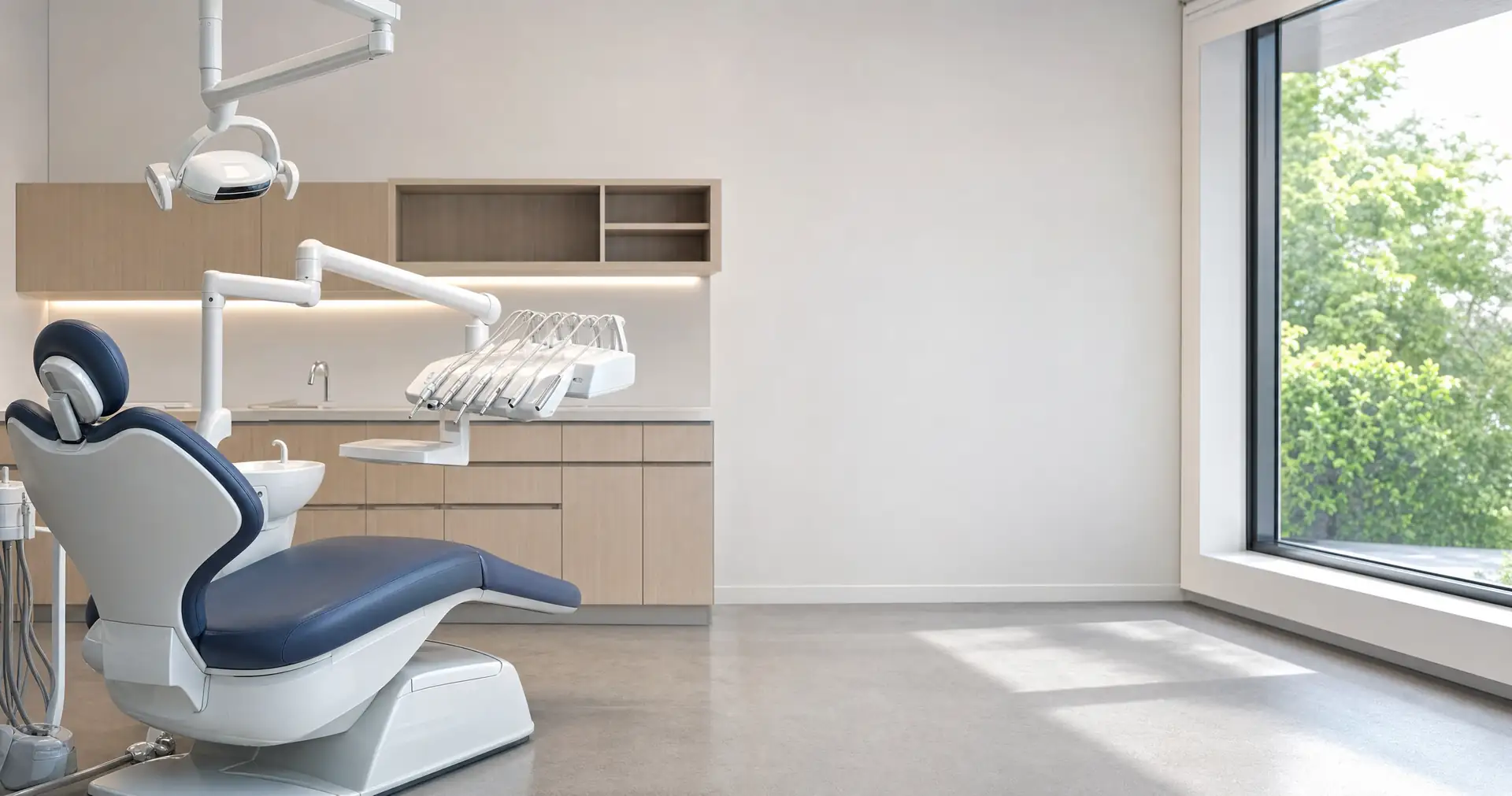
Dental capex in NZ ranges from a single A-dec or Planmeca chair through to a full suite fitout with iTero or Trios scanner, OPG or CBCT imaging, and CEREC chairside milling. Specialist lenders DLL via Dentec and Henry Schein Financial Services dominate the segment, alongside Speirs Finance Healthcare and the major banks for established operators.
What you need to know about NZ dental chair and suite finance.
→Single chair commonly $40K to $120K A-dec, Planmeca, KaVo, and Belmont are the dominant chair brands in NZ. The chair, light, delivery unit, and operator stool typically sit inside this band.
→Full suite fitout commonly $250K to $400K+ A four-surgery greenfield fitout layers chairs, compressor and suction plant, sterilisation, cabinetry, and the imaging and digital workflow stack (iTero, OPG, CBCT, CEREC).
→DLL via Dentec publishes a new-practice programme The Dentec programme lends up to $500,000 to new-to-practice operators with no financial statements required, per its published terms.
→DCNZ and HPCAA 2003 frame the regulatory overlay The Dental Council of New Zealand registers practitioners under the Health Practitioners Competence Assurance Act 2003. Lenders commonly confirm registration as part of the application file.
The landscape
A specialist lender pool sits on top of the NZ dental equipment segment.
Dental equipment finance in New Zealand sits in a specialist pocket of the wider equipment finance market. The chair itself is the centrepiece, but the surrounding suite (compressor, suction, autoclave, cabinetry, plumbing, electrical, X-ray shielding) commonly carries a higher combined cost than the chair. A full four-surgery practice fitout layers four chairs, the supporting plant room, sterilisation bay, reception fitout, and the digital imaging and CAD/CAM workflow.
Three specialist lenders publish dental programmes in NZ. DLL (De Lage Landen) operates the Dentec programme, which is widely referenced in NZ dental industry discussion as a route to fund a new practice without the trading data a generic lender requires; per the published Dentec terms, the programme lends up to $500,000 with no financial statements for new-to-practice operators. Henry Schein Financial Services funds equipment supplied through its distribution network. Speirs Finance Healthcare runs a dedicated medical and dental book covering both equipment and goodwill on practice acquisitions.
The major banks (ANZ, ASB, BNZ, Westpac) cover established practice operators with multi-year trading data, commonly through relationship-managed health-sector teams. UDC Finance and Heartland Bank participate where the asset is the primary security and the LVR sits within standard equipment finance bounds. The Dental Council of New Zealand (DCNZ) sits as the registering body under the Health Practitioners Competence Assurance Act 2003 (HPCAA), and current registration is commonly confirmed by lenders as part of the file.
Single chair
$40K to $120K
Full suite (4 surgery)
$250K to $400K+
Imaging stack
$60K to $180K
Common term
5 to 7 years
Dental finance scenarios
Four common NZ dental chair and suite finance scenarios.
Most dental equipment applications fall into one of four patterns. Each pattern has a typical loan amount, structure, and lender pool.
New graduate buying into associate-to-owner pathway
New graduate transitioning from associate to practice ownership. Single chair replacement plus reception and digital workflow upgrade. Dentec new-practice programme commonly the entry route given limited trading data.
·Loan amount: $80K to $180K
·Term: 5 to 7 years
Single chair replacement at end of life
Existing practice replacing a 12 to 15 year old chair at end of operating life. A-dec, Planmeca, or KaVo chair plus delivery unit, light, and operator stool. Existing trading data tightens the rate band.
·Loan amount: $40K to $120K
·Term: 5 years
Greenfield four-surgery practice fitout
Greenfield build in a new suburb or growth corridor. Four chairs, compressor and suction plant, sterilisation bay, OPG or CBCT imaging, CEREC milling, full reception and surgery cabinetry. Staged drawdown common.
·Loan amount: $300K to $500K+
·Term: 5 to 7 years
Digital workflow upgrade (scanner and milling)
Existing practice adding intra-oral scanner (iTero or Trios), CBCT imaging, and chairside CEREC milling unit to bring crown and aligner workflows in-house. Typically funded as a separate equipment finance tranche.
·Loan amount: $80K to $200K
·Term: 5 years
What dental practices borrow for
Six common NZ dental equipment finance purposes.
Dental equipment lending volume falls into six common purposes. Each has a typical structure that fits.
Dental chairs and delivery units
A-dec 500 and 300 series, Planmeca Compact and Sovereign, KaVo Estetica, Belmont Cleo and Voyager. Chattel mortgage on a 5 to 7 year term; chair life commonly 12 to 18 years with maintenance.
Compressor, suction, and sterilisation
Cattani or DurrDental compressor and suction plant, Melag or W&H autoclave, ultrasonic cleaner. Plant-room kit commonly bundled into the suite finance tranche on a 5 to 7 year term.
Intra-oral scanners and digital workflow
iTero Element 5D, 3Shape Trios 5, Medit i700. Intra-oral scanners are the entry point to a digital crown, aligner, and implant workflow. Smaller-ticket finance often as a separate tranche.
OPG, cephalometric, and CBCT imaging
Planmeca ProMax, Sirona Orthophos, Vatech PaX-i, Carestream CS 8100. OPG imaging is the standard panoramic; CBCT adds cone-beam 3D imaging for implant and endodontic planning.
CEREC chairside CAD/CAM milling
Dentsply Sirona CEREC Primemill, Primescan, and SpeedFire. Chairside milling brings same-visit crown, inlay, and onlay restorations in-house. Typically $130K to $200K combined.
Cabinetry, plumbing, and X-ray shielding
Custom surgery cabinetry, dental-grade plumbing (compressed air, suction, water lines), lead-lined wall shielding for X-ray rooms. Commonly funded as fitout finance alongside the chair and plant tranches.
Tax and GST
How GST and IRD depreciation typically work on dental chairs and equipment.
A GST-registered NZ dental practice can typically claim the GST component on dental chairs, imaging systems, sterilisation plant, and cabinetry as input tax in the relevant GST return, subject to the accountant's confirmation. Where the equipment is acquired under chattel mortgage, the full GST is typically claimable upfront in the next GST return after settlement. Where it is acquired under finance lease, GST is typically claimed across the rental payments. IRD publishes asset-class depreciation rates covering medical and dental equipment; chairs, autoclaves, compressor and suction plant, and imaging systems each carry their own asset-class rate. The accountant is the right person to confirm structure choice and depreciation treatment on the specific practice position. Dental services are an exempt supply in some categories, which can affect the input-tax recovery position; this is another point worth confirming with the accountant.
Dental equipment bands
Indicative NZ dental chair, suite, and imaging finance bands.
Dental equipment pricing varies by brand, spec, accessory bundle, and supplier. The bands below are observed across the NZ dental equipment finance pool in 2026.
Asset category
Used or refurbished
New
Common term
Single chair, light, delivery unit, stool
$25K to $55K
$40K to $120K
5 to 7 years
Compressor, suction, autoclave plant room
$18K to $40K
$35K to $75K
5 to 7 years
OPG panoramic imaging
$25K to $55K
$55K to $95K
5 years
CBCT cone-beam imaging
$60K to $120K
$120K to $200K
5 to 7 years
Intra-oral scanner (iTero, Trios, Medit)
Limited used market
$35K to $60K
5 years
CEREC chairside milling unit
Limited used market
$130K to $200K
5 to 7 years
Full four-surgery suite fitout
N/A
$300K to $500K+
5 to 7 years
Indicative bands only. Actual price depends on brand, spec, accessory bundle, and supplier. Final rate, fee, and approval decisions are made by the lender after assessment.
New practice vs replacement vs digital upgrade
New-practice fitout vs single-chair replacement vs digital workflow upgrade.
The structure choice tracks practice maturity, trading data, and asset mix. New-to-practice operators typically lean on the Dentec programme; established practices access tighter pricing through relationship-managed bank teams.
Feature
Greenfield new-practice fitout
Single chair replacement (existing practice)
Digital workflow upgrade (scanner + CBCT + CEREC)
Typical loan amount
$300K to $500K+
$40K to $120K
$130K to $300K
Trading data required
Limited or none (Dentec programme)
12 to 24 months
12 to 24 months
Common lender route
DLL via Dentec, Henry Schein FS, Speirs
Existing relationship lender or UDC
Henry Schein FS or relationship bank
Drawdown pattern
Staged across fitout milestones
Single drawdown at delivery
Single drawdown at delivery
Common term
5 to 7 years
5 years
5 years
Practice ownership status
New ownership entity
Established practice
Established practice
How it works
A typical NZ dental equipment finance application.
New-practice applications under the Dentec programme carry a different documentation path to established-practice applications. Established operators with multi-year trading data move faster and access tighter pricing.
01
Day 1 to 14
Define the asset spec and tranche structure
A typical dental loan combines a chattel mortgage on the chair and delivery unit with separate tranches for plant-room kit, imaging, and digital workflow. Greenfield fitouts are commonly drawn in stages tied to fitout milestones (cabinetry installed, plant commissioned, imaging delivered, chairs commissioned).
·Digital workflow quote (scanner, CEREC where applicable)
·Fitout build quote (greenfield)
02
Day 3 to 14
Submit application with dental-specific documents
Beyond the standard SME application pack, dental lenders ask for current DCNZ registration under the Health Practitioners Competence Assurance Act 2003, professional indemnity insurance evidence, and (for established practices) 12 to 24 months of trading data. New-to-practice applications under the Dentec programme commonly bypass the financial statements requirement per the published programme terms.
Documents commonly required
·NZBN, practice owner ID
·DCNZ registration (current)
·Professional indemnity insurance
·12 to 24 months bank statements (established practice)
·Last 2 years financial statements (established practice)
·Patient base data or transition plan (associate-to-owner pathway)
·Lease agreement or property title (premises)
03
Day 7 to 21
Lender assessment and offer
Lenders assess against three things: the DCNZ registration and practitioner profile, the asset and security position (LVR after deposit), and the practice trading or transition evidence. Offers commonly come back with conditions: deposit, additional security, staged drawdowns tied to fitout milestones, or insurance requirements.
04
Week 3 onward (single chair) to Month 3-6 (greenfield)
Settle, register PPSR, take delivery
Asset finance settles directly to the supplier or fitout contractor. The lender registers a security interest on the Personal Property Securities Register (PPSR) for each financed asset. Greenfield fitouts settle in stages across milestones; single-chair replacements settle on delivery and commissioning. First clinical sessions commonly scheduled within 1 to 4 weeks of commissioning.
A finance broker familiar with the Dentec, Henry Schein, and Speirs programmes commonly tightens the indicative rate band and reduces the documentation cycle for new-to-practice applications versus a direct application to a generic SME lender.
Worked scenarios
Three NZ dental chair and suite finance scenarios.
Real-world structures across new-graduate associate-to-owner pathway, established practice digital upgrade, and greenfield four-surgery fitout. Each illustrates how trading data, programme eligibility, and asset mix shift the offered rate.
Newly DCNZ-registered graduate transitioning to ownership
A Wellington dental graduate with 2 years of associate experience transitioning to practice ownership through an associate-to-owner pathway with the existing principal. Total project $160,000 ex-GST: $85,000 new A-dec 300 chair plus delivery unit and light, $35,000 plant-room upgrade (Cattani compressor and suction), $30,000 reception cabinetry refit, $10,000 sterilisation bay refit. No personal financial statements available given the transition stage.
Structure agreed under the Dentec programme: equipment finance on the chair and plant ($120,000 combined, 7-year term, indicative 9-11% p.a.), unsecured term loan on the cabinetry refit ($40,000, 5-year term, indicative 11-13% p.a.). DCNZ registration confirmed; professional indemnity insurance in place via the New Zealand Dental Association (NZDA) member scheme.
PPSR security interest registered against the chair, delivery unit, and plant kit at settlement. First independent clinical sessions scheduled for 4 weeks after commissioning; existing practice patient base transitioned across the first 6 months of the new ownership entity.
Indicative figures
Total project
$160,000
Equipment finance
$120,000
Cabinetry refit (unsecured)
$40,000
Indicative blended rate
10-12% p.a.
Three-surgery practice adding scanner, CBCT, and CEREC
Auckland established practice digital workflow upgrade
An Auckland three-surgery established practice with 12 years of trading adding a digital workflow stack to bring crown, implant planning, and aligner workflows in-house. Total project $245,000 ex-GST: $50,000 iTero Element 5D intra-oral scanner, $145,000 Sirona CEREC Primemill and Primescan combined, $50,000 Sirona Orthophos CBCT cone-beam imaging unit.
Existing 12-year trading and an established health-sector relationship with Henry Schein Financial Services materially tightened the indicative rate band. Equipment finance on the combined digital workflow ($245,000, 5-year term, indicative 8-10% p.a.). X-ray shielding upgrade in the imaging room funded out of working capital separately.
PPSR security interest registered against each unit at settlement. Workflow training and CEREC commissioning scheduled across weeks 2 to 6 after delivery. First in-house chairside crown restoration completed in week 4. The accountant confirmed GST and depreciation treatment on the imaging and milling assets.
Indicative figures
Total project
$245,000
CEREC milling and scanner
$195,000
CBCT imaging
$50,000
Indicative rate
8-10% p.a.
Two-principal partnership opening a new growth-corridor practice
Christchurch greenfield four-surgery practice fitout
A two-principal partnership opening a greenfield four-surgery practice in a Christchurch growth corridor. Total package $470,000 ex-GST: $360,000 four A-dec 500 chairs and delivery units plus plant-room kit, $80,000 OPG panoramic imaging and intra-oral scanner, $30,000 reception and surgery cabinetry contribution. Building lease and base building fitout funded separately by the landlord.
Structure agreed with Speirs Finance Healthcare: equipment finance staged across fitout milestones ($470,000 total, 7-year term, indicative 8-10% p.a.). Both principals hold current DCNZ registration and 8+ years of associate experience. Professional indemnity insurance bound through the NZDA member scheme. Personal guarantees from both principals.
PPSR security interest registered against each chair, plant unit, and imaging asset at the relevant stage. Practice opened to patients in week 14 after lender first settlement. Build commissioning sequence: cabinetry installed week 6, plant commissioned week 9, chairs commissioned week 11, imaging commissioned week 13, first clinical session week 14.
Indicative figures
Total package
$470,000
Chairs and plant
$360,000
Imaging
$80,000
Indicative blended rate
8-10% p.a.
NZ dental equipment lenders
Lenders that fund NZ dental chairs and suites well.
Several specialist lenders carry deep familiarity with the dental segment. The shortlist below is editorial.
Regulatory framework for health practitioners under HPCAA 2003.
FAQ
Dental chair and suite finance, NZ small-business questions answered
How much does it cost to set up a new dental practice in NZ?
A new four-surgery dental practice fitout commonly runs $300,000 to $500,000 ex-GST for the equipment and fitout components, before any building or lease costs borne by the landlord. Single-surgery startups commonly run $120,000 to $200,000 ex-GST. The total covers chairs and delivery units (commonly $40,000 to $120,000 each), plant-room kit (compressor, suction, autoclave, sterilisation), imaging (OPG or CBCT), reception and surgery cabinetry, and X-ray shielding. The DLL Dentec programme is widely used for new-to-practice fitouts where personal financial statements are not yet available.
Does Dentec really lend up to $500,000 with no financial statements?
Per the published Dentec programme terms (operated by DLL), the programme lends up to $500,000 to new-to-practice operators without requiring financial statements as part of the application. The programme is positioned for graduates and associates moving into ownership where trading data is not yet available. DCNZ registration under HPCAA 2003 is confirmed, and the equipment itself secures the loan via PPSR registration. Final rate, fee, and approval decisions are made by DLL after assessment of the practitioner profile and asset spec.
What is the typical loan term for a dental chair in NZ?
Dental chair finance commonly runs 5 to 7 year loan terms in NZ, with 5 years being the most common single-asset term and 7 years used for greenfield fitouts where the combined plant value is higher. Chair operating life commonly runs 12 to 18 years with manufacturer maintenance, so the loan term sits well within the practical residual life of the asset. The full suite (chair plus plant plus imaging) commonly attracts a 7-year term reflecting the longer combined asset life.
What rate range applies to NZ dental equipment finance in 2026?
Indicative rates on dental equipment finance commonly sit in the 8% to 13% per annum band depending on lender, structure, security, and practitioner profile. Established practices with multi-year trading data accessing relationship-managed bank teams (ANZ, ASB, BNZ, Westpac) commonly sit at the lower end (8-10%). Specialist health-sector lenders (Henry Schein FS, Speirs) sit in the middle. The Dentec programme for new-to-practice operators commonly sits in the 9-12% band reflecting the limited trading data position. Final rate is set by the lender after assessment.
Which dental chair brands are most common in NZ?
A-dec is the most widely installed chair brand in NZ practices, with the A-dec 500 and A-dec 300 series being the dominant choices across new and replacement installations. Planmeca (Compact i, Sovereign), KaVo (Estetica), and Belmont (Cleo, Voyager) round out the main brand pool. The chair brand affects ongoing parts and service economics over the 12 to 18 year operating life more than it affects the finance application itself; lenders are typically comfortable across the major brands provided the supplier is a recognised NZ distributor.
Can I claim GST on a dental chair financed under chattel mortgage?
A GST-registered NZ dental practice can typically claim the GST component on a dental chair, plant kit, and imaging acquired under chattel mortgage as input tax in the relevant GST return, subject to the accountant's confirmation. Where the equipment is acquired under chattel mortgage, the full GST is typically claimable upfront in the next GST return after settlement. Where it is acquired under finance lease, GST is typically claimed across the rental payments. Some dental services are an exempt supply, which can affect the input-tax recovery position, so the accountant is the right person to confirm structure choice on the specific practice position.
What does DCNZ registration require for a new dental practice owner?
The Dental Council of New Zealand (DCNZ) registers practitioners under the Health Practitioners Competence Assurance Act 2003. Practitioners hold a current Annual Practising Certificate (APC) that confirms registration in good standing. Lenders commonly confirm the APC as part of the application file. DCNZ also publishes practice standards covering record keeping, infection control, and continuing professional development. Practice ownership itself does not require a separate DCNZ approval, but each clinical practitioner working at the practice must hold a current APC. DCNZ publishes the registration framework and APC process in full.
How is dental equipment depreciated for tax purposes in NZ?
IRD publishes asset-class depreciation rates covering medical and dental equipment, with each asset class (chairs, autoclaves, compressor and suction plant, panoramic imaging, CBCT imaging) carrying its own rate. Most dental equipment falls within IRD asset classes that allow either diminishing-value or straight-line depreciation, with the practitioner's accountant selecting the method aligned to the practice tax position. Depreciation begins from the date the asset is first available for use. The accountant is the right person to confirm the applicable rate and method on the specific practice position.
What happens if my dental practice closes before the loan is repaid?
Where the chair, plant, or imaging is financed under chattel mortgage and the practice closes before the loan is repaid, the lender typically has a security interest registered on the Personal Property Securities Register (PPSR) and can take possession of the asset to recover the outstanding balance. Any shortfall between resale value and balance owing typically falls to the practice and any personal guarantor. Used dental chairs and plant retain materially less value in the secondary market than at new, particularly once 8 to 10 years old. Lenders commonly work with practices to restructure repayments before resorting to repossession.
Can a dental practice acquisition be financed alongside the equipment?
Yes. NZ specialist health-sector lenders (notably Speirs Finance Healthcare) fund both the equipment side of a practice acquisition and the goodwill component (the patient base, brand, and going-concern value). Equipment is funded under chattel mortgage with PPSR registration; goodwill is funded under term lending typically secured by personal guarantees and sometimes property. Practice acquisition applications commonly require a patient base report, the seller's 2-3 year trading history, and a transition plan. The combined acquisition and equipment package commonly runs $400,000 to $1,500,000 depending on practice size.
Do I need to upgrade X-ray shielding when installing CBCT imaging?
CBCT cone-beam imaging units commonly require enhanced X-ray shielding compared to standard intra-oral or OPG imaging, given the higher radiation dose profile. NZ practices installing CBCT typically engage a medical physicist to specify shielding (lead-lined wall thickness, control booth shielding) and the local council for building consent on structural changes. Shielding costs vary by room layout and existing wall construction, commonly $8,000 to $25,000 for a CBCT room upgrade. The Office of Radiation Safety (within the Ministry of Health) publishes radiation safety standards relevant to dental imaging in NZ.
What is the difference between an iTero, Trios, and Medit scanner?
iTero (Align Technology), 3Shape Trios, and Medit are the three intra-oral scanner platforms most commonly installed in NZ dental practices. iTero is closely linked to the Invisalign aligner workflow given the shared parent company. Trios is widely supported across crown, implant, and aligner workflows with a strong third-party software ecosystem. Medit sits at a lower price point with strong scanning capability and an open-architecture export workflow. The choice typically tracks the practice clinical mix (aligner-heavy practices commonly choose iTero) more than it affects the finance application; lenders fund all three across the standard intra-oral scanner band.
Can a sole practitioner refinance equipment finance into better pricing?
Yes. Established sole practitioners with 2 to 3 years of clean trading history commonly refinance from new-practice programme pricing (9-12% under Dentec) into established-practice pricing (8-10% via relationship-managed bank or specialist health-sector lenders). Refinancing is also commonly used to consolidate multiple equipment loans (chair, plant, imaging, digital workflow) into a single facility, or to release equity to fund a digital workflow upgrade. Early-repayment fees on the existing loans are the main consideration; the loan contract is the authoritative reference on break costs.
Is professional indemnity insurance required as part of the finance application?
Most NZ dental lenders confirm professional indemnity insurance as part of the application file, given the regulatory overlay under HPCAA 2003 and the practice's exposure to clinical negligence claims. The New Zealand Dental Association (NZDA) operates a member professional indemnity scheme that is widely used across the profession. Lenders typically take confirmation of cover rather than detailed policy review. Professional indemnity insurance is separate from public liability insurance (covering the practice premises) and motor vehicle insurance (where applicable).
Indicative content only. Not personalised financial advice.
A business loan is a commitment that runs for months or years, and repayments come out of the same operating cash flow as everything else. Before committing, it is worth modelling the weekly and monthly cost against the business's working-capital position, which is what this site is built to help with. Borrowing at a level that stays comfortable through a quiet quarter, not just a strong one, is widely regarded as the safer frame.
What this site is
A calculator and information tool. Not a lender, not a broker, not a registered financial adviser. Nothing here is personalised financial advice.
What the figures show
Modelled estimates based on the inputs you enter. Not a quote. Not an offer of credit. Not a guarantee of approval, rate, or fees.
What the lender decides
Final rates, fees, and approval are set by the lender after a CCCFA-appropriate assessment of the applicant's circumstances and credit decision.
Commercial disclosure
Businessloans.org.nz earns a commission from Prospa when a visitor applies through this site and their application is approved. The commission is paid by Prospa, not by the borrower, and it does not influence the rate Prospa offers. Full disclosure on the partner page.
Tax, GST, and accountant framing
Tax-treatment statements (GST claim timing, interest deductibility, depreciation rates) are general in nature and subject to your accountant's confirmation on the specific business position. For material amounts, professional advice from a registered financial adviser or chartered accountant is widely regarded as the safer frame.