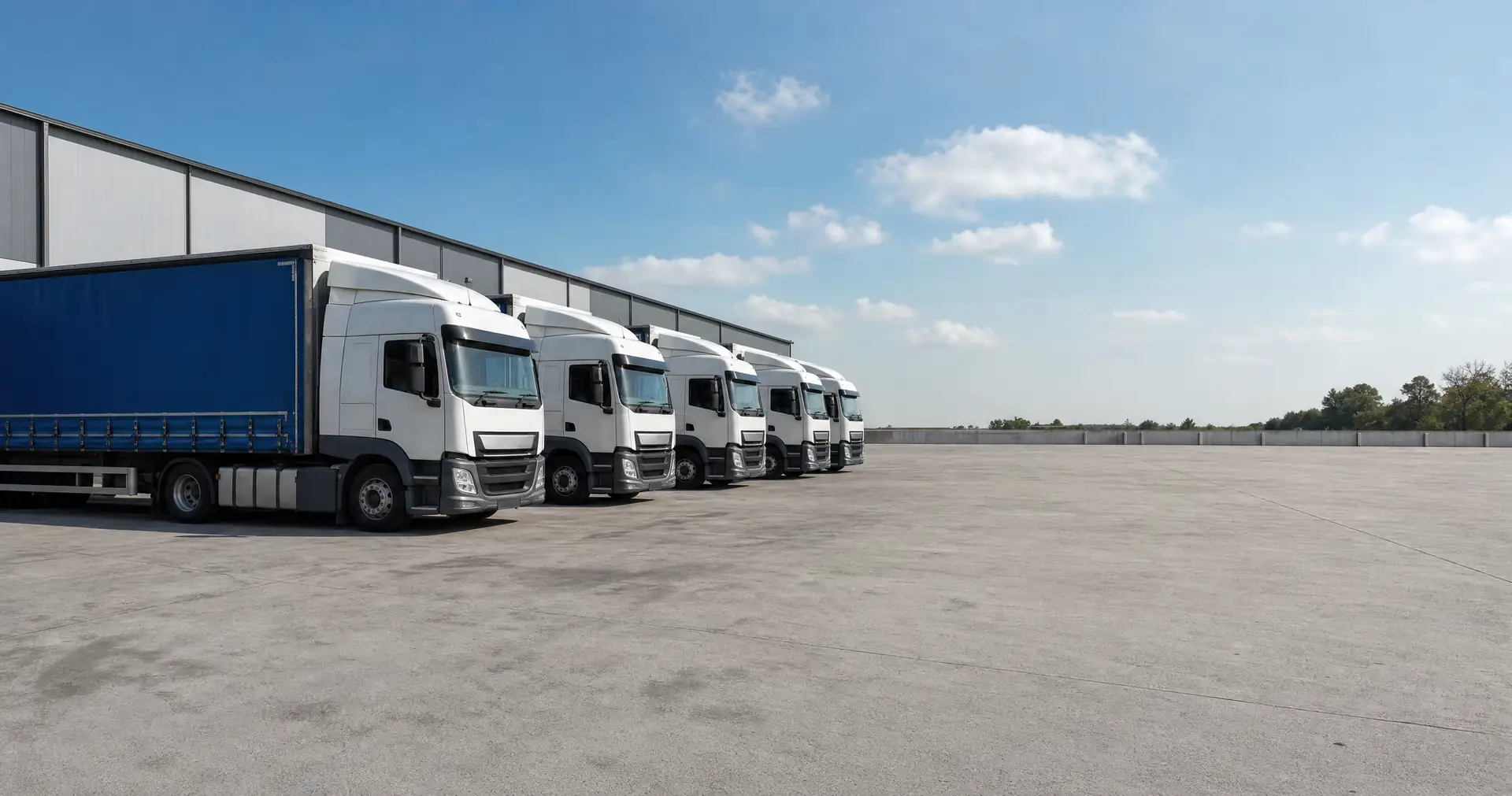
Business loans for New Zealand transport and logistics.
Trucking, courier, and freight operators borrow against capital-heavy fleet, fuel-price volatility, and Road User Charges cash flow. Lenders commonly weight NZTA work-time compliance, COF history, driver licensing classes, and the operator's record across the fleet replacement cycle.
3 dedicated guides covering the eligibility quirks, capex bands, lender mix, and worked NZ scenarios that matter for each sub-segment of transport & logistics.
What you need to know about transport and logistics finance in NZ.
→Trucks and trailers are the dominant capital event line-haul rigs commonly $250K to $700K, financed via chattel mortgage on 5 to 8-year terms.
→Road User Charges are an operating-cost driver RUC prepaid in 1,000 km blocks to NZTA shapes weekly cash flow and feeds working-capital reviews.
→NZTA work-time and log-book compliance matter driver work-time records, log-book audits, and COF history all feed the lender file for transport finance.
→Fuel-price volatility is the recurring working-capital pressure diesel and petrol price swings against fixed contract rates drive line-of-credit and invoice-finance demand across fleet operators.
The landscape
A capital-intensive, regulation-bound segment shaped by fuel and RUC.
New Zealand transport and logistics is a long-established small-business segment. Stats NZ Business Demography figures show a sustained population of registered road freight, courier, and passenger transport operators across the country. Stats NZ Industry Production data and Ministry of Transport (MoT) freight reporting attribute a meaningful share of national output to land transport, with road freight carrying the substantial majority of domestic freight tonnage per Ministry of Transport National Freight Demand Study material.
The structures that fit transport most cleanly are chattel-mortgage asset finance for trucks, trailers, and vans; a line of credit or invoice finance for fuel and RUC working capital; and a term loan for depot or yard fit-out. Lenders that play in this space include UDC Finance, Heartland Bank, MTF Finance, Marac Asset Finance, Avanti Finance, Prospa, the major banks for property-secured operators, and a small number of transport-specialist brokers.
Lender posture on transport is shaped by fleet age, NZTA compliance history, and customer concentration. The NZTA Operator Rating System (ORS) and Transport Service Licence (TSL) regime cover commercial road operators under the Land Transport Act 1998 and the Land Transport (Driver Licensing) Rule 1999. Operators with clean COF history, current TSL, full driver licensing across the relevant classes (Class 2 to 5 plus endorsements), and disciplined work-time and log-book records commonly attract a tighter indicative rate band than newer operators or those with concentrated single-customer exposure.
NZ transport credit also carries a regional shape. The State Highway 1 spine across the North Island and the SH1 / SH8 / SH73 network across the South Island concentrate line-haul work, while metro Auckland, Wellington, Christchurch, and Hamilton concentrate last-mile and distribution work. Port-adjacent operators (Auckland, Tauranga, Lyttelton, CentrePort Wellington) commonly run container logistics and skel-trailer fleets. Each regional shape carries a slightly different lender appetite, with Tauranga and Auckland seeing the highest concentration of HPMV and 50MAX-permitted operators in the country per NZTA permit data.
Line-haul truck and trailer
$180K to $700K
Last-mile courier van
$50K to $110K
Refrigerated trailer / unit
$120K to $400K
Fuel and RUC working capital
$30K to $250K
Sub-segments
How NZ transport operators borrow, by sub-segment.
Transport is not one segment; it is several. Each sub-segment has its own typical loan amounts, common purposes, and regulatory framing.
Line-haul trucking
Inter-city freight on the State Highway 1 / SH2 / SH8 spine. Capex weighted to prime movers (Kenworth, Volvo, Scania) and trailers (curtainsider, flat-deck, B-trains). Class 5 driver licensing, TSL, and full work-time compliance the baseline. Owner-driver and fleet models both common.
·Loan amount: $250K to $700K+
·Term: 5 to 8 years
Last-mile courier and parcel
Auckland, Wellington, Christchurch metro courier work, often as franchisees of NZ Post / CourierPost, NZ Couriers, Aramex, or DX Mail. Capex weighted to vans (Hiace, Transit class) and tracking technology. Lighter capex profile but recurring contract-route revenue.
·Loan amount: $50K to $150K
·Term: 4 to 6 years
Taxi and rideshare
Auckland, Wellington, Queenstown, and Christchurch taxi and rideshare operators (Uber, Ola, Zoomy). Capex tied to passenger vehicles with Passenger Service Licence (PSL) compliance. Operator P endorsement on driver licence required.
·Loan amount: $30K to $90K
·Term: 3 to 5 years
Refrigerated transport
Chilled and frozen freight for dairy, meat, seafood, and produce supply chains. Capex weighted to refrigerated trailers, reefer units (Thermo King, Carrier), and dual-temperature equipment. Compliance with cold-chain integrity standards required for major customers.
·Loan amount: $250K to $900K
·Term: 5 to 8 years
Livestock and rural transport
Stock truck operators servicing dairy, sheep and beef, and saleyard work across Waikato, Manawatū, Canterbury, and Southland. Specialist deck and crate fit-out. Commonly seasonal cash flow tied to calving, weaning, and prime stock cycles.
·Loan amount: $200K to $600K
·Term: 5 to 8 years
Heavy haulage and container logistics
Oversize / over-mass operators (HPMV, 50MAX), container side-loader and skel-trailer operators servicing Ports of Auckland, Tauranga, Lyttelton, and Wellington. Specialist permits, pilot vehicles, and route planning feed compliance. Largest capex profile.
·Loan amount: $400K to $2M+
·Term: 6 to 10 years
Common reasons
What NZ transport businesses borrow for.
The bulk of NZ transport lending volume falls into six common purposes. Each has a typical structure that fits.
01
Truck and prime-mover purchase
Kenworth, Volvo, Scania, Mercedes-Benz, and DAF tractor units for line-haul and rigid configurations for distribution work. Largest single capex commitment most operators face. Chattel mortgage on a 5 to 8-year term, sometimes extended to 10 years for new heavy units.
02
Trailer and reefer-unit purchase
Curtainsiders, flat-decks, B-trains, refrigerated trailers, container skels, and tipper trailers. Chattel mortgage, often financed alongside the prime mover under a single combined facility against both assets.
03
Fleet refresh and replacement cycle
NZ trucks typically replace at 5 to 10 years depending on configuration and kilometre count. Lenders commonly fund staged fleet refresh under multiple chattel mortgages or a single facility against several units.
04
Fuel-price volatility working capital
Diesel and petrol price swings against fixed contract rates create cash-flow pressure for fleet operators. Line of credit or invoice finance against verified freight invoices commonly bridges the gap.
05
Road User Charges prepayment
RUC paid in advance to NZTA in 1,000 km blocks at category-specific rates ties up working capital across diesel-vehicle fleets. Operators with high monthly km commonly hold material RUC float, partially funded by working-capital lines.
06
Depot, yard, and workshop expansion
Truck wash bays, secure yard expansion, in-house workshop fit-out for COF preparation and routine servicing. Term loan against personal property or commercial mortgage where freehold premises are owned.
Eligibility quirks
What transport lenders ask that other industries don't.
Beyond the standard NZBN, trading history, and turnover questions, NZ transport lenders commonly ask about NZTA compliance, driver licensing across the fleet, COF history, and customer concentration.
TSL and ORS history
Transport Service Licence currency and NZTA Operator Rating System grade are commonly part of the lender file. Operators with elevated ORS scores (poor compliance) typically face tighter conditions or are declined; clean ORS supports the application.
Driver licensing and endorsements
Class 2 (medium rigid), Class 4 (heavy rigid), Class 5 (heavy combination), plus dangerous goods (D), passenger (P), and overdimension endorsements where applicable. Operator workforce coverage across required classes feeds the lender review.
COF and maintenance history
Six-monthly Certificate of Fitness inspections under the NZTA COF rule are a baseline compliance hurdle. Lenders commonly ask for COF pass history and maintenance records before disbursing on used-truck finance.
Customer concentration and contract
Single-customer line-haul or single-franchise courier operators face tighter lender review than diversified operators. Contracted-route revenue with NZ Post / CourierPost or major-customer freight contracts is widely treated as a positive working-capital signal.
Capex by sub-segment and region
Indicative transport capex bands by NZ region.
Auckland and Wellington truck and trailer pricing commonly runs 5% to 10% above regional NZ pricing for the same specification, primarily driven by dealer margin and transport-on costs from main-port distribution. The bands below are observed across NZ transport finance applications in 2026.
Sub-segment
Auckland
Wellington / Christchurch
Regional NZ
Prime mover (line-haul, new)
$280K to $550K
$260K to $500K
$240K to $470K
Prime mover (line-haul, used)
$140K to $300K
$130K to $280K
$120K to $260K
Curtainsider trailer
$110K to $220K
$100K to $200K
$90K to $190K
Refrigerated trailer + reefer unit
$200K to $420K
$180K to $390K
$160K to $370K
Container skel trailer
$80K to $180K
$70K to $170K
$65K to $160K
Last-mile courier van (fitted)
$60K to $130K
$55K to $120K
$50K to $115K
Stock truck (livestock crate)
$220K to $500K
$200K to $470K
$180K to $450K
Indicative bands only. Actual cost depends on dealer pricing, vehicle or trailer specification, age, configuration, and any HPMV or 50MAX upgrades. Premium specialty operators can run materially higher.
Worked scenarios
Three NZ transport finance scenarios.
Real-world structures across an Auckland line-haul truckie, a Wellington courier franchisee, and a Christchurch refrigerated freight operator, illustrating how compliance history and contract base shift the offered rate.
Line-haul trucking
Auckland line-haul prime mover and trailer
A South Auckland-based owner-driver with 12 years trading and a clean NZTA Operator Rating Score upgrading to a new Kenworth K200 prime mover and B-train curtainsider for the Auckland to Wellington spine. Total capex $620K ex-GST: $440K prime mover and $180K trailer. Class 5 licensed with current dangerous goods endorsement; existing single-customer freight contract supplemented by a confirmed second contract.
Structure: $620K combined chattel mortgage at indicative 9.5% across 7 years (asset life aligned to expected fleet replacement cycle). Operator's clean trading history, ORS grade, and diversified contract base tightened the rate band. Indicative weekly ~$2,165. GST claim of around $93,000 typically claimable in the next return, subject to the accountant's confirmation.
Indicative figures
Total capex
$620,000
Term
7 years
Indicative rate
9.5% p.a.
Weekly indicative
~$2,165
GST claim (indicative)
~$93,000
Last-mile courier
Wellington courier franchisee fleet refresh
A Wellington-based CourierPost franchisee with 6 years on a contracted parcel route across Lower Hutt and Wainuiomata, refreshing two ageing Hiace vans with new fitted-out vans and tracking. Total capex $180K ex-GST: $90K per van including racking, signage, and barcode scanning hardware.
Structure: $180K chattel mortgage on the fleet at indicative 11% across 5 years (asset life aligned to expected courier-van replacement). Contracted parcel-route revenue and clean franchisee performance metrics tightened the rate band. Indicative weekly ~$895. GST claim of around $27,000 typically claimable in the next return, subject to the accountant's confirmation.
Indicative figures
Fleet value
$180,000
Term
5 years
Indicative rate
11% p.a.
Weekly indicative
~$895
GST claim (indicative)
~$27,000
Refrigerated transport
Christchurch refrigerated freight expansion
A Hornby-based refrigerated freight operator (8 years trading) adding a third truck and reefer trailer to support an expanded contract with a Canterbury dairy customer. Total capex $480K ex-GST: $300K rigid truck and $180K reefer trailer with Thermo King unit. Cold-chain audit current, ORS grade clean.
Structure: $480K chattel mortgage at indicative 9% across 7 years (cold-chain commercial unit supports the longer term). Contracted dairy customer pipeline and the operator's reefer track record tightened the rate band. Indicative weekly ~$1,635. GST claim of around $72,000 typically claimable in the next return, subject to the accountant's confirmation.
Indicative figures
Total capex
$480,000
Term
7 years
Indicative rate
9% p.a.
Weekly indicative
~$1,635
GST claim (indicative)
~$72,000
Structure × purpose
Which loan structure fits which transport purpose.
No single structure suits every transport or logistics purpose. The matrix below maps the four common structures to the most common purposes.
Feature
Asset / chattel mortgage
Term loan
Line of credit
Invoice finance
Prime mover and trailer
Best fit
Marginal
No
No
Reefer unit / cold-chain trailer
Best fit (specialist)
Marginal
No
No
Courier van fleet
Best fit
Possible (smaller tickets)
No
No
Taxi / rideshare vehicle
Best fit
Possible
No
No
Fuel-price working capital
No
Marginal (term too long)
Best fit
Best fit (against verified invoices)
RUC prepayment float
No
No
Best fit
Possible
Depot, yard, workshop fit-out
Equipment portion only
Best fit
No
No
Regulatory framing
Transport-specific regulatory and tax items lenders weigh.
Transport operators sit under NZTA frameworks that lenders verify before disbursing. Commercial road operators require a Transport Service Licence under the Land Transport Act 1998, with separate categories for goods, passenger, and rental services. The NZTA Operator Rating System (ORS) tracks compliance across COF outcomes, work-time and logbook breaches, traffic offences, and other measures, and lenders commonly ask for ORS detail as part of the file. Heavy vehicles require a Certificate of Fitness inspection every six months under the NZTA COF rule. Heavy Project Mass Vehicle (HPMV) and 50MAX permits cover oversize and over-mass operations under the Land Transport Rule: Vehicle Dimensions and Mass 2016. Lapses in TSL, COF, or ORS standing typically stop a transport finance application; current and clean records support it.
Driver licensing under the Land Transport (Driver Licensing) Rule 1999 covers Class 1 (car) through Class 5 (heavy combination) plus endorsements for dangerous goods (D), passenger transport (P), heavy vehicle endorsements (V, W, R, T, F), and overdimension and forklift work. Lender reviews commonly check that the operator workforce holds the licensing and endorsements required by the fleet configuration. Work-time and logbook compliance under the Land Transport Rule: Work Time and Logbooks 2007 sets maximum continuous and cumulative driving hours; breaches are widely treated by lenders as a negative operator signal because they correlate with ORS deterioration and accident risk.
Road User Charges under the Road User Charges Act 2012 are paid in advance to NZTA in 1,000 km blocks at category-specific rates that vary by vehicle type, weight, and axle configuration. RUC sits as a working-capital line item across diesel fleet operators, with monthly RUC bills running materially against the cost base for high-kilometre fleets. ALCAM (Accident Location Information Mapping) and NZTA road safety funding programmes support some categories of fleet upgrade work, although direct lender involvement in ALCAM is limited.
IRD depreciation rates relevant to transport vary by category. Trucks (heavy goods) commonly depreciate at 18% diminishing value, prime movers at similar rates, trailers at 13.5% to 18%, refrigeration units at 25%, light commercial vehicles at 30%, passenger vehicles at 30%, and electronic tracking and dispatch systems faster reflecting technology obsolescence. The accountant's confirmation is the standard last step on the depreciation schedule and the diminishing-value vs straight-line election. GST on truck, trailer, and reefer-unit purchases is typically claimable in the next return after settlement under chattel mortgage, subject to the accountant's confirmation that the operator is GST-registered and the asset qualifies. Fringe benefit tax (FBT) commonly applies where vehicles are also used by directors or employees for private purposes, and the accountant's confirmation is the standard last step on FBT exposure. PPSR registration on financed trucks, trailers, and reefer units is standard practice across NZ transport asset finance.
Insurance is also a recurring item across NZ transport finance. Goods-in-transit cover, motor-fleet cover, and public liability cover are commonly required by major customers and freight networks. Lender reviews typically reference current insurance schedules as part of the application file, with material gaps in cover treated as a serviceability risk. Industry bodies including the Road Transport Forum (Ia Ara Aotearoa Transporting NZ), the National Road Carriers Association, and Z Energy and Mobil commercial fuel programmes also shape the operator-signal picture lenders use when reviewing applications. Each of these touchpoints feeds the broader operator-quality view across the credit assessment.
Lenders to know
NZ lenders that fund transport and logistics well.
Transport is supported by a mix of asset finance specialists (for trucks and trailers), alternative SME lenders (for working capital and fuel float), invoice-finance providers, and the major banks (for property-secured larger projects).
Transport & logistics finance, NZ small-business questions answered
How do New Zealand truckies commonly finance a prime mover and trailer?
A typical NZ line-haul prime mover plus B-train trailer combination runs $400,000 to $700,000 ex-GST depending on configuration, age, and brand. Operators commonly fund this through a combined chattel mortgage against both assets, with terms of 5 to 8 years aligned to the expected fleet replacement cycle. UDC Finance, Heartland Bank, and MTF Finance are typical lenders, alongside dealer-tied finance from Southpac Trucks or TR Group. PPSR registration on each unit is standard practice.
How do Road User Charges affect transport working capital?
RUC is paid in advance to NZTA in 1,000 km blocks at category-specific rates under the Road User Charges Act 2012. For high-kilometre fleets, monthly RUC bills can be material against the cost base and tie up working capital ahead of customer invoice payment. Operators commonly bridge this gap with a line of credit or invoice finance against verified freight invoices, repaid as customer payments land. The cash-flow timing is one of the recurring working-capital pressures across NZ trucking.
What does the NZTA Operator Rating System cover?
The Operator Rating System (ORS) tracks compliance across COF outcomes, work-time and logbook breaches, traffic offences, and other measures for commercial road operators. Lenders commonly ask for current ORS detail as part of the application file. Operators with elevated ORS scores (poor compliance) typically face tighter conditions or are declined; clean ORS standing supports the application materially. The system is widely viewed as the central operator-quality signal in NZ transport credit.
What driver licensing do transport lenders commonly verify?
Lender reviews commonly check that the operator workforce holds the licensing and endorsements required by the fleet configuration: Class 2 (medium rigid) through Class 5 (heavy combination), plus dangerous goods (D), passenger (P), and overdimension endorsements where applicable. Workforce coverage gaps relative to fleet configuration are widely treated as a key-person continuity risk. The licensing register is administered by NZTA under the Land Transport (Driver Licensing) Rule 1999.
What rate range applies to NZ transport finance in 2026?
Indicative rates on transport finance commonly sit in the 7% to 18% per annum band depending on structure, asset, and operator profile. Property-secured commercial mortgages for established fleet operators sit at the lower end. Asset-secured chattel mortgages on prime movers and trailers sit in the middle band, often tighter for operators with strong ORS standing. Unsecured working capital and invoice-finance facilities sit at the upper end. Final rate is set by the lender after assessment.
Is GST claimable on a prime-mover or trailer purchase?
A GST-registered transport business can typically claim the GST component on a truck, trailer, or reefer-unit purchase as input tax in the relevant GST return, subject to the accountant's confirmation. Where the asset is acquired under chattel mortgage, the full GST is typically claimable upfront. Where it is acquired under finance lease, GST is typically claimed across the rental payments. The structure choice affects cash-flow timing more than total cost.
Can a brand-new owner-driver access truck finance?
Brand-new owner-drivers with limited trading history can typically access truck finance, though deposit and personal-guarantee requirements are commonly tighter than for established multi-truck fleets. A clean credit file, current Class 5 licensing with relevant endorsements, a confirmed initial freight contract, and (for some lenders) a property-backed guarantee materially help the application. Indicative rates often sit at the upper end of the band until trading history extends beyond 12 to 24 months.
How does fleet age affect transport finance?
Lenders commonly weight fleet age in two ways: as a credit-quality signal (older fleet correlates with higher COF risk and ORS deterioration) and as an asset-life constraint on loan term. Trucks 8 to 10 years old typically attract shorter terms (3 to 5 years) and tighter conditions, while new units often qualify for 7 to 8 year terms. Refrigerated and specialty units commonly hold value longer than general freight equipment.
What deposit do NZ transport lenders typically require?
For asset finance on trucks and trailers, deposits commonly run 0% to 25% of the asset value depending on lender, operator profile, and asset age. Established fleet operators with multi-year trading history and clean ORS standing can often access zero-deposit asset finance on standard configurations. New owner-drivers or operators on used heavy vehicles commonly face deposit requirements of 15% to 25%, alongside a personal guarantee, subject to the lender's credit assessment.
How does fuel-price volatility shape working-capital lending?
Diesel and petrol price swings against fixed contract rates create recurring cash-flow pressure for fleet operators. Lenders commonly fund this gap through line of credit or invoice finance against verified freight invoices, allowing operators to bridge the timing between fuel purchase, RUC prepayment, and customer payment. Fleet operators with fuel-price escalator clauses in customer contracts typically face less pressure than those on fixed pricing.
Can a refrigerated unit be financed separately from the trailer?
Reefer units (Thermo King, Carrier) can be financed separately from the trailer where the unit is added later or refreshed mid-life. Separate chattel mortgages with PPSR registration on each asset are common, although most operators find a combined facility simpler. Reefer units commonly carry shorter terms (5 to 7 years) than the trailer chassis (7 to 10 years) reflecting different replacement cycles.
Can I refinance my transport loan after a few years of trading?
Often yes, particularly after 12 to 24 months of clean trading and repayments where the financial profile has strengthened and ORS standing remains clean. Refinancing is commonly used to consolidate multiple transport loans (truck + trailer + working capital) into a single facility, or to move from alternative-lender pricing to bank pricing once trading history supports it. Early-repayment fees on the original loan and any residual term mismatch are the main considerations.
How does HPMV permitting affect transport finance?
High Productivity Motor Vehicle (HPMV) and 50MAX operators carry NZTA permits under the Land Transport Rule: Vehicle Dimensions and Mass 2016 covering oversize and over-mass operations. Lenders commonly verify current permit status before disbursing on specialist heavy or oversize equipment, since the asset utilisation depends on permit currency. HPMV-specified trailers also typically command stronger residual values, which can support tighter financing terms.
How does ALCAM road safety funding fit into transport operations?
The Accident Location Information Mapping (ALCAM) framework administered through NZTA and the Road Efficiency Group informs road safety investment across the network. Direct lender involvement in ALCAM is limited, but the framework underpins some categories of road improvement work that can affect freight route choice and fleet utilisation. Operators commonly reference NZTA road safety priorities in route planning rather than in finance applications directly.
How do tow-truck and recovery operators fit into transport finance?
Tow operators sit alongside the broader heavy-vehicle category. Capex commonly weighted to tilt-tray recovery vehicles, hydraulic wreckers, and roll-back trucks, with NZTA Class 4 or Class 5 driver licensing and TSL coverage for commercial work. Lenders commonly fund tow vehicles through chattel mortgage on 5 to 7-year terms, with insurance-referral or AA Roadservice contract relationships treated as a positive working-capital signal for the recurring revenue base.
Can rideshare and Uber drivers access vehicle finance?
Rideshare drivers (Uber, Ola, Zoomy) operating with a current P endorsement and PSL coverage can typically access standard motor finance for the rideshare vehicle, although lender appetite varies by individual operator profile and trip-volume history. Specialist motor lenders and major-bank consumer finance arms both fund rideshare vehicles, with chattel mortgage on 3 to 5-year terms widely standard. Trading history of rideshare earnings (typically via the platform statements) feeds the lender file.
How does a clean-fuel transition affect transport finance?
NZ transport is gradually transitioning toward lower-emission options including electric vans (last-mile courier), hydrogen and electric truck pilots (line-haul), and biofuel blends. Clean-vehicle Discount and EECA programmes have shifted across recent budget cycles, and current incentive settings change periodically. Lenders commonly fund electric and hybrid transport assets under standard chattel mortgage, with shorter terms reflecting battery and technology obsolescence. The accountant's confirmation is the standard last step on any current incentive eligibility.
Indicative content only. Not personalised financial advice.
A business loan is a commitment that runs for months or years, and repayments come out of the same operating cash flow as everything else. Before committing, it is worth modelling the weekly and monthly cost against the business's working-capital position, which is what this site is built to help with. Borrowing at a level that stays comfortable through a quiet quarter, not just a strong one, is widely regarded as the safer frame.
What this site is
A calculator and information tool. Not a lender, not a broker, not a registered financial adviser. Nothing here is personalised financial advice.
What the figures show
Modelled estimates based on the inputs you enter. Not a quote. Not an offer of credit. Not a guarantee of approval, rate, or fees.
What the lender decides
Final rates, fees, and approval are set by the lender after a CCCFA-appropriate assessment of the applicant's circumstances and credit decision.
Commercial disclosure
Businessloans.org.nz earns a commission from Prospa when a visitor applies through this site and their application is approved. The commission is paid by Prospa, not by the borrower, and it does not influence the rate Prospa offers. Full disclosure on the partner page.
Tax, GST, and accountant framing
Tax-treatment statements (GST claim timing, interest deductibility, depreciation rates) are general in nature and subject to your accountant's confirmation on the specific business position. For material amounts, professional advice from a registered financial adviser or chartered accountant is widely regarded as the safer frame.