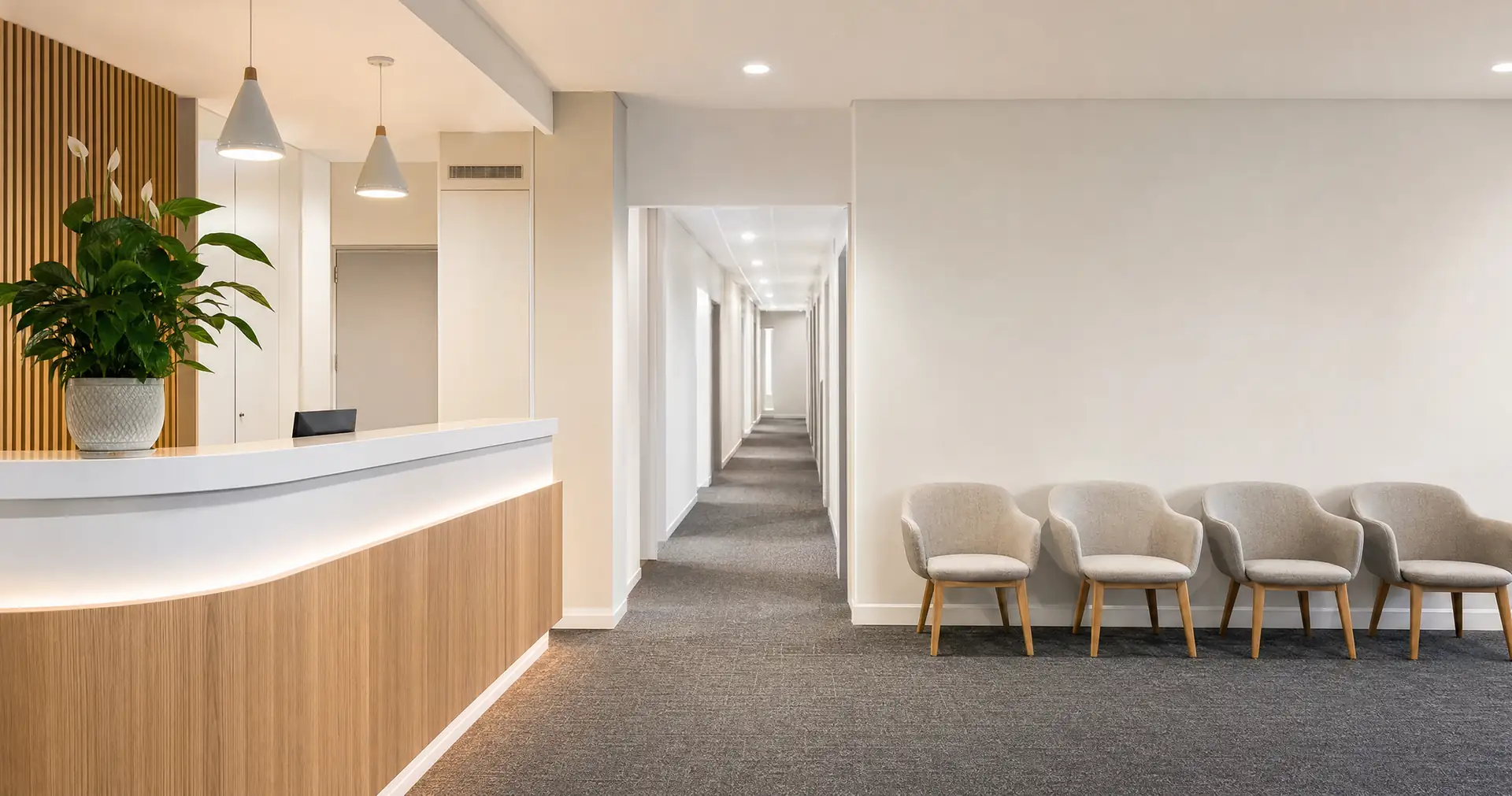
Business loans for New Zealand healthcare practices.
GP practices, dental clinics, physios, vets, and allied health providers borrow against a stable revenue model with high upfront equipment cost. Chairs, imaging, autoclaves, and clinical fit-out drive the capex. Lenders commonly weight registration, capitation, and partnership-deed structuring.
What you need to know about healthcare finance in NZ.
→Clinical equipment is the largest single spend dental chairs, digital imaging, and autoclaves commonly $80K to $400K, financed via chattel mortgage on 5 to 7-year terms.
→Stable revenue is a positive lender signal capitation (GP), ACC, and private-pay mix is widely viewed as predictable cash-flow, tightening indicative pricing once registration is verified.
→Partnership buy-ins are their own product junior dentists or GPs buying into a senior partner commonly fund through a specialist medical-finance loan secured against the equity stake and personal guarantee.
→Council registration is a precondition Medical Council, Dental Council, Physiotherapy Board, and Veterinary Council registration of key practitioners feeds every healthcare finance application.
New Zealand healthcare is one of the more financially predictable small-business segments in the country, supported by a layered revenue mix of capitation funding from Primary Health Organisations (PHOs), ACC treatment payments, Ministry of Health contracts, private-pay fees, and (for vets and dental) wholly private revenue. Stats NZ Business Demography figures show a steady population of registered healthcare and social-assistance enterprises across primary care, allied health, and aged care.
The structures that fit healthcare most cleanly are chattel-mortgage equipment finance for clinical kit, a term loan for fit-out and acquisition, a commercial mortgage where the practice owns the premises, and a specialist partnership-buy-in loan for senior-to-junior practitioner transitions. Lenders that play in this space include the major banks (BNZ, ANZ, ASB, Westpac) which run dedicated medical-finance teams, Heartland Bank, UDC Finance, Avanti Finance, Prospa, and a small number of specialist medical-finance brokers.
Lender posture on healthcare is shaped by the regulatory environment and the practitioner profile. Registration of key practitioners with the relevant council (Medical Council of New Zealand, Dental Council, Physiotherapy Board, Veterinary Council, Optometrists and Dispensing Opticians Board, Pharmacy Council, Podiatrists Board) is a precondition. Most lenders also weight the funding mix, with practices carrying strong capitation or ACC components widely viewed as more stable than wholly private-pay equivalents. BNZ and Heartland in particular have visible medical-finance specialisations that commonly tighten indicative pricing for established practices.
Dental chair and imaging
$80K to $400K
GP practice fit-out
$120K to $500K
Practice acquisition
$300K to $3M+
Partnership buy-in
$150K to $1M+
Sub-segments
How NZ healthcare practices borrow, by sub-segment.
Healthcare is not one segment; it is several. Each sub-segment has its own typical loan amounts, common purposes, and regulatory framing.
GP and medical practices
Primary care general practice, often within a PHO. Capitation-led funding mixed with ACC and private-pay. Capex tied to consult-room fit-out, ECG and spirometry, point-of-care diagnostics, and practice-management software (Medtech, Indici, MyPractice).
·Loan amount: $120K to $1M
·Term: 5 to 10 years
Dental clinics
General dental, orthodontic, and specialist dental practices. Capex significantly higher than most healthcare segments: dental chairs, intraoral scanners (iTero, Trios), OPG and CBCT imaging, autoclave sterilisation, milling and printing equipment for in-house prosthetics.
·Loan amount: $150K to $1.5M
·Term: 5 to 10 years
Allied health
Physiotherapy, chiropractic, podiatry, occupational therapy, osteopathy, optometry. ACC treatment funding important across physio and podiatry. Capex lighter than dental: treatment beds, ultrasound, shockwave, optical equipment, gait analysis.
·Loan amount: $40K to $250K
·Term: 4 to 7 years
Veterinary
Companion animal clinics, equine and farm-animal practice, mixed practice. Capex tied to digital X-ray, ultrasound, anaesthesia machines, surgical tables, and (for mixed) farm vehicles. Wholly private-pay revenue with practice-management software (ezyVet, RxWorks).
·Loan amount: $100K to $800K
·Term: 5 to 8 years
Specialist surgical and day-stay
Day-stay surgical, endoscopy, ophthalmology surgical, cosmetic, fertility, dermatology. Capex high: theatre tables, anaesthesia, surgical microscopes, laser technology. MoH licensing required for some categories under the Health and Disability Services (Safety) Act 2001.
·Loan amount: $300K to $3M+
·Term: 7 to 12 years
Aged care
Rest home, hospital-level, and dementia-level care. Capex weighted to building, beds, hoists, medication management, and specialist equipment. Operators contracted to MoH and DHB / Te Whatu Ora under specific service contracts. Property-secured lending dominates.
·Loan amount: $500K to $10M+
·Term: 10 to 25 years
Common reasons
What NZ healthcare businesses borrow for.
The bulk of NZ healthcare lending volume falls into six common purposes. Each has a typical structure that fits.
01
Practice acquisition
Buying a going-concern practice (capitation-buyer transactions in GP land, established dental practices in metro areas, vet clinics with established client base). Vendor finance commonly part of the structure. Verified patient or client list, consultation volumes, and prior-year financials drive the lender review.
02
Clinical equipment package
Dental chairs, digital imaging (X-ray, OPG, CBCT, intraoral scanners), ultrasound, autoclaves, ECG and spirometry, examination lights and tables. Largest single spend most practices face. Chattel mortgage on a 5 to 7-year term aligned to clinical-equipment life.
03
Refurbishment and fit-out
Consult-room and surgery refit, infection-control compliance upgrades, accessibility (Building Act 2004) compliance, waiting-area refresh. Term loan against personal property or, where lease length supports it, an unsecured fit-out loan.
04
Partnership buy-in
Junior dentist, GP, or vet buying equity into a senior partner. Specialist medical-finance loan secured against the practice equity stake plus personal guarantee. BNZ and Heartland medical teams run dedicated products for this scenario, subject to the lender's assessment of the partnership deed.
05
Practice-management technology
Medtech, Indici, MyPractice, ezyVet, Dental4Windows, Best Practice software platforms; cloud migration; integrated patient portals. Smaller-ticket finance with shorter terms (3 to 5 years) reflecting software lifecycle.
06
Premises purchase
Owner-occupied medical or dental rooms, often in a strata-titled medical centre. Commercial mortgage at materially tighter pricing than equipment finance, on terms commonly 15 to 25 years. Major banks dominate this segment; specialist medical-finance teams add structuring depth.
Eligibility quirks
What healthcare lenders ask that other industries don't.
Beyond the standard NZBN, trading history, and turnover questions, NZ healthcare lenders commonly ask about council registration, funding mix, partnership structure, and licensing status.
Council registration of practitioners
Medical Council of New Zealand, Dental Council, Physiotherapy Board, Veterinary Council, Optometrists and Dispensing Opticians Board, Podiatrists Board, and Pharmacy Council registration of key practitioners feeds every application. Lapsed registration typically stops the application.
Funding mix
Capitation (GP), ACC, MoH contract, DHB / Te Whatu Ora contract, and private-pay split. Practices with stronger capitation or ACC components are widely viewed as more predictable than wholly private-pay equivalents.
MoH licensing where applicable
Hospital-level day-stay surgical, fertility, and aged-care providers operate under licences issued under the Health and Disability Services (Safety) Act 2001. Lenders typically require current licence evidence before disbursing on premises or equipment finance.
Partnership and shareholder deed
Multi-partner practices typically run under a partnership deed or shareholder agreement specifying buy-in, buy-out, drag-along, and continuity provisions. Lenders financing buy-ins commonly review the deed alongside the practice financials.
Capex by sub-segment and region
Indicative healthcare capex bands by NZ region.
Auckland and Wellington healthcare fit-out and equipment installation commonly run 10-20% above regional NZ pricing for the same brief, reflecting consenting and supplier delivery costs. The bands below are observed across NZ healthcare finance applications in 2026.
Sub-segment
Auckland
Wellington / Christchurch
Regional NZ
GP practice fit-out (4 to 6 consult rooms)
$220K to $500K
$190K to $440K
$160K to $380K
Dental clinic (3 to 5 chairs, full digital)
$450K to $1.4M
$390K to $1.2M
$330K to $1M
Physio / chiro / podiatry studio
$60K to $180K
$55K to $160K
$45K to $140K
Veterinary clinic (companion-animal)
$220K to $700K
$190K to $600K
$160K to $520K
Day-stay surgical theatre
$700K to $3M+
$600K to $2.6M+
$500K to $2.2M+
Optometry practice with retail
$160K to $400K
$140K to $360K
$120K to $320K
Indicative bands only. Actual cost depends on equipment specification, building condition, infection-control compliance scope, and consenting timeline. Premium specialist practices can run materially higher.
Worked scenarios
Three NZ healthcare finance scenarios.
Real-world structures across an Auckland dental practice, a Wellington GP capitation-buyer transaction, and a Christchurch veterinary clinic, illustrating how registration profile and funding mix shift the offered rate.
Dental clinic
Auckland dental partnership buy-in
A Mount Eden-based 5-chair dental practice where a junior dentist with 6 years post-qualification experience is buying a 30% equity stake from the founding senior partner. Equity value $480K. Practice trading 14 years with strong private-pay revenue and stable patient list.
Structure: $480K specialist medical-finance partnership loan at indicative 9.5% over 10 years, secured against the equity stake plus personal guarantee. The senior-partner continuity provisions in the shareholder deed and the junior partner's Dental Council registration tightened the indicative rate. Indicative weekly ~$1,425. Tax treatment of the buy-in interest cost is subject to the accountant's confirmation on whether the structure is treated as share acquisition or partnership-equity acquisition.
Indicative figures
Equity value
$480,000
Term
10 years
Indicative rate
9.5% p.a.
Weekly indicative
~$1,425
Equity stake
30%
GP medical practice
Wellington GP capitation-buyer transaction
A Karori-based 3-GP medical practice being acquired by an existing GP and a new partner from a retiring founder. Practice acquired for $1.2M including goodwill, equipment, and patient list. Capitation-led funding through a Wellington PHO with a 4,800-patient enrolled population.
Structure: $900K specialist medical-finance term loan at indicative 8.5% over 10 years, secured against practice goodwill and equipment, plus joint personal guarantees. Vendor finance of $150K subordinated for 3 years and $150K vendor cash consideration on settlement. Combined indicative weekly ~$2,565. The capitation funding profile and verified patient list tightened the bank pricing materially.
Indicative figures
Practice value
$1,200,000
Senior loan
$900K @ 8.5%
Vendor finance
$150K subordinated
Combined weekly
~$2,565
Term
10 years
Veterinary
Christchurch veterinary clinic equipment refresh
A Riccarton-based companion-animal veterinary clinic upgrading digital X-ray, adding a new ultrasound unit, and refreshing the surgical anaesthesia machines. Total project $180K ex-GST. Existing operation profitable with 4 vets on staff and 9 years trading history.
Structure: $180K chattel mortgage at indicative 10.5% across 6 years (asset life aligned to expected equipment replacement). Operator's clean trading history and Veterinary Council registration of all practitioners tightened the rate band. Indicative weekly ~$745. GST claim of around $27,000 typically claimable in the next return, subject to the accountant's confirmation.
Indicative figures
Asset value
$180,000
Term
6 years
Indicative rate
10.5% p.a.
Weekly indicative
~$745
GST claim (indicative)
~$27,000
Structure × purpose
Which loan structure fits which healthcare purpose.
No single structure suits every healthcare purpose. The matrix below maps the four common structures to the most common purposes.
Feature
Equipment finance
Term loan
Commercial mortgage
Partnership-buy-in loan
Dental chairs and imaging
Best fit
Possible (combined)
No
No
Practice acquisition (going concern)
Equipment portion only
Best fit (with vendor finance)
If property included
No
Premises purchase (owner-occupied)
No
Marginal
Best fit
No
Refurbishment and fit-out
Equipment portion only
Best fit
Possible if property-secured
No
Junior partner equity buy-in
No
Possible
No
Best fit
Practice-management software
Best fit
Possible
No
No
Regulatory framing
Healthcare-specific regulatory and tax items lenders weigh.
Healthcare operators sit under several NZ regulatory frameworks that lenders verify before disbursing. The Health Practitioners Competence Assurance Act 2003 (HPCA Act) sets the registration framework for medical doctors, dentists, physiotherapists, optometrists, podiatrists, and other regulated health practitioners. The Veterinary Council operates under the Veterinarians Act 2005. Each council issues annual practising certificates that lenders typically ask for as a settlement condition. Lapsed registration of a key practitioner typically stops a finance application; current registration of all listed practitioners supports it. The Medicines Act 1981 and the regulatory framework administered by Medsafe also bear on practices that prescribe or dispense, with Pharmacy Council registration mandatory for pharmacies.
Hospital-level day-stay surgical, fertility services, and aged care operators are licensed under the Health and Disability Services (Safety) Act 2001, with audits commonly conducted by approved Designated Auditing Agencies. Lenders financing premises or major equipment for these operators typically require current licensing evidence. ACC interactions are central for physiotherapy, chiropractic, podiatry, and occupational therapy practices: ACC treatment-provider contracts and the related billing arrangements feed both the revenue mix and the lender review. GP practices typically receive capitation funding from a Primary Health Organisation under contracts with the local DHB / Te Whatu Ora region, with the per-patient capitation rate adjusted for high-needs and very-low-cost-access status.
IRD depreciation rates relevant to healthcare vary by category. Dental chairs commonly depreciate at 13.5% diminishing value, medical and surgical instruments at 13%, X-ray equipment at 13.5%, computer and IT equipment faster at 30% to 40%, and motor vehicles used in the practice at 30%. Building improvements such as plumbing modifications and lead-lined walls typically attach to the building structure and depreciate at 0% under post-2011 IRD treatment, while loose chattels separated from the structure can depreciate independently. The accountant's confirmation is the standard last step on the depreciation schedule and the diminishing-value vs straight-line election.
GST on equipment purchases is typically claimable in the next return after settlement under chattel mortgage, subject to the accountant's confirmation that the practice is GST-registered and the asset qualifies. A particular complication for healthcare is that some healthcare services are GST-exempt (specifically listed in the Goods and Services Tax Act 1985), which can affect input-tax claim ratios. The accountant's confirmation is the standard last step on the GST treatment for any practice with mixed taxable and exempt supplies. Personal Property Securities Register (PPSR) registration on financed equipment is standard practice across healthcare equipment finance. Where practices are structured as partnerships or shareholder agreements, lenders financing buy-ins commonly review the partnership deed and the cross-guarantee provisions alongside the practice financials.
Lenders to know
NZ lenders that fund healthcare well.
Healthcare is supported by a mix of major-bank medical-finance teams, asset finance specialists, and alternative SME lenders for working capital and smaller projects.
Specialist medical-finance brokers operate in Auckland, Wellington, and Christchurch and commonly tighten the offered rate by knowing which lender fits each practice profile. Editorial-only listing; commercial relationship with Prospa disclosed at /partner/.
How do New Zealand dental practices commonly finance a chair and imaging package?
A typical NZ dental equipment package runs $150,000 to $800,000 depending on chair count and imaging specification. Operators commonly fund this through chattel mortgage against the equipment, with terms of 5 to 7 years aligned to clinical-equipment life. BNZ medical-finance, Heartland Bank, and UDC Finance are typical lenders. Some operators also use equipment supplier finance offers from Henry Schein Halas or A-dec as an alternative path.
How does a partnership buy-in loan work for a junior dentist or GP?
A specialist medical-finance partnership-buy-in loan funds the equity stake a junior practitioner is acquiring from a senior partner. The structure is commonly a term loan secured against the equity stake plus personal guarantee, on terms of 7 to 12 years. BNZ and Heartland medical teams run dedicated products for this scenario. Lenders typically review the partnership deed alongside the practice financials. The tax treatment of the buy-in interest cost is subject to the accountant's confirmation.
What eligibility questions do healthcare lenders ask that other industries do not?
Beyond the standard NZBN, trading history, and turnover questions, NZ healthcare lenders commonly ask about council registration of key practitioners (Medical Council, Dental Council, Physiotherapy Board, Veterinary Council), funding mix (capitation, ACC, MoH, private-pay), MoH licensing for surgical and aged care, and partnership or shareholder deed terms. Lapsed registration typically stops a healthcare finance application.
How do NZ lenders view capitation funding for a GP practice?
Capitation funding from a Primary Health Organisation under contract with the local Te Whatu Ora region is widely viewed by NZ lenders as a stable, predictable revenue stream once the enrolled patient list is verified. GP practices with strong capitation components (especially with high-needs or VLCA loadings) commonly attract a tighter indicative rate band than wholly private-pay equivalents. The capitation rate adjustment for high-needs and very-low-cost-access status feeds the lender review.
What rate range applies to NZ healthcare finance in 2026?
Indicative rates on healthcare finance commonly sit in the 7% to 16% per annum band depending on structure and practice profile. Property-secured commercial mortgages for established practices and aged-care operators sit at the lower end. Major-bank medical-finance equipment loans for established practices typically sit in the 8% to 11% range. Asset-secured chattel mortgages on clinical equipment from specialist asset finance lenders sit in the middle band. Final rate is set by the lender after assessment.
Is GST claimable on a dental chair or medical equipment purchase?
A GST-registered healthcare practice can typically claim the GST component on equipment purchases as input tax in the relevant GST return, subject to the accountant's confirmation. Where the equipment is acquired under chattel mortgage, the full GST is typically claimable upfront. A particular complication is that some healthcare services are GST-exempt under the Goods and Services Tax Act 1985, which can affect input-tax claim ratios for practices with mixed taxable and exempt supplies. The accountant's confirmation is the standard last step.
How does MoH licensing affect day-stay surgical or aged care finance?
Hospital-level day-stay surgical, fertility services, and aged-care operators are licensed under the Health and Disability Services (Safety) Act 2001, with audits commonly conducted by approved Designated Auditing Agencies. Lenders financing premises or major equipment for these operators typically require current licensing evidence as a settlement condition. Lapsed licensing typically stops the application; current licensing supports it.
What deposit do NZ healthcare lenders typically require?
For equipment finance, deposits commonly run 0% to 20% of the asset value depending on lender and practice profile. Established practices with multi-year trading history can commonly access zero-deposit asset finance on standard clinical-equipment categories. Practice acquisition financing commonly requires a 20% to 40% equity contribution from the buyer, often funded through personal property security or vendor finance. Premises purchase typically follows commercial-mortgage LVR norms (commonly 60% to 75% LVR).
Can a newly-registered practitioner access practice-acquisition finance?
Newly-registered practitioners with limited post-qualification experience face a tighter lender posture on full practice acquisition. The structure commonly used is a partnership buy-in loan into an established practice rather than a full acquisition, with the senior partner providing continuity and the lender taking comfort from the established practice trading record. Major-bank medical-finance teams run specific products for this scenario, subject to the lender's assessment.
How does ACC treatment funding affect physio or chiro finance?
ACC treatment-provider contracts and the related billing arrangements feed both the revenue mix and the lender review for physiotherapy, chiropractic, podiatry, and occupational therapy practices. Practices with stable ACC billing volumes are widely viewed as having more predictable cash flow than wholly private-pay equivalents. Lenders commonly ask for ACC-registered provider numbers and billing history alongside the standard financial statements.
Can I refinance my healthcare practice loan to a better rate after trading?
Often yes, particularly after 12 to 24 months of clean trading and repayments where the financial profile has strengthened. Refinancing is commonly used to consolidate multiple healthcare loans (equipment + fit-out + working capital) into a single facility, or to move from alternative-lender pricing to major-bank medical-finance pricing once trading history supports it. Early-repayment fees on the original loan are the main consideration.
Is operating lease an option for clinical equipment?
Operating lease is available across some categories of clinical equipment, particularly imaging and IT equipment where short replacement cycles favour rental over ownership. Cash-flow simpler than chattel mortgage but no GST claimed upfront and no asset on the balance sheet. The right structure depends on the practice's priorities, subject to the accountant's confirmation on the specific tax position.
How is a practice acquisition financed when the seller wants vendor finance?
Vendor finance is commonly part of NZ healthcare practice acquisitions, especially in GP and dental segments where senior practitioners retire over a 2 to 5-year transition. The typical structure has a senior bank loan covering 60% to 80% of the purchase price, vendor finance subordinated for 2 to 5 years covering 10% to 20%, and a buyer equity contribution of 10% to 20%. The vendor-finance terms are typically negotiated alongside the senior facility, subject to the bank's assessment.
Indicative content only. Not personalised financial advice.
A business loan is a commitment that runs for months or years, and repayments come out of the same operating cash flow as everything else. Before committing, it is worth modelling the weekly and monthly cost against the business's working-capital position, which is what this site is built to help with. Borrowing at a level that stays comfortable through a quiet quarter, not just a strong one, is widely regarded as the safer frame.
What this site is
A calculator and information tool. Not a lender, not a broker, not a registered financial adviser. Nothing here is personalised financial advice.
What the figures show
Modelled estimates based on the inputs you enter. Not a quote. Not an offer of credit. Not a guarantee of approval, rate, or fees.
What the lender decides
Final rates, fees, and approval are set by the lender after a CCCFA-appropriate assessment of the applicant's circumstances and credit decision.
Commercial disclosure
Businessloans.org.nz earns a commission from Prospa when a visitor applies through this site and their application is approved. The commission is paid by Prospa, not by the borrower, and it does not influence the rate Prospa offers. Full disclosure on the partner page.
Tax, GST, and accountant framing
Tax-treatment statements (GST claim timing, interest deductibility, depreciation rates) are general in nature and subject to your accountant's confirmation on the specific business position. For material amounts, professional advice from a registered financial adviser or chartered accountant is widely regarded as the safer frame.