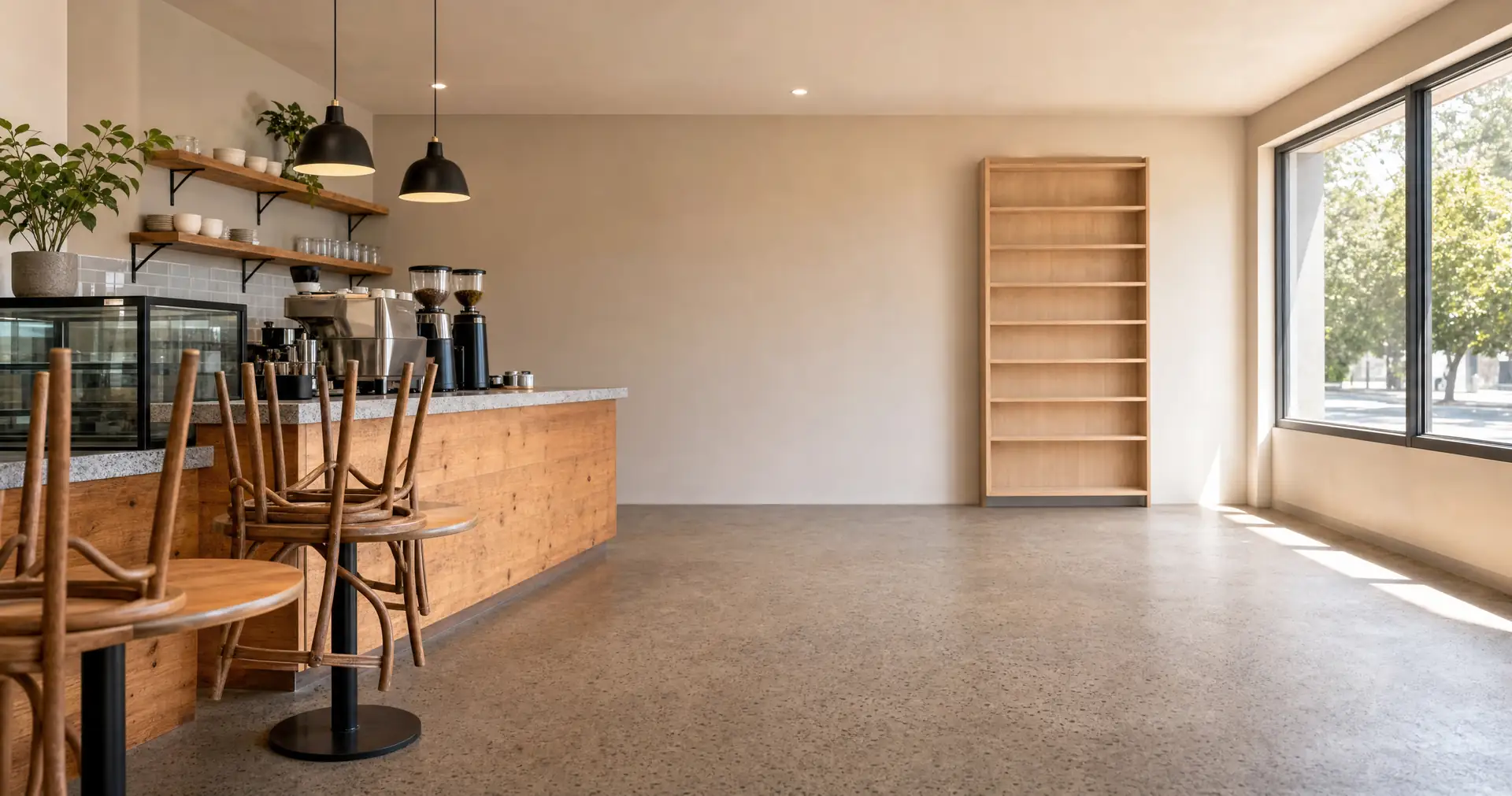
Cafes are the most-financed hospitality sub-segment in NZ by application volume. Fit-out, espresso kit, and pre-summer working capital each draw a different structure. Free-on-loan coffee machine arrangements sit alongside chattel-mortgage equipment finance and term loans against shopfit.
→Espresso machine + grinder + setup commonly $25K to $35K Roma, DiPacci, Coffex publish package pricing in this band as of 2026. Standalone machines $5K to $25K.
→Fit-out commonly $60K to $200K Auckland CBD and Wellington run 20-40% above regional NZ pricing for a comparable brief.
→Free-on-loan coffee machine deals are widespread Roma Coffee Roasters and Coffee Biz both publish free-on-loan arrangements tied to a minimum monthly bean spend.
→Lender posture is tighter than other small-business segments Cafes are widely viewed as higher-risk because of the first-18-month failure rate. Operator experience and IRD compliance are the strongest mitigants.
The landscape
Most-financed hospitality sub-segment by application volume in NZ.
New Zealand has roughly 4,500 cafes and coffee shops trading at any time, per Stats NZ business demography series. The combination of low entry capital relative to a full-service restaurant, strong urban demand, and well-developed roaster supply has kept the segment finance-active across every economic cycle.
Three structures dominate cafe lending. Equipment finance (chattel mortgage on the espresso machine, grinder, and refrigeration) is the cheapest tier because the asset secures the loan. A term loan against fit-out and joinery is the middle tier, commonly secured by personal guarantees from the operators. A working-capital line of credit covers the pre-summer build-up and the slower wet-winter months in cities like Auckland and Wellington.
Free-on-loan coffee machine arrangements through roasters such as Roma Coffee Roasters and Coffee Biz are a fourth pattern that sits outside conventional finance. The roaster supplies the machine at no upfront cost in exchange for a minimum monthly bean spend commitment, typically over a 3 to 5 year term. The cost is embedded in the wholesale bean price.
Fit-out cost band
$60K to $200K
Espresso package
$25K to $35K
Working capital
$10K to $40K
Term loan term
3 to 5 years
Cafe scenarios
Four common NZ cafe finance scenarios.
Most cafe applications fall into one of four patterns. Each pattern has a typical loan amount, structure, and lender pool.
Independent owner-operator opening
New 50-cover cafe in a regional centre. Total project commonly $80K-$140K: $25K-$35K espresso package, $50K-$100K fitout. Combined chattel mortgage + term loan structure typical.
·Loan amount: $80K to $140K
·Term: 4 to 5 years
Second-site expansion
Established operator opening site two. Existing trading data tightens the indicative rate band. Total project $120K-$200K. Term loan against fit-out, with the existing site providing serviceability comfort.
·Loan amount: $120K to $200K
·Term: 5 years
Espresso machine upgrade only
Existing cafe upgrading from a 2-group to a 3-group machine. Asset finance on the new machine; trade-in credit against the old kit. Common at the 5-7 year mark when a flagship machine reaches end-of-warranty.
·Loan amount: $20K to $50K
·Term: 3 to 4 years
Acquisition of an existing cafe
Buying a going concern. Vendor finance commonly part of the structure (the seller carries 20-40% of the purchase price as a subordinated loan). Trading data from the existing operation drives lender confidence.
·Loan amount: $150K to $400K
·Term: 5 years
What cafes borrow for
Six common NZ cafe loan purposes.
Cafe lending volume falls into six common purposes. Each has a typical structure that fits.
Shopfit and joinery
New build or refurbishment. Counter, banquette seating, signage, lighting, exposed-brick or timber finishes. Term loan against fit-out, often staged in drawdowns tied to milestones.
Espresso kit
Machine + grinder + bean hopper + tamper kit + water filtration. Chattel mortgage on a 3-5 year term. GST claimed upfront commonly material to opening cash flow.
Cool storage and prep
Display fridge, gelato cabinet, prep bench, dishwasher, panini press. Asset finance against each unit. SilverChef Rent-Try-Buy or Lease-to-Keep also common.
Pre-summer stock and packaging
Beans, milk contracts, paper cups, lids, sleeves, takeaway packaging. Short-term loan or revolving facility. Repaid out of the season.
Working capital and payroll
Bridging quiet weeks, smoothing the GST cycle, covering wages while waiting on event invoices. Line of credit suits the recurring pattern better than a term loan.
Roastery vertical integration
Established cafes adding their own roasting capacity. Sample roaster $8K-$25K, production roaster $50K-$200K. Equipment finance on the roaster, term loan on the green-bean inventory build.
Tax and GST
How GST and depreciation typically work on cafe equipment.
A GST-registered cafe can typically claim the GST component on espresso machines, grinders, fridges, and fitout as input tax in the relevant GST return, subject to the accountant's confirmation. Where equipment is acquired under chattel mortgage, the full GST is typically claimable upfront. Where it is acquired under finance lease, GST is typically claimed across the rental payments. IRD depreciation on espresso machines and commercial kitchen equipment commonly uses the 30% diminishing-value or 21% straight-line rate, depending on the asset class. The structure choice affects cash-flow timing more than total cost over the life of the loan.
Cafe fitout costs by region
Indicative cafe fitout cost by NZ region.
Cafe fitout cost varies materially by region, landlord condition of the premises, and the specification of the brief. Auckland CBD pricing commonly runs 30-40% above regional NZ for a comparable brief. The bands below are observed across NZ cafe fitouts in 2026.
Cafe size
Auckland CBD
Wellington
Christchurch / regional
Small (30-40 covers)
$80K to $130K
$70K to $110K
$60K to $90K
Mid (50-70 covers)
$130K to $200K
$110K to $170K
$90K to $140K
Large (80-120 covers)
$200K to $320K
$170K to $280K
$140K to $230K
Quick-service / takeaway only
$50K to $90K
$45K to $80K
$40K to $70K
Espresso bar / standing only
$45K to $80K
$40K to $70K
$35K to $60K
Indicative bands only. Actual fit-out cost depends on building condition, brief complexity, and consenting timeline. Premium concepts can run materially higher.
Free-on-loan vs purchase
Free-on-loan coffee machine vs chattel-mortgage purchase.
Roasters such as Roma Coffee Roasters and Coffee Biz publish free-on-loan arrangements where the machine is supplied at no upfront cost in exchange for a minimum monthly bean spend. The decision against purchasing the machine outright depends on cash-flow priority, expected bean volume, and ownership preference at the end of the term.
Feature
Free-on-loan from roaster
Chattel mortgage purchase
Operating lease (SilverChef, Speirs)
Upfront cash outlay
None
Deposit (commonly 0-20%)
None
GST upfront claim
Not applicable (no purchase)
Yes, full GST in next return
No, claimed across payments
Monthly cost shape
Embedded in wholesale bean price
Fixed loan repayment + bean cost
Fixed lease payment + bean cost
Ownership at end of term
Roaster retains
Cafe owns from settlement
Option to buy or return
Bean supplier flexibility
Locked to roaster for term
Open
Open
Lender / supplier exit cost
Variable (per supplier contract)
Early-repayment fees may apply
Lease break fees apply
How it works
A typical NZ cafe finance application.
Cafe applications carry a documentation premium over generic SME applications because lenders need confidence in the lease, operator, and concept. Established operators with trading history move faster.
01
Day 1 to 3
Define the scope and structure
A typical cafe loan combines multiple structures: chattel mortgage on the espresso machine and grinder, a term loan on the shopfit, an operating lease or rent-try-buy on the prep equipment via SilverChef, and a small working-capital line for opening stock. Defining these components upfront tightens the application.
Documents commonly required
·Project brief and concept overview
·Itemised quote breakdown by structure
·Floor plan and seating count
02
Day 1 to 7
Submit application with cafe-specific documents
Beyond the standard SME application pack, cafe lenders ask for the lease (or heads of agreement), the operator CV showing prior hospitality experience, the menu and price points, and a 12-month forecast.
Documents commonly required
·NZBN, business owner ID
·Last 6 months business bank statements (if existing)
·Lease or heads of agreement
·Operator CV
·Concept brief and menu
·12-month financial forecast
·IRD compliance certificate (PAYE, GST)
·Itemised supplier quotes
03
Day 5 to 14
Lender assessment and offer
Lenders assess against three things: the operator (experience, prior trading), the concept (brief, location, market), and the numbers (forecast vs typical sub-segment benchmarks). Offers commonly come back with conditions: shorter term, larger deposit, additional security, or staged drawdowns tied to fit-out milestones.
04
Week 2 onward
Settle, drawdown, fit-out
Equipment finance settles directly to the supplier. Fit-out term loans commonly drawn in stages tied to milestones (deposit on contractor signing, progress payment on rough-in, balance on completion). The line of credit opens before the cafe trades to fund opening stock and pre-launch payroll.
A hospitality broker who knows the cafe segment commonly tightens the rate band and reduces the documentation cycle by 30-50% versus a direct application to a generic SME lender.
Worked scenarios
Three NZ cafe finance scenarios.
Real-world structures across owner-operator, expansion, and acquisition cases. Each illustrates how the regional cost profile and operator experience shift the offered rate.
Independent owner-operator, first cafe
Wellington Cuba Street cafe opening
A first-time operator opening a 60-cover cafe on Cuba Street, Wellington. New 6-year lease with a 6-year right of renewal. Total project $145,000 ex-GST: $30,000 espresso machine + grinder package, $90,000 shopfit and joinery, $25,000 cool storage and prep equipment.
Structure agreed with a hospitality-experienced broker: chattel mortgage on the espresso machine and grinder ($30,000, 5-year term, indicative 9-11% p.a.), SilverChef Lease-to-Keep on the prep equipment ($25,000, 4-year term), unsecured term loan on shopfit ($90,000, 5-year term, indicative 12-14% p.a.).
Personal guarantee from the operator. IRD compliance certificate issued 2 days before settlement. Drawdown staged: deposit on contractor signing, progress payment on rough-in, balance on completion. Cafe traded 8 weeks after settlement.
Indicative figures
Total project
$145,000
Espresso package
$30,000
Shopfit term loan
$90,000
Indicative blended rate
11-13% p.a.
Established operator, opening site two
Christchurch second-site expansion
A Riccarton cafe operator with 4 years of clean trading at site one opening a second site in Sydenham. Total project $185,000 ex-GST: $35,000 espresso package, $130,000 shopfit, $20,000 cool storage.
Existing trading data from site one (turnover, GP%, EBITDA) materially tightened the indicative rate band. The new site loan structured as a single term loan ($150,000, 5-year, indicative 8-10% p.a.) plus chattel mortgage on the espresso package. Existing line of credit on site one extended to cover both sites.
Personal guarantee from the operator. No additional security beyond the chattel mortgage. Heartland Bank provided the term loan; existing relationship with ASB business banking covered the working-capital line.
Indicative figures
Total project
$185,000
Term loan amount
$150,000
Indicative rate
8-10% p.a.
Trading history at site one
4 years
New owner buying an existing cafe
Auckland cafe acquisition with vendor finance
A Ponsonby cafe trading 12 years offered for sale at $450,000 (going concern, GST nil-rated). Buyer puts in $150,000 of personal capital. Vendor agrees to carry $90,000 as a subordinated vendor loan over 4 years at 7% p.a. Bank funds $210,000 as a 5-year term loan.
Existing trading data from the seller (3 years of accounts, IRD-aligned) drove the bank confidence. The vendor loan ranks behind the bank loan in the security stack. Personal guarantee from the buyer. Lease assigned with landlord consent.
Settlement completed 6 weeks after offer. Buyer took over operations the same day with all staff retained.
Indicative figures
Purchase price
$450,000
Buyer cash
$150,000
Vendor loan
$90,000
Bank term loan
$210,000
NZ cafe lenders
Lenders that fund NZ cafes well.
No NZ lender markets exclusively to the cafe segment, but several lenders carry deep familiarity with hospitality and consistently fund cafe applications. The shortlist below is editorial.
How much does it cost to fit out a cafe in New Zealand?
NZ cafe fit-out commonly runs $60,000 to $200,000 for an independent operator, depending on cover count, lease condition, and regional pricing. Auckland CBD and Wellington pricing commonly runs 20-40% above regional NZ for a comparable brief. A small 40-cover regional cafe typically sits at the lower end of the band; a mid 70-cover Auckland cafe typically sits at the upper end. Premium concepts and inner-city flagship sites can run materially higher.
How much does an espresso machine cost in NZ?
A package of espresso machine, grinder, water filtration, and setup commonly runs $25,000 to $35,000 in NZ as of 2026, per published package pricing from Roma Coffee Roasters, DiPacci, and Coffex. Standalone commercial machines start around $5,000 for entry-level single-group units and run to $25,000 or more for premium 3-group machines. Roaster-supplied free-on-loan arrangements remove the upfront cost in exchange for a minimum monthly bean spend.
What is a free-on-loan coffee machine arrangement?
A free-on-loan arrangement is a supply contract where a coffee roaster provides an espresso machine at no upfront cost in exchange for a minimum monthly bean spend, typically over a 3 to 5 year term. Roma Coffee Roasters, Coffee Biz, and several other NZ roasters publish this model. The cost of the machine is embedded in the wholesale bean price. The cafe does not own the machine at the end of the term; the roaster retains it. This structure suits cafes wanting to minimise upfront cash outlay and committing to a single supplier.
How much working capital does a NZ cafe typically need?
Working capital requirements for an established NZ cafe commonly sit in the $10,000 to $40,000 range, used for pre-summer stock build, GST cycle smoothing, and quiet-week payroll. A line of credit is typically the right structure rather than a term loan because the use is recurring, not one-off. Cafes with strong seasonal patterns (summer-heavy or ski-season-aligned) commonly draw the line down before peak and repay it through the season.
What rate range applies to NZ cafe finance in 2026?
Indicative rates on cafe finance commonly sit in the 8% to 16% per annum band depending on structure, security, and operator profile. Equipment finance secured by the espresso machine and grinder sits at the lower end (commonly 8-12%). Unsecured term loans on fit-out sit in the middle (commonly 11-15%). Unsecured working-capital lines sit at the upper end (commonly 13-16%). Final rate is set by the lender after assessment. Property-secured commercial mortgages for cafe-with-premises operators sit below the unsecured bands.
Can a first-time cafe operator get a business loan in NZ?
Yes, but the lending posture is tighter. First-time operators with no prior hospitality experience face larger deposit requirements, shorter loan terms, additional personal-guarantee security, and indicative rates in the upper band. Operators with prior senior hospitality experience (8+ years as a cafe manager or chef, for example) commonly access close to established-operator pricing. Alternative SME lenders such as Bizcap and Prospa fund first-time operators where mainstream banks decline.
Is GST claimable on a cafe espresso machine and fitout?
A GST-registered cafe can typically claim the GST component on espresso machines, grinders, fridges, and fitout as input tax in the relevant GST return, subject to the accountant's confirmation. Where equipment is acquired under chattel mortgage, the full GST is typically claimable upfront in the next GST return. Where it is acquired under finance lease or operating lease, GST is typically claimed across the rental payments. The structure choice affects cash-flow timing more than total cost over the life of the loan.
How long does a typical cafe loan term run?
NZ cafe term loans commonly run 3 to 5 years, with 5 years the most common term on a fit-out loan and 3 to 4 years on equipment finance. The loan term should fit comfortably inside the remaining lease (plus options) so the lender is not left with security against equipment in a venue that may close before the loan is repaid. Lenders typically decline a 5-year fit-out loan against a 3-year remaining lease unless the operator can demonstrate a clear renewal path.
What happens to financed cafe equipment if the cafe closes?
Where equipment is financed under chattel mortgage and the cafe closes before the loan is repaid, the lender typically has a security interest registered on the Personal Property Securities Register (PPSR) and can take possession of the equipment to recover the outstanding balance. Any shortfall between resale value and balance owing typically falls to the borrower and any personal guarantor. Espresso machines and commercial grinders typically retain 40-60% of value in the secondary market depending on age and condition. Lenders commonly work with operators to restructure repayments before resorting to repossession.
Should a NZ cafe operator finance an espresso machine or take a free-on-loan deal?
The decision tracks cash-flow priority, expected bean volume, and ownership preference. Free-on-loan removes upfront capital but locks the cafe to a single roaster for the term and commonly carries a higher embedded cost in the wholesale bean price. Chattel-mortgage purchase requires upfront deposit (commonly 0-20%) but gives ownership from settlement and bean-supplier flexibility. Cafes with high bean volume (12kg+ per week) commonly find the embedded free-on-loan cost expensive relative to outright purchase. Cafes with lower volume commonly find free-on-loan cheaper.
How does a cafe lease affect the loan application?
NZ cafe lenders commonly want the loan term to fit comfortably inside the remaining lease (plus options). A 5-year fit-out term loan against a 3-year remaining lease is a hard sell unless the operator can demonstrate landlord support for renewal. Lenders also ask about lease conditions affecting business continuity: assignment clauses (can the lease transfer in a sale), make-good obligations at end of lease (the cost of restoring the premises), and rent-review patterns (CPI vs market vs fixed step). These shape the lender comfort more than the headline rent figure.
Are there finance options for a mobile coffee cart or food truck?
Yes. Mobile coffee carts and food trucks commonly fund the vehicle and the cart kit through a small-ticket combination of asset finance (vehicle on chattel mortgage) and unsecured term loan (cart, espresso machine, generator, water tanks). Total borrowing commonly sits in the $40,000 to $120,000 range. Trading history of 12 months or more, current public liability insurance, and council vending permit support the application. UDC, MTF, and alternative SME lenders are typical funders for the mobile coffee category.
What lenders specialise in NZ cafe and hospitality lending?
No NZ lender markets exclusively to cafes, but Heartland Bank, BNZ business banking, Prospa, Bizcap, and SilverChef all carry deep familiarity with the cafe sub-segment. Heartland and BNZ handle larger fit-out and acquisition tickets. Prospa and Bizcap suit unsecured working capital and smaller-ticket fit-outs. SilverChef specialises in equipment finance for the prep and cool-storage portion. A hospitality-experienced broker commonly tightens the indicative rate band by knowing which lender fits each operator profile.
Can an established cafe owner refinance into better pricing?
Yes. Established cafe operators with 18 to 36 months of clean trading commonly refinance from alternative-lender pricing (12-16%) into bank pricing (8-11%) once the cafe has hit its turnover targets and built operating history. Refinancing is also commonly used to consolidate multiple loans (chattel mortgage, term loan, working-capital line) into a single facility. Early-repayment fees on the original loans and any landlord-bond conditions are the main considerations. The refinance application typically requires 12 months of bank statements, current financial statements, and IRD compliance evidence.
Indicative content only. Not personalised financial advice.
A business loan is a commitment that runs for months or years, and repayments come out of the same operating cash flow as everything else. Before committing, it is worth modelling the weekly and monthly cost against the business's working-capital position, which is what this site is built to help with. Borrowing at a level that stays comfortable through a quiet quarter, not just a strong one, is widely regarded as the safer frame.
What this site is
A calculator and information tool. Not a lender, not a broker, not a registered financial adviser. Nothing here is personalised financial advice.
What the figures show
Modelled estimates based on the inputs you enter. Not a quote. Not an offer of credit. Not a guarantee of approval, rate, or fees.
What the lender decides
Final rates, fees, and approval are set by the lender after a CCCFA-appropriate assessment of the applicant's circumstances and credit decision.
Commercial disclosure
Businessloans.org.nz earns a commission from Prospa when a visitor applies through this site and their application is approved. The commission is paid by Prospa, not by the borrower, and it does not influence the rate Prospa offers. Full disclosure on the partner page.
Tax, GST, and accountant framing
Tax-treatment statements (GST claim timing, interest deductibility, depreciation rates) are general in nature and subject to your accountant's confirmation on the specific business position. For material amounts, professional advice from a registered financial adviser or chartered accountant is widely regarded as the safer frame.