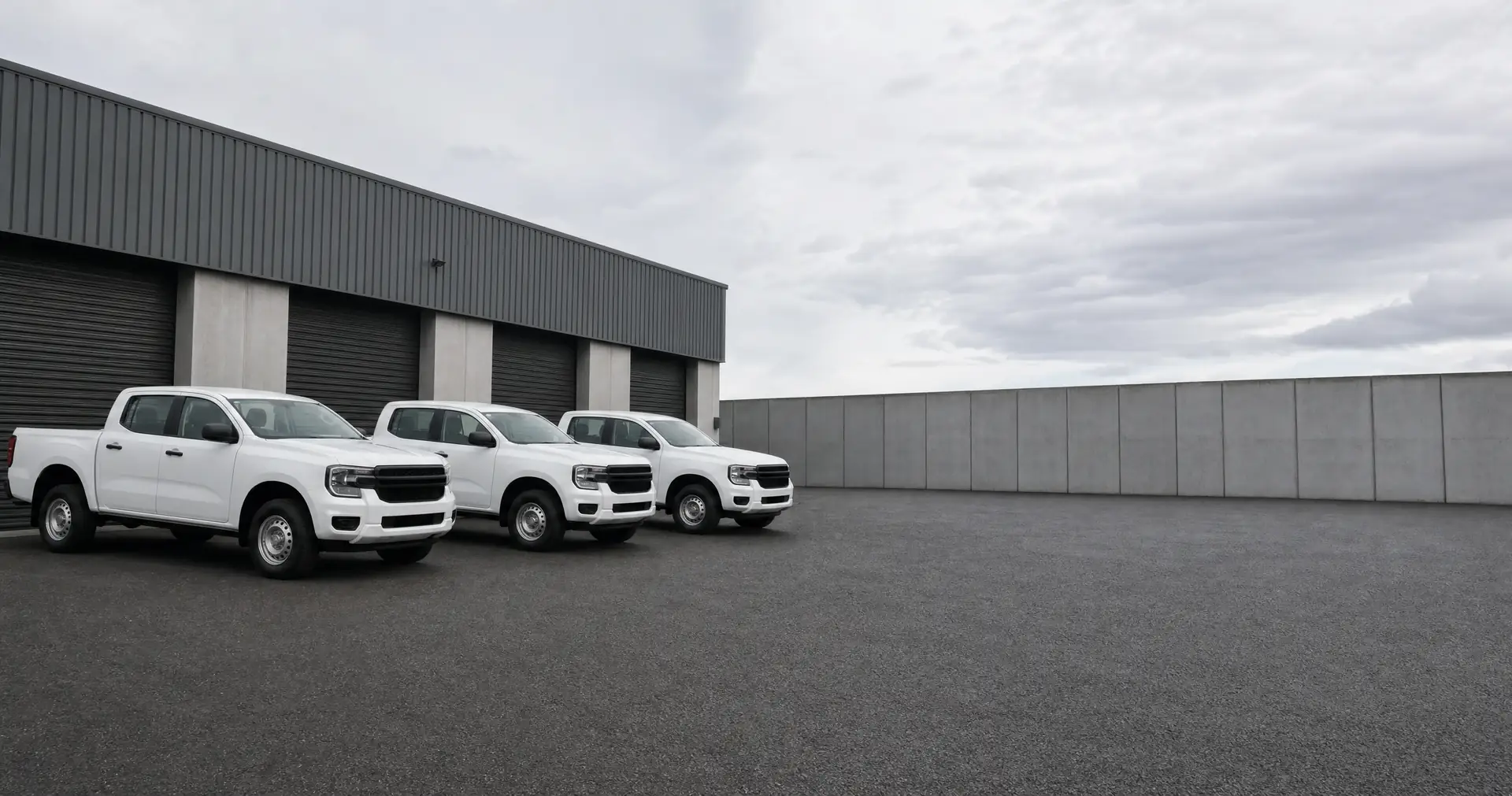
Buy a business vehicle for tradies and small fleets across NZ.
Funding a work ute, van, light truck, or small fleet for NZ trades, services, and delivery businesses. The four asset-finance structures, indicative weekly costs, decision matrix, and three borrower scenarios.
What you need to know about business vehicle finance.
→Asset-secured against the vehicle PPSR registration over the vehicle keeps the rate band well below unsecured working capital.
→Four common structures chattel mortgage, hire purchase, finance lease, operating lease. Each has a different GST and balance-sheet profile.
→Indicative 8% to 14% p.a. across most NZ business-vehicle finance. Specialist lenders price the lower band on clean applications with newer vehicles.
→Term matched to vehicle life utes and vans typically run 4 to 5 years; light trucks 4 to 7 years; high-utilisation courier vehicles often shorter.
What it is
Funding the vehicle that does the productive work.
Business vehicle finance is borrowing used to acquire a ute, van, light truck, courier vehicle, mobile-services rig, food truck, or small fleet for productive use across the asset life. The vehicle itself is registered as security on PPSR, which is why the rate band sits well below an unsecured working-capital loan and broadly in line with general equipment finance.
NZ borrowers in this segment include sole-trader sparkies, plumbers, builders, painters, and roofers running a single ute; mobile-services operators (mobile mechanics, mobile dog groomers, mobile car-wash, on-site IT); courier and last-mile operators on a small van fleet; food-truck and trailer operators; and growing trades businesses adding the second or third van. Common asset suppliers are franchised dealers (Ford, Toyota, Isuzu, Hyundai, LDV, Hino), independent commercial-vehicle dealers, and direct private import.
The structure choice typically follows three drivers: when the business wants to claim GST (chattel mortgage allows the upfront GST claim, leases spread GST inside the rental, subject to the accountant's confirmation), whether the asset sits on the balance sheet as owned or rented, and whether the business prefers to own the vehicle at end of term or roll into the next vehicle on a fixed cycle.
Typical amount
$15K to $250K+
Term
2 to 5 years
Security
The vehicle itself
Rate band
8% to 14% indicative
Common scenarios
When NZ businesses borrow to buy a vehicle.
The six scenarios below cover the bulk of NZ small-business vehicle finance volume. Each scenario maps to one or two structures that fit best.
01
First work ute for a sole-trader sparky
A newly-licensed Auckland electrician trading 12 months as a sole trader. A $55K ute with a tray and toolbox; chattel mortgage at indicative 10% to 12% p.a. across 5 years, with PPSR security over the vehicle.
02
Replacement van for a plumber or builder
A Christchurch plumber rolling out of an aged van and into a new $65K Hiace or Transit. The trade-in is rolled into a new chattel-mortgage facility; the old vehicle is sold, with the loan balance settled out of trade-in equity plus a fresh advance.
03
Light truck for a courier or removalist
A Hamilton last-mile courier adding a $90K Isuzu or Hino curtainsider. The truck runs longer days at higher utilisation, so a 4-year term commonly fits better than a 5-year, matching the heavier wear profile.
04
Mobile-services rig (groomer, mechanic, car-wash)
A Tauranga mobile dog-grooming operator buying a fitted-out van with on-board water tank, generator, hydraulic table, and shower. Total cost typically $90K to $140K including the fit-out work; chattel mortgage covers vehicle and fit-out together.
05
Food truck or trailer purchase
A Wellington food-truck operator buying a fitted commercial trailer with cooktop, fridge, and serving window. Chattel mortgage with the trailer registered on PPSR; term commonly 5 years; weekly repayment commonly $300 to $500 indicative.
06
Adding the second or third van to a small fleet
A Mt Wellington plumbing business adding a third van as the team grows from three trades to five. A multi-asset chattel-mortgage facility, sometimes structured as a master agreement with individual asset draw-downs, simplifies the documentation as the fleet grows.
07
Used vehicle from a dealer or private seller
A Dunedin landscaping operator buying a 4-year-old Ford Ranger from a franchised dealer for $42K. Used-vehicle finance is widely available in NZ from MTF, UDC, Heartland, and major-bank asset-finance arms; the vehicle age and Carjam history influence the rate band.
Structures
Four structures that fit a business vehicle in NZ.
The dominant structures across NZ business-vehicle finance are chattel mortgage and hire purchase. Finance lease and operating lease are common for fleet-managed positions and rapid-turnover roles.
Chattel mortgage
The business owns the vehicle from day one; the lender registers a PPSR security interest. GST on the vehicle cost is typically claimable in the next GST return, subject to the accountant's confirmation.
The lender owns the vehicle until final payment; ownership transfers on settlement. Structurally close to chattel mortgage with slightly different GST and accounting timing, subject to the accountant's confirmation.
·Rate band: 9% to 14% indicative
·Suits: Trades, traditional vehicle financing
Finance lease
The lender owns the vehicle; the business rents it across the term and typically takes ownership at residual. Lease rentals are expensed against income, with GST treated inside the rental, subject to the accountant's confirmation.
Pure rental. The business never owns the vehicle; lender retains residual risk and resale exposure. Off-balance-sheet under the rental treatment, subject to the accountant's confirmation.
·Rate band: 10% to 15% effective
·Suits: Fleet roll cycles, rapid-turnover use
Decision matrix
Which structure fits which vehicle scenario.
No single structure suits every borrower. The matrix below is a starting point; the accountant or asset-finance broker conversation typically refines it against the specific business position.
Feature
Chattel mortgage
Hire purchase
Finance lease
Operating lease
New ute or van, GST-registered sole trader
Best fit
Works
Marginal
Marginal
Used vehicle from a dealer
Best fit
Best fit
Works
Marginal
Light truck, 4 to 5 year term
Best fit
Best fit
Works
Works
Mobile-services rig with fit-out
Best fit
Works
Marginal
No (fit-out)
Fleet of 3+ vans, fixed roll cycle
Works
Works
Best fit
Best fit
High-utilisation courier vehicle
Works
Works
Works
Best fit
Off-balance-sheet preference
No
No
Marginal
Best fit
Upfront GST claim preference
Best fit
Works
No
No
Private-seller second-hand purchase
Best fit
Works
Marginal
No
"Best fit" means the structure is widely chosen for this scenario; "works" means viable but not the optimal pick; "marginal" means usable but better alternatives commonly exist.
Worked scenarios
Three NZ business-vehicle finance scenarios.
How the structure choice and indicative cost play out across three different NZ borrower profiles.
Trades (sole trader)
Penrose electrician, first work ute
A 26-year-old Auckland sparky 14 months into sole-trader trading, replacing a personal car with a fitted-out work ute. The vehicle is a new Ford Ranger XLT priced at $62,000 ex-GST, with a $4,000 alloy tray and $3,000 of toolbox and ladder rack fit-out.
The structure was a chattel mortgage at indicative 11% p.a. across 5 years, total $69,000 financed. Weekly repayment runs around $345. The business claims $10,350 GST in the next GST return, subject to the accountant's confirmation. PPSR security registered against the vehicle by the lender.
Indicative figures
Asset cost (ex-GST)
$69,000
Term
5 years
Indicative rate
11% p.a.
Weekly
~$345
GST claim
~$10,350
Mobile services
Tauranga mobile groomer, fitted van
A Mount Maunganui mobile dog-grooming operator buying a 2-year-old LDV V90 van fitted out with hydraulic grooming table, on-board water tank, generator, and shower setup. Vehicle $48K ex-GST plus fit-out $32K ex-GST.
Structure: $80,000 chattel mortgage at indicative 12% p.a. across 5 years. Weekly repayment runs around $410. The business claims $12,000 GST on vehicle plus fit-out in the next return, subject to the accountant's confirmation.
Indicative figures
Vehicle plus fit-out
$80,000
Term
5 years
Indicative rate
12% p.a.
Weekly
~$410
GST claim
~$12,000
Courier and logistics
Hamilton last-mile courier, light truck
A Te Rapa last-mile courier buying a new Isuzu N-Series curtainsider for B2B parcel runs across the central North Island. Total cost $92,000 ex-GST.
The structure was a hire purchase at indicative 10.5% p.a. across 4 years, matching the heavier-utilisation wear profile. Weekly repayment runs around $560. The truck is owned by the lender during the term; ownership transfers on final payment.
Indicative figures
Asset cost (ex-GST)
$92,000
Term
4 years
Indicative rate
10.5% p.a.
Weekly
~$560
GST treatment
On ownership transfer
Common pitfalls
Where business-vehicle finance commonly goes sideways.
These pitfalls show up repeatedly across NZ business-vehicle borrowers. Awareness of them at the application stage typically tightens the structure and saves money over the term.
01
Skipping the Carjam check on a used vehicle
A Carjam report typically surfaces existing PPSR registrations, odometer history, written-off status, and import history. Buying a used vehicle without surfacing these items can leave the borrower paying out a previous lender's security interest before clean title transfers.
02
Term too long for the vehicle's working life
A high-utilisation courier vehicle running 60,000 km a year on a 5-year facility commonly hits end-of-term with significant residual maintenance cost. Many NZ trades businesses match the term to expected useful working life rather than the maximum lender-allowed term.
03
Ignoring fit-out and accessories at the structure stage
Tray, toolboxes, ladder racks, signwriting, custom shelving, and beacon kits commonly run $4K to $15K on a trades ute. Folding the fit-out cost into the chattel-mortgage advance at the same time as the vehicle is generally cleaner than separate financing later, subject to the lender's policy on accessory funding.
04
Choosing operating lease without modelling end-of-term
Operating leases keep the asset off the balance sheet, but the rentals are typically higher than the comparable chattel mortgage, and the business owns nothing at term end. Many NZ businesses model the total cost across two or three vehicle cycles before committing to operating lease, subject to the accountant's confirmation.
05
Underestimating Road User Charges and FBT
Diesel utes, vans, and light trucks attract NZTA Road User Charges, currently quoted in distance bands. Where the vehicle is also available for private use, fringe benefit tax can apply. The combined run cost commonly shifts the structure conversation, subject to the accountant's confirmation.
06
Cross-collateralising vehicles with home equity
Some major-bank asset-finance offers price the lower band where the borrower also offers a home-equity charge. This can lift loan-to-value on the home and entangle business default with the family home. Many NZ borrowers separate the two, accepting a slightly higher rate band in exchange for cleaner risk separation.
Eligibility and lender criteria
What NZ vehicle-finance lenders look at.
Eligibility for business-vehicle finance in NZ commonly turns on five factors: trading history, the vehicle itself, deposit and balance-sheet equity, credit file, and personal guarantee strength. Trading history of 6 to 12 months reads stronger than first-day trading; specialist lenders write first-day deals where the borrower has substantial industry experience and a contract in hand.
The vehicle itself is the primary security. Lenders typically prefer NZ-new vehicles from franchised dealers, with used vehicles up to 5 to 8 years old at end of term commonly accepted (the rate band widens with age). Private-import grey imports, salvage-rebuild vehicles, and certain heavily-modified vehicles can fall outside policy at mainstream lenders, with specialist or alternative lenders filling the gap at a wider rate band.
Deposit ranges typically run nil to 20% across NZ business-vehicle finance, with nil-deposit deals common on clean applications and newer vehicles. Larger deposits commonly tighten the rate band by 0.5 to 1.0 percentage points indicative.
Credit file is reviewed on the business and on directors providing personal guarantees. Past defaults, current arrears, and recent inquiries all feature in the assessment. The personal guarantee is standard across NZ business-vehicle finance for sole traders, partnerships, and most SME companies, with the PG falling away for larger established businesses with strong balance sheets.
Documentation commonly includes the vehicle invoice or quote, NZBN registration, business owner ID, last 6 months of business bank statements, and (on amounts above $100,000) a recent P&L plus a brief on the vehicle's role in the business. Same-business-day decisions are common on amounts under $80,000 with established trading and clean credit.
Lenders to know
NZ lenders that fund business vehicles well.
The lender shortlist below is editorial. Indicative rate bands are general market observation, not a quote. Final pricing depends on the lender's assessment.
Rate bands are indicative and based on general market observation, not a quote. Final pricing depends on the lender's credit assessment. We refer borrowers to Prospa via the calculator handoff; the broader directory is editorial.
Beyond the repayment
The finance cost is a minority of what the vehicle costs each week.
Comparing two vehicles on their weekly finance repayment is the most common way a New Zealand business ends up with the more expensive one. Road user charges apply to diesel and to electric and plug-in hybrid vehicles at rates set by weight class, and for a high-mileage work vehicle that is a material weekly line rather than a rounding item. Comprehensive insurance with the lender noted is commonly a settlement condition and is worth quoting before committing. Servicing intervals arrive faster on vehicles working unsealed roads and building sites, and commercial vehicles need a certificate of fitness rather than an annual warrant. The fall in resale value across the term is the largest cost of all on most vehicles, and it is the number an operating lease is quietly pricing when its monthly figure looks high next to a finance repayment.
Structure
Matching the term and the structure to how the vehicle is used.
A vehicle covering 60,000 kilometres a year on unsealed roads and a vehicle covering 15,000 on the motorway are different assets by year three, and the finance decision should reflect that rather than defaulting to a standard five-year term.
High-use vehicles reach the end of their economic life sooner, so a shorter term keeps the loan balance in step with the resale value and avoids a period where the business owes more than the vehicle is worth. Low-use vehicles hold value longer and can carry a longer term without that risk.
Where the business replaces vehicles on a fixed cycle, an operating lease becomes genuinely competitive because the residual-value risk sits with the lessor and the cost is known from the outset. That comparison is more often assumed than run.
Fleet changes the arithmetic again. A master facility approving a total limit that individual vehicles draw against removes an application per vehicle and commonly prices below the equivalent separate contracts, because the lender assesses the business once and holds security over several vehicles.
FBT framing where the vehicle is also available for private use.
FAQ
Buy a business vehicle, NZ small-business questions answered
Can a NZ business borrow specifically to buy a vehicle?
Yes, business-vehicle finance is one of the most established asset-finance categories in the NZ market. UDC Finance, Heartland Bank, MTF, Avanti, and the major-bank asset-finance arms all write substantial volume in this segment, with the vehicle itself acting as PPSR-registered security.
How much can a NZ business borrow against a vehicle?
Indicative amounts run $15,000 to over $250,000 per vehicle across the NZ asset-finance market, with multi-vehicle and fleet facilities running larger. Sole-trader and SME applications typically settle in the $30,000 to $100,000 band for a single ute, van, or light truck.
What rate applies to business-vehicle finance in NZ?
Indicative rates run 8% to 14% per annum across the NZ market. Specialist lenders and bank asset-finance arms compete for the lower band on new vehicles with clean applications; used vehicles, private imports, and harder-profile applications widen the band.
Should a borrower choose chattel mortgage or finance lease for a work ute?
Borrowers prioritising upfront GST recovery and ownership of the vehicle commonly choose chattel mortgage; borrowers prioritising rental tax treatment and balance-sheet simplicity sometimes choose finance lease. The right structure depends on the trading position, and the accountant is the right person to confirm.
Can GST be claimed on a vehicle bought through chattel mortgage?
On a chattel mortgage, the GST on the vehicle cost is typically claimable in the next GST return where the business is GST-registered and the vehicle is used primarily for business, subject to the accountant's confirmation on the specific business position.
What term is right for a business-vehicle loan?
Common terms run 2 to 5 years, ideally matched to the productive life of the vehicle. Trades utes and vans commonly run 4 to 5 years; light trucks 4 to 7 years; high-utilisation courier vehicles often shorter to match heavier wear.
Is interest on business-vehicle finance tax-deductible?
Interest on a vehicle finance facility used primarily for business purposes is generally deductible against business income in New Zealand, subject to the accountant's confirmation on the apportionment between business and private use.
Are deposits required on business-vehicle finance in NZ?
Deposits commonly run nil to 20% across the NZ market, with nil-deposit deals available on clean applications and newer vehicles. Larger deposits typically tighten the rate band and shorten the loan term, but are not always required.
Can a sole trader get a business-vehicle loan?
Yes, sole traders are eligible across most NZ business-vehicle lenders. The application typically references both the personal financial position and the business trading history. Personal guarantees are standard for sole-trader vehicle finance.
Can a brand-new business get a business-vehicle loan?
First-day businesses face a harder application because trading history has not been demonstrated. Specialist asset-finance lenders sometimes write first-day deals where the borrower has substantial industry experience, an existing client base, or a contract in hand to support repayment capacity.
What documents are typically needed for a business-vehicle finance application?
Standard documents include NZBN registration, business owner ID, the vehicle invoice or quote, last 6 months of business bank statements, and a brief on the vehicle's role in the business. Larger applications above $100,000 commonly add a recent P&L statement and an aged debtors report.
What happens if the business defaults on a vehicle loan?
On default, the lender enforces the PPSR security after the statutory notice period under the Personal Property Securities Act 1999. The vehicle is repossessed and sold; proceeds apply to the loan balance, sale costs, and fees. Any shortfall is pursued under the personal guarantee, with credit-file marks accumulating in parallel.
Can a used vehicle from a private seller be financed?
Yes, private-seller used-vehicle finance is widely available in NZ through MTF, Avanti, Heartland, and specialist alternative lenders. The vehicle is typically subject to a Carjam check and an inspection through AA, VTNZ, or similar; the PPSR position is settled out of the loan advance to ensure clean title transfer.
Indicative content only. Not personalised financial advice.
A business loan is a commitment that runs for months or years, and repayments come out of the same operating cash flow as everything else. Before committing, it is worth modelling the weekly and monthly cost against the business's working-capital position, which is what this site is built to help with. Borrowing at a level that stays comfortable through a quiet quarter, not just a strong one, is widely regarded as the safer frame.
What this site is
A calculator and information tool. Not a lender, not a broker, not a registered financial adviser. Nothing here is personalised financial advice.
What the figures show
Modelled estimates based on the inputs you enter. Not a quote. Not an offer of credit. Not a guarantee of approval, rate, or fees.
What the lender decides
Final rates, fees, and approval are set by the lender after a CCCFA-appropriate assessment of the applicant's circumstances and credit decision.
Commercial disclosure
Businessloans.org.nz earns a commission from Prospa when a visitor applies through this site and their application is approved. The commission is paid by Prospa, not by the borrower, and it does not influence the rate Prospa offers. Full disclosure on the partner page.
Tax, GST, and accountant framing
Tax-treatment statements (GST claim timing, interest deductibility, depreciation rates) are general in nature and subject to your accountant's confirmation on the specific business position. For material amounts, professional advice from a registered financial adviser or chartered accountant is widely regarded as the safer frame.