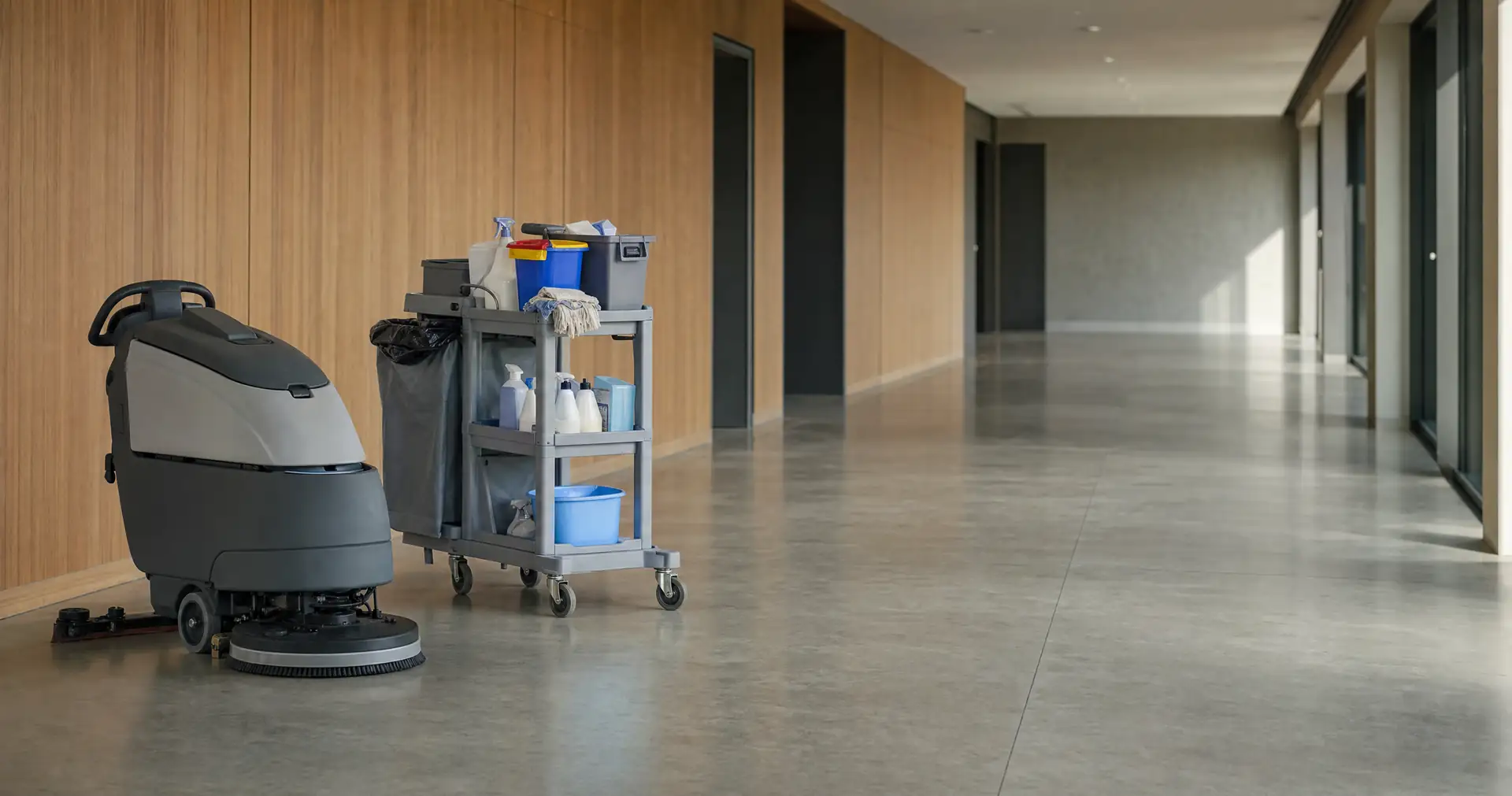
Business loans for New Zealand cleaning and facilities businesses.
Commercial cleaners and facility-management operators borrow against contract revenue. Vehicle fleets, ride-on scrubbers, hospital-grade compliance kit, and the wages-before-invoice gap shape both the structure and the eligibility conversation.
What you need to know about cleaning and facilities finance in NZ.
→Wages-before-invoice is the defining cash-flow gap weekly payroll runs ahead of monthly client invoices. Invoice finance or a line of credit is the standard fit.
→Fleet and equipment dominate capex cleaning vans, ride-on scrubbers, sweepers, and high-pressure kit are commonly chattel-mortgaged on 3 to 5-year terms.
→Contract revenue is the strongest approval lever a signed multi-year contract with a credible counterparty (DHB, MoE school, supermarket chain) tightens the indicative rate.
→Hospital-grade and hazardous-substances work carries compliance overlay HSWA 2015 and Hazardous Substances regulations shape kit specification, training records, and lender posture.
The landscape
A contract-led, fleet-heavy NZ small-business segment.
Commercial cleaning and facilities management is one of the larger employment-intensive small-business categories in New Zealand. Stats NZ data on Administrative and Support Services (Division N) places building-cleaning services among the larger sub-industries by enterprise count. Operators range from owner-driver sole traders subcontracting to a single building, through Crewcut, Jae's, and V.I.P. Home Services franchisees with a small staff, to mid-sized independent contract houses tendering for school, hospital, supermarket, and council work.
The structures that fit the segment most cleanly are vehicle finance against vans and utes, equipment finance against ride-on scrubbers, sweepers, and pressure cleaners, invoice finance or a line of credit to bridge the weekly wages versus monthly client invoices, and a term loan for franchise buy-ins or contract-acquisition funding. Lenders that play in the segment include Heartland Bank, UDC Finance, Avanti Finance, MTF Finance, Prospa, and the major banks for property-secured larger operators.
Industry posture is shaped by contract economics. Margins are typically tight (the BSCNZ peak body has long advocated against under-priced tenders that erode wage-floor compliance), and a lost contract can move the cash-flow profile materially within a quarter. Lenders commonly look for a balanced contract book, evidence of contract roll-over rates, and confirmation of compliance with the Health and Safety at Work Act 2015 and (for industrial cleaners) the Hazardous Substances and New Organisms framework.
Cleaning vehicle fleet
$25K to $250K
Ride-on scrubber / sweeper
$15K to $90K
Working capital (wages bridge)
$20K to $150K
Franchise buy-in
$15K to $200K
Sub-segments
How NZ cleaning and facilities operators borrow, by sub-segment.
The category is not one segment; it is several. Each sub-segment carries its own typical loan amounts, common purposes, and compliance overlay.
Commercial office cleaning
Contract-led nightly and after-hours cleans across CBD office buildings. Fleet of vans, vacuums, microfibre systems, and consumables. Typical contracts run 1 to 3 years with a renewal cycle. Wages-versus-invoice gap is the standard working-capital reason.
·Loan amount: $30K to $200K
·Term: 3 to 5 years
Hospital and aged-care cleaning
Higher-compliance specialty. Hospital-grade and clinical environments require trained staff, validated chemical lists, colour-coded equipment systems, and audit-ready cleaning records. Contracts typically longer (3 to 5 years) and lender posture more favourable on track-record operators.
·Loan amount: $50K to $300K
·Term: 3 to 5 years
Industrial and post-construction
Heavier kit specialty. Ride-on scrubbers, industrial sweepers, high-pressure water blasting, post-construction make-readies. Hazardous Substances handling for some chemical and dust environments. Equipment finance dominates the capex line.
·Loan amount: $40K to $250K
·Term: 4 to 6 years
Franchise home and small-commercial
Crewcut, Jae's, V.I.P. Home Services, and similar franchise networks. Buy-in commonly $15K to $80K plus van and equipment pack. Some networks operate preferred-lender relationships that streamline the application.
·Loan amount: $15K to $200K
·Term: 3 to 5 years
Facility management (multi-service)
Bundled cleaning, security, grounds, and minor maintenance under one contract. Larger contract values, longer terms, and broader equipment mix. Commonly tenders for council, government, and large corporate building portfolios.
·Loan amount: $80K to $500K
·Term: 4 to 7 years
Specialty (carpet, window, hood)
Carpet and upholstery cleaning, exterior and high-rise window cleaning, kitchen-hood degreasing. Equipment-led capex (truck-mount carpet rigs, water-fed pole systems, hood-cleaning kit). Often owner-operator with a small van fleet.
·Loan amount: $20K to $120K
·Term: 3 to 5 years
School and education cleaning
Ministry of Education and individual school contracts. Term-time intensity with a holiday deep-clean cycle. Compliance overlay for child-safe chemical use and contractor police-vetting under the Vulnerable Children Act framework.
·Loan amount: $30K to $180K
·Term: 3 to 5 years
Mobile and on-demand operators
Van-based rapid-response specialists (move-in/move-out, end-of-tenancy, AirBnB turnovers). Smaller fleet, faster job rotation, mixed B2B and B2C work. Vehicle finance and a small line of credit are the common structures.
·Loan amount: $20K to $90K
·Term: 3 to 5 years
Common reasons
What NZ cleaning and facilities businesses borrow for.
The bulk of cleaning and facilities lending volume falls into a handful of common purposes. Each has a typical structure that fits.
Cleaning van and ute fleet
New or used vans for nightly contract teams. Commonly chattel-mortgaged via an asset finance lender on 4 to 5-year terms. PPSR registration is standard. GST is typically claimable upfront on a chattel mortgage, subject to the accountant's confirmation.
Ride-on scrubbers and sweepers
Industrial floor-cleaning equipment for warehouses, supermarkets, and large retail. Indicative kit cost commonly $15K to $90K. Equipment finance against the asset is the standard structure on a 4 to 6-year term aligned to the depreciation cycle.
Working capital for wages bridge
Weekly payroll runs ahead of monthly client invoices. A line of credit or invoice finance facility against the receivables ledger is the most common fit. Sized commonly to 4 to 8 weeks of wages.
Invoice finance against contracts
Drawing against unpaid invoices from credible counterparties (corporates, councils, DHBs). Frees up cash that would otherwise sit on the receivables ledger for 30 to 60 days. Particularly common for mid-sized operators with concentrated client bases.
Franchise buy-in or territory expansion
New Crewcut, Jae's, or V.I.P. franchisees, or existing franchisees adding territories. Term loan against personal property or a structured franchise-finance product. Some networks operate preferred-lender panels that streamline applications.
Contract acquisition or tender startup
Funding the fleet, equipment, staff onboarding, and 4 to 8 weeks of wages required to mobilise a newly-won contract. Term loan plus a line of credit. The signed contract is the strongest approval lever.
Compliance equipment and training
Hospital-grade colour-coded systems, validated chemical lists, hazardous-substances handling kit, and HSWA 2015 training cycles. Smaller spend but commonly bundled into a larger working-capital application.
Acquisition of an existing book
Buying out a retiring owner-operator's contract book. Typical earn-out and vendor-finance overlay. Lender focus on contract roll-over rates, key-staff retention, and the verified turnover trend across the prior 24 months.
Eligibility quirks
What cleaning lenders ask that other industries do not.
Beyond the standard NZBN, trading history, and turnover questions, NZ asset and SME lenders financing cleaning operators commonly look at contract concentration, compliance posture, and counterparty quality.
Contract concentration
A book that is 70%+ reliant on a single client is a tighter risk than a balanced book of 8 to 12 contracts. Lenders commonly ask for a contract schedule and concentration analysis.
HSWA 2015 and HazSub compliance
Lenders financing industrial or hospital-grade operators commonly ask for evidence of Health and Safety at Work Act 2015 systems and Hazardous Substances and New Organisms compliance documentation.
Wage-floor and Holidays Act posture
BSCNZ has long flagged the under-pricing risk in the sector. Lenders commonly ask for evidence of minimum-wage compliance and current Holidays Act 2003 calculation methodology before approving working-capital limits.
Counterparty credit quality
A book weighted to government, council, DHB, and ASX-listed counterparties supports a tighter rate band than one weighted to small private clients on 60-plus day payment terms.
Capex by sub-segment and region
Indicative loan and equipment ranges across cleaning and facilities.
The bands below are observed across NZ cleaning and facilities finance applications in 2026. Auckland and Wellington fleet pricing typically runs slightly above regional NZ for the same vehicle and equipment specification.
Sub-segment
Auckland / Wellington
Christchurch / regional
Typical structure
Owner-operator van plus kit
$30K to $70K
$25K to $60K
Vehicle + equipment finance
Mid-sized office cleaning (10-30 staff)
$80K to $250K
$70K to $200K
Term loan + line of credit
Hospital and aged-care contract pack
$100K to $300K
$90K to $260K
Equipment finance + working capital
Industrial floor-care kit (ride-on)
$15K to $90K
$15K to $90K
Chattel mortgage
Franchise buy-in (Crewcut, Jae's, V.I.P.)
$15K to $80K + van
$15K to $80K + van
Term loan, franchise finance
Multi-service facility management
$150K to $500K
$130K to $450K
Term loan + invoice finance
Carpet / window / hood specialty
$25K to $120K
$20K to $100K
Equipment finance
Indicative bands only. Actual loan size depends on contract book, fleet specification, operator history, and the lender's assessment.
Worked scenarios
Three NZ cleaning and facilities finance scenarios.
Three illustrative borrower scenarios across the Auckland office-cleaning, Christchurch industrial, and Wellington hospital-grade ends of the segment.
Commercial cleaning
Auckland office-cleaning fleet refresh
An Auckland office-cleaning operator with 22 staff and 14 building contracts replacing the ageing fleet ahead of a tender renewal. Five new mid-size cleaning vans plus kit. Total $135K ex-GST. Operator trading 9 years with a balanced contract book.
Indicative structure on these assumptions: $135K chattel mortgage at 11% across 5 years, weekly repayment around $695. GST claim of around $20,250 typically returnable in the next GST cycle, subject to the accountant's confirmation. The signed multi-year contract renewals were the strongest approval lever in this scenario.
Indicative figures
Total fleet
$135,000
Term
5 years
Indicative rate
11% p.a.
Weekly indicative
~$695
Indicative GST claim
~$20,250
Industrial cleaning
Christchurch industrial scrubber and contract mobilisation
A Christchurch industrial cleaner winning a 3-year supermarket distribution centre contract. Two ride-on scrubbers ($75K), one sweeper ($35K), additional staff onboarding, and 6 weeks of wages bridge ahead of first invoice. Total funding requirement $190K ex-GST.
Indicative structure on these assumptions: $110K chattel mortgage on the floor-care kit at 11.5% across 5 years, plus an $80K invoice finance facility against the new contract receivables. Combined indicative weekly cost around $585 on the chattel mortgage with the invoice finance priced as a fee per drawn invoice. Wage-floor compliance documentation was requested as part of the assessment.
Indicative figures
Total funding
$190,000
Equipment finance
$110K @ 11.5%
Invoice finance
$80K facility
Equipment weekly indicative
~$585
Term (equipment)
5 years
Healthcare cleaning
Wellington hospital-grade contract acquisition
A Wellington-based hospital and aged-care cleaning operator buying out a retiring competitor with a 4-contract book across two private hospitals and two retirement villages. Acquisition price $320K. Vendor finance covering $100K, lender funding $220K with personal-property security.
Indicative structure on these assumptions: $220K term loan at 9.5% across 5 years (lower indicative band reflecting the property security and mature contract book), weekly indicative around $1,165. Contract roll-over rates across the prior 24 months and the staff-retention plan were the central items in the lender's assessment.
Indicative figures
Acquisition price
$320,000
Lender-funded
$220,000
Indicative rate
9.5% p.a.
Term
5 years
Weekly indicative
~$1,165
Structure × purpose
Which loan structure fits which cleaning purpose.
No single structure suits every cleaning and facilities purpose. The matrix below maps the four common structures to the most common purposes in the segment.
Feature
Vehicle / equipment finance
Term loan
Line of credit
Invoice finance
Cleaning van or ute purchase
Best fit
Possible (combined package)
No (purpose mismatch)
No
Ride-on scrubber or sweeper
Best fit
Possible (combined package)
No
No
Wages bridge between invoice cycles
No
Marginal (term too long)
Best fit
Best fit
Contract mobilisation costs
Equipment portion
Best fit
Useful for short bridge
Useful once first invoice issued
Franchise buy-in
Vehicle and kit portion
Best fit
No
No
Acquisition of contract book
Equipment portion
Best fit (often with vendor finance)
No
Useful post-settlement
Compliance and training cycle
No
Marginal
Best fit (small recurring spend)
No
Regulatory items
Regulatory and compliance items that shape cleaning finance.
Cleaning and facilities operators sit inside a heavier compliance frame than many SME categories. The Health and Safety at Work Act 2015 (HSWA) places the primary duty of care on the PCBU (person conducting a business or undertaking), which captures cleaning contractors directly. Lenders financing mid-sized and larger cleaning operators commonly ask for evidence of an HSWA system, hazard registers, and incident-reporting documentation as part of the application.
Industrial and specialty operators handling chemicals at scale fall under the Hazardous Substances and New Organisms framework, administered by WorkSafe NZ. Class-by-class chemical thresholds, approved handler requirements, and signage rules apply. Operators using chlorinated, acidic, or solvent-based products in volume are commonly asked by lenders to confirm the HSNO compliance position before equipment finance settles. Information on the framework is published by WorkSafe at worksafe.govt.nz.
Industry standards and tendering posture are shaped in part by the Building Service Contractors of New Zealand (BSCNZ), the peak body for the segment. BSCNZ has long advocated against under-priced tenders and for wage-floor compliance, and lenders commonly view BSCNZ membership as a positive signal on operator professionalism. The Cleaning Industry Council of NZ also publishes guidance on technical standards.
IRD treatment is largely standard SME territory. Vehicle and equipment depreciation rates published by IRD typically apply at 30% diminishing value on cleaning equipment and at the standard motor-vehicle depreciation rate on the fleet, subject to the accountant's confirmation on the diminishing-value vs straight-line election and the asset categorisation. GST is typically claimable upfront on a chattel mortgage in the next return after settlement, where the business is GST-registered. School-cleaning operators also face contractor police-vetting requirements under the Children's Act 2014 framework, which is administered by the Ministry of Justice.
Lenders to know
NZ lenders that fund cleaning and facilities well.
Cleaning and facilities is supported by a mix of asset finance specialists (for fleet and equipment), alternative SME lenders (for working capital and contract mobilisation), and the major banks (for property-secured larger operators).
Contractor vetting framework relevant to school-cleaning operators.
FAQ
Cleaning and facilities finance, NZ small-business questions answered
How do New Zealand commercial cleaners commonly finance a vehicle fleet?
NZ commercial cleaners commonly finance vans and utes through a chattel mortgage with an asset finance lender (Heartland Bank, UDC Finance, MTF Finance) on a 4 to 5-year term. The vehicle is held as security and registered on the PPSR. GST is typically claimable upfront on the next return after settlement, subject to the accountant's confirmation on the specific business position. Indicative rate bands commonly sit between 10% and 16% per annum depending on operator history, fleet size, and the security on offer.
What is the most common reason cleaning businesses borrow working capital?
The wages-versus-invoice cash-flow gap is the dominant working-capital reason in NZ cleaning. Weekly payroll runs ahead of monthly client invoices, and many corporate, council, and DHB clients pay on 20th-of-the-month-following or longer terms. Operators commonly bridge this with a line of credit sized to 4 to 8 weeks of wages, or with an invoice finance facility drawing against the receivables ledger. Both structures are widely available from NZ SME lenders.
How do hospital-grade and aged-care cleaning contracts affect lender posture?
Hospital and aged-care contracts are commonly viewed favourably by NZ lenders for two reasons. The contracts are typically longer (3 to 5 years) than office cleaning, and the counterparties (DHBs, retirement villages, private hospitals) are generally credit-strong. The trade-off is the compliance overlay: lenders commonly want to see evidence of trained staff, validated chemical lists, colour-coded equipment systems, and HSWA 2015 compliance documentation before approving larger limits.
Is invoice finance suitable for a NZ cleaning contractor?
Invoice finance is commonly a good fit for mid-sized cleaning operators with concentrated client bases of credible counterparties, because the lender draws against a known and traceable receivables stream. Operators with a fragmented book of small private clients on long payment terms typically find a line of credit cheaper. The decision usually turns on the counterparty quality and the average days-sales-outstanding figure across the book.
Can a Crewcut, Jae's, or V.I.P. franchisee finance the buy-in?
Yes. NZ franchise cleaning networks (Crewcut, Jae's, V.I.P. Home Services among others) commonly operate with NZ lenders that are familiar with the franchise model. Buy-in plus the van and equipment pack commonly runs $30K to $80K total. Some networks operate preferred-lender relationships that streamline the application. The franchisor's contract typically outlines what equipment, branding, and training is required, which feeds the loan structure.
What rate should a NZ cleaning business expect on a working-capital loan?
Indicative rates on cleaning working-capital finance commonly sit in the 10% to 22% per annum band, depending on operator history, contract concentration, security on offer, and the lender. Asset-secured structures (line of credit secured by personal property, or invoice finance against a credible counterparty) price at the lower end. Unsecured short-term finance for newer operators or harder profiles sits at the upper end.
Is GST claimable on cleaning equipment and ride-on scrubbers?
A GST-registered cleaning business can typically claim the GST component on equipment purchases as input tax in the relevant GST return, subject to the accountant's confirmation. Where the equipment is acquired under a chattel mortgage, the full GST is typically claimable upfront in the next return. Where it is acquired under a finance lease, GST is typically claimed across the rental payments. The structure choice affects cash-flow timing more than total cost.
How does HSWA 2015 compliance affect a cleaning loan application?
The Health and Safety at Work Act 2015 places the primary duty of care on the PCBU, which captures cleaning contractors directly. Lenders financing mid-sized and larger cleaning operators commonly ask for evidence of an HSWA system (hazard registers, incident-reporting, training records) as part of the application. Operators with mature systems typically attract a tighter rate band than those without documented practices, particularly for hospital-grade or industrial work.
Can a sole-trader cleaner with no contracts get finance?
Sole-trader cleaners with no current contracts but with a clean credit file and an owner-driver van requirement can commonly access vehicle finance through MTF Finance or Heartland Bank on a chattel-mortgage structure, often with a personal guarantee. Working-capital limits are typically harder to access without trading history. Many new entrants start by subcontracting to an established cleaning operator while building 12 to 24 months of trading data.
How do NZ lenders treat contract concentration risk in cleaning?
Lenders financing cleaning operators commonly look at the contract book composition. A book that is 70% or more reliant on a single client is typically viewed as higher-risk than a balanced book of 8 to 12 contracts across multiple sectors. The practical implication is a tighter lending posture on concentrated books: smaller working-capital limits, shorter terms, or a request for personal-property security to offset the contract concentration.
What documents do cleaning lenders typically ask for on a working-capital application?
Beyond the standard NZBN, owner ID, and last 6 months of business bank statements, NZ cleaning lenders commonly ask for a contract schedule (clients, contract values, terms remaining), an aged receivables report, an IRD compliance certificate (PAYE, GST), and where relevant, evidence of HSWA 2015 systems and Hazardous Substances compliance. Wage-floor compliance evidence is also commonly requested for working-capital limits given the BSCNZ-flagged sector risk.
How does industrial-cleaning equipment depreciate for IRD purposes?
IRD's published depreciation rate for cleaning equipment commonly sits at 30% diminishing value, with motor vehicles at the standard motor-vehicle rate. The diminishing-value vs straight-line election is the accountant's call, and the asset categorisation (cleaning equipment vs general plant vs motor vehicle) determines the applicable rate. Subject to the accountant's confirmation on the specific business position. IRD publishes the current rates on its depreciation page.
Can a cleaning business refinance multiple loans into one facility?
Often yes, particularly after 12 to 24 months of clean trading. Refinance is commonly used to consolidate a vehicle finance loan, an equipment chattel mortgage, and a working-capital line into a single facility, or to move from alternative-lender pricing to major-bank pricing as the operator matures. Early-repayment fees on the original loans and the refinance lender's assessment of the consolidated package are the main considerations.
Do school-cleaning contracts require additional compliance for finance?
School-cleaning operators are subject to contractor police-vetting requirements under the Children's Act 2014 framework administered by the Ministry of Justice. Lenders financing operators with a heavy school-contract weighting commonly ask for evidence that the vetting cycle is current. The Ministry of Education's contracting standards also shape the operational frame. Compliance is largely a tendering and operational matter rather than a direct lender requirement.
How does the BSCNZ peak body affect cleaning finance applications?
The Building Service Contractors of New Zealand (BSCNZ) is the industry peak body and has long advocated against under-priced tenders that erode wage-floor compliance. NZ lenders commonly view BSCNZ membership as a positive professionalism signal, particularly for mid-sized operators tendering for government, council, and corporate contracts. Membership is not a lender requirement, but it commonly forms part of the qualitative case in larger working-capital applications.
Indicative content only. Not personalised financial advice.
A business loan is a commitment that runs for months or years, and repayments come out of the same operating cash flow as everything else. Before committing, it is worth modelling the weekly and monthly cost against the business's working-capital position, which is what this site is built to help with. Borrowing at a level that stays comfortable through a quiet quarter, not just a strong one, is widely regarded as the safer frame.
What this site is
A calculator and information tool. Not a lender, not a broker, not a registered financial adviser. Nothing here is personalised financial advice.
What the figures show
Modelled estimates based on the inputs you enter. Not a quote. Not an offer of credit. Not a guarantee of approval, rate, or fees.
What the lender decides
Final rates, fees, and approval are set by the lender after a CCCFA-appropriate assessment of the applicant's circumstances and credit decision.
Commercial disclosure
Businessloans.org.nz earns a commission from Prospa when a visitor applies through this site and their application is approved. The commission is paid by Prospa, not by the borrower, and it does not influence the rate Prospa offers. Full disclosure on the partner page.
Tax, GST, and accountant framing
Tax-treatment statements (GST claim timing, interest deductibility, depreciation rates) are general in nature and subject to your accountant's confirmation on the specific business position. For material amounts, professional advice from a registered financial adviser or chartered accountant is widely regarded as the safer frame.