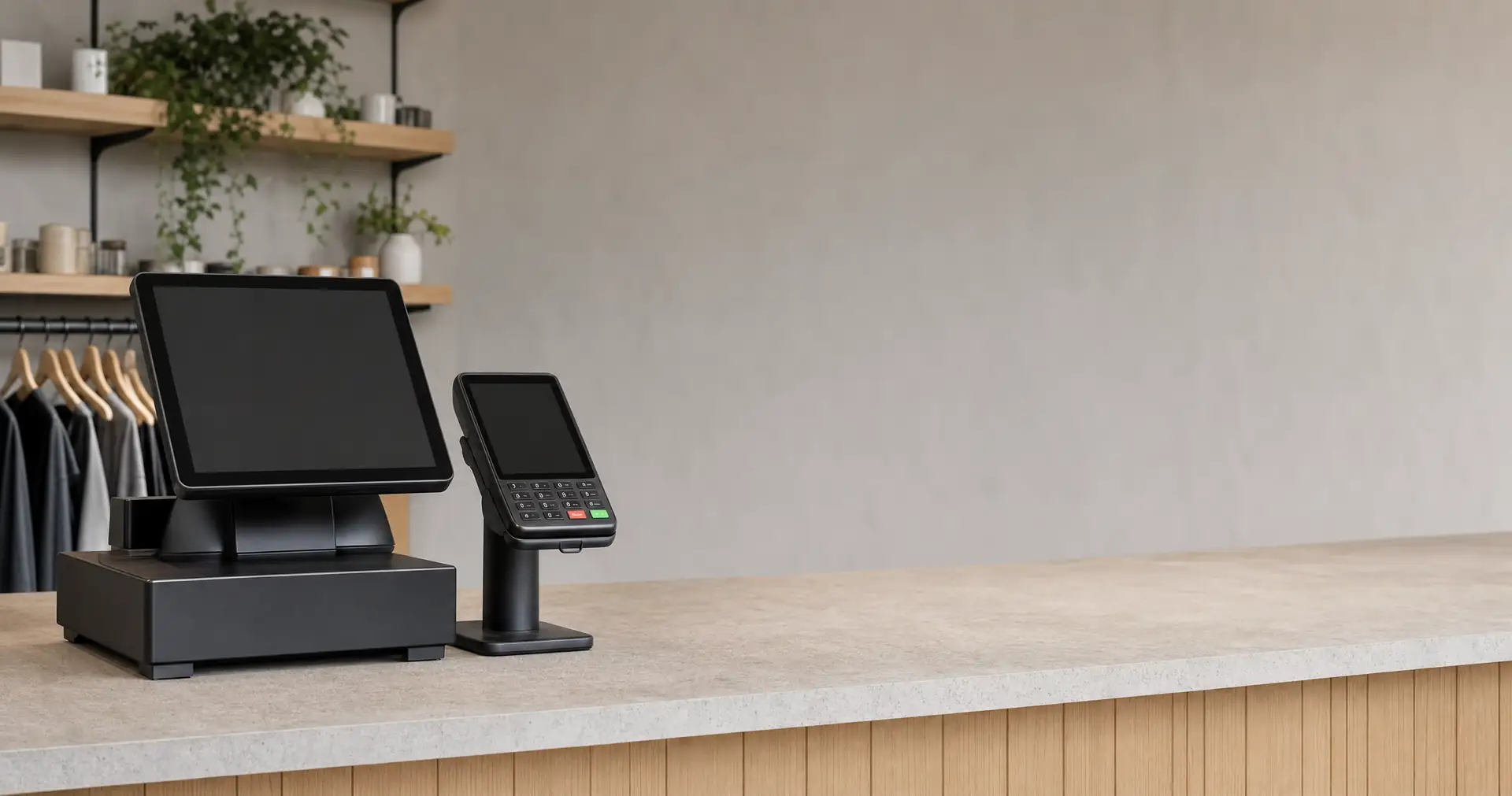
EFTPOS and POS system finance for New Zealand retailers and hospitality operators .
EFTPOS terminals and full POS systems are among the most commonly financed assets in NZ retail and hospitality. Rental from suppliers such as Eftpos Hire NZ starts at $43+GST per terminal per month on published terms; outright purchase of certified Verifone, Ingenico, or PAX terminals runs $1,000 to $8,000 per unit, with integrated Lightspeed, Vend, or Square Stand systems sitting at $5,000 to $50,000 once hardware, software, and install are combined.
What you need to know about NZ EFTPOS and POS system finance.
→Terminal rental from $43+GST per month Eftpos Hire NZ publishes rental from $43+GST per terminal per month on standard countertop hardware. Rental fees are typically tax-deductible operating expenses subject to the accountant's confirmation.
→Terminal purchase commonly $1,000 to $8,000 Verifone V200c, Ingenico Move/2500, and PAX A920 are the typical Verifone Network certified terminals. Pricing tracks countertop vs portable vs Android smart-terminal spec.
→Full POS systems commonly $5,000 to $50,000 Lightspeed Retail, Vend, Cova, Posera, and Square Stand sit across the system tier. Hardware, software licence, and install combine to set the total spend per site.
→Verifone Network fee around $15+GST per terminal per month Most NZ EFTPOS terminals connect through the Verifone Network under Payments NZ rules. The network fee sits on top of the rental or purchase cost.
The landscape
EFTPOS and POS sit at the core of every NZ retail and hospitality counter.
New Zealand operates one of the most card-active economies in the OECD, with EFTPOS terminals and integrated POS systems present at almost every retail and hospitality counter. Payments NZ administers the scheme rules and certification framework that hardware and software providers operate within, and the Reserve Bank of New Zealand publishes payments-system data showing card-based transactions sitting at a high share of consumer payment volume.
Two structures dominate EFTPOS and POS finance. Operating-lease rental from a specialist supplier (Eftpos Hire NZ from $43+GST per terminal per month, EzEftpos, Kiwi Eftpos & Point of Sale Group, NZ EFTPOS, TotalPOS Solutions) suits operators wanting to expense the cost as an operating overhead with no upfront capital outlay. Chattel-mortgage purchase from a finance lender (Heartland Bank, UDC Finance, Prospa) suits operators preferring ownership and upfront GST recovery on the asset, particularly where the spend includes a full POS system rather than just a single terminal.
The Verifone Network connection sits on top of either structure. Most NZ EFTPOS terminals certified for use on the Verifone Network carry a published connection fee of around $15+GST per terminal per month, separate from the rental or finance payment. The connection fee is typically a deductible operating expense. Integration costs to a POS system (Lightspeed, Vend, Cova, Posera) are commonly bundled into the install quote.
Terminal rental
$43+GST per month
Terminal purchase
$1K to $8K
Full POS system
$5K to $50K
Network fee
$15+GST per month
EFTPOS and POS scenarios
Four common NZ EFTPOS and POS finance scenarios.
Most EFTPOS and POS applications fall into one of four patterns. Each pattern has a typical loan amount or rental, structure, and supplier pool.
Single terminal rental for a small retailer
New Mount Maunganui boutique adding a single Verifone V200c countertop terminal on a 36-month rental from Eftpos Hire NZ. Rental from $43+GST per month plus the Verifone Network connection fee. No upfront capital outlay.
·Monthly rental: $43+GST
·Term: 36 months
Multi-terminal hospitality fit-out
New 80-cover Wellington restaurant deploying 4 portable Ingenico Move/2500 terminals for table-side payment plus a counter PAX A920. Mix of rental on the portables and chattel-mortgage purchase on the counter unit.
·Combined value: $12K to $18K
·Term: 36 to 48 months
Full POS system on chattel mortgage
Auckland gift retailer installing a Lightspeed Retail POS system: 2 iPad-based stations, cash drawer, receipt printers, barcode scanners, integrated Verifone terminals, software licences, and on-site install. Chattel mortgage on a 4-year term.
·Loan amount: $15K to $25K
·Term: 4 years
Multi-site POS rollout for an established chain
Established 6-site Christchurch hospitality group standardising on Posera across all venues. Combined hardware, software licensing, integration to back-of-house accounting, and staff training. Term loan against the rollout, drawn in stages by site.
·Loan amount: $80K to $180K
·Term: 4 to 5 years
What retailers and operators borrow for
Six common NZ EFTPOS and POS purposes.
EFTPOS and POS spend falls into six common purposes. Each has a typical structure that fits.
Countertop EFTPOS terminals
Verifone V200c, Ingenico Desk/3500, PAX A77. Standard countertop hardware on rental from $43+GST per month or purchase $1,000-$3,000 per unit. Common across small retail and quick-service.
Portable and table-side terminals
Ingenico Move/2500, Verifone V240m, PAX A920 Pro. Wireless portable terminals for restaurants, mobile trade, and pop-up retail. Rental or purchase $1,500-$4,500 per unit depending on connectivity spec.
Integrated POS systems
Lightspeed Retail, Vend (Lightspeed), Cova, Posera, Square Stand. Hardware plus software licence plus install. Total system cost commonly $5,000-$50,000 per site depending on station count and integration depth.
Network connection and certification
Verifone Network connection fee around $15+GST per terminal per month. Payments NZ scheme certification handled by the supplier. Costs sit on top of the rental or purchase.
Software licences and updates
Lightspeed, Vend, Cova, and Posera publish monthly per-station SaaS pricing. Annual upgrades, payment-card industry compliance updates, and integration to Xero or MYOB sit alongside the licence.
Multi-site rollout and training
Standardising hardware and software across 3+ sites. Staff training, data migration from legacy systems, and integration to centralised back-of-house. Term loan structure commonly fits better than per-terminal rental.
Tax and GST
How GST, deductibility, and depreciation typically apply to EFTPOS and POS spend.
A GST-registered NZ retailer or hospitality operator can typically treat EFTPOS terminal rental and Verifone Network connection fees as deductible operating expenses, with GST claimable on each invoice in the relevant return, subject to the accountant's confirmation. Where a terminal or full POS system is acquired under chattel mortgage, the full GST is typically claimable upfront in the next GST return after settlement, and the asset is then depreciated over its useful life under IRD rates published for office and electronic equipment. Where it is acquired under finance lease or operating lease, GST is typically claimed across the rental payments. Software licence fees (Lightspeed, Vend, Cova, Posera SaaS subscriptions) are typically deductible as operating expenses with GST on each invoice. The accountant is the right person to confirm structure choice and depreciation treatment on the specific business position.
EFTPOS and POS bands
Indicative NZ EFTPOS and POS finance bands.
Pricing varies by hardware spec, software depth, and supplier. The bands below are observed across the NZ EFTPOS and POS finance pool in 2026, drawn from supplier published terms and integrator quoting.
Asset category
Rental (per month)
Purchase
Common term
Single countertop terminal (Verifone V200c, Ingenico Desk/3500)
Posera / Lightspeed multi-station hospitality system
Software per-station SaaS
$15,000 to $35,000 per site
4 to 5 years
Multi-site POS rollout (6+ sites)
Software per-station SaaS
$80,000 to $180,000 total
4 to 5 years
Indicative bands only. Actual rental, purchase, and total system pricing depend on supplier, spec, and integration depth. Final rate, fee, and approval decisions are made by the lender or supplier after assessment.
Rental vs purchase vs full POS rollout
EFTPOS rental vs chattel-mortgage purchase vs term-loan POS rollout.
The structure choice tracks operator preference for ownership, expected upgrade cycle, and the depth of POS integration. Pure rental suits cash-flow simplicity; chattel mortgage suits ownership and upfront GST; term-loan rollout suits multi-site standardisation.
Feature
Operating-lease rental (Eftpos Hire NZ, EzEftpos)
Chattel-mortgage purchase (Heartland Bank, UDC Finance)
Term loan for full POS rollout
Typical contract value
$43+GST per terminal per month
$1K to $8K per terminal, $5K to $50K per system
$80K to $180K across multi-site rollout
Upfront cash outlay
None
Deposit (commonly 0-20%)
Deposit and staged drawdowns
GST treatment
Claimed across each rental invoice
Full GST in next return after settlement
Full GST per invoice as drawn
Ownership at end of term
Supplier retains; option to renew or return
Operator owns from settlement
Operator owns each asset
Hardware refresh
Commonly included or available at term renewal
Operator manages refresh cycle
Operator manages refresh across the fleet
Verifone Network connection fee
Sits on top of the rental
Sits on top of the loan repayment
Sits on top of the loan repayment
How it works
A typical NZ EFTPOS or POS finance application.
EFTPOS terminal rental applications move quickly because the supplier carries the credit risk on hardware they retain ownership of. Full POS system finance through a finance lender carries a fuller documentation cycle.
01
Day 1 to 5
Define the hardware and software scope
A typical EFTPOS and POS application combines hardware (terminals, station hardware, peripherals), software licences (Lightspeed, Vend, Cova, Posera SaaS), and install or integration work. Defining the scope upfront tightens the application and helps the supplier or lender size the package correctly.
Documents commonly required
·Site or store list (multi-site)
·Hardware itemised quote
·Software licence quote
02
Day 1 to 10
Submit application or sign rental contract
For rental from a specialist supplier (Eftpos Hire NZ, EzEftpos, Kiwi Eftpos & Point of Sale Group, NZ EFTPOS, TotalPOS Solutions), the application is commonly a short merchant onboarding pack: NZBN, business owner ID, recent bank statements. For chattel-mortgage purchase or a multi-site POS rollout, the application is the standard SME finance pack with the supplier quotes attached.
Suppliers assess against trading evidence and merchant suitability for the Verifone Network and Payments NZ scheme rules. Finance lenders assess against the standard SME criteria: serviceability, security position, and operator profile. Conditions may include a deposit, hardware swap-in date, or staged drawdowns tied to install milestones.
04
Week 2 onward
Settle, install, and connect to the network
Hardware is shipped or delivered by the supplier or integrator. Install commonly includes terminal configuration, Verifone Network certification, POS data migration from any legacy system, and staff training. The Verifone Network connection fee starts on activation. Where the hardware is purchased on chattel mortgage, the lender registers a security interest on the Personal Property Securities Register (PPSR).
A POS integrator familiar with NZ retail and hospitality fit-outs commonly handles the hardware quote, the software licensing, and the Payments NZ certification within one engagement, which compresses the documentation cycle versus separate vendor and lender applications.
Worked scenarios
Three NZ EFTPOS and POS finance scenarios.
Real-world structures across single-terminal rental, full POS system purchase, and multi-site rollout. Each illustrates how trading history and project depth shift the structure and the supplier or lender pool.
New owner-operator, single-site retail
Mount Maunganui boutique adding a countertop terminal
A new Mount Maunganui clothing and gift boutique opening with a single Verifone V200c countertop terminal. Total cost on rental: $43+GST per month for the terminal plus $15+GST per month for the Verifone Network connection. 36-month rental contract with Eftpos Hire NZ on published terms.
Structure agreed: pure operating-lease rental, no upfront capital outlay, monthly invoicing with GST claimed on each invoice. Existing accounting integration to Xero handled by the boutique's bookkeeper. Trading commenced the day the terminal was activated on the Verifone Network.
Rental fees treated as deductible operating expenses subject to the accountant's confirmation. PPSR security interest not relevant because the supplier retains ownership of the terminal under the rental contract.
Indicative figures
Monthly rental
$43+GST
Network fee
$15+GST
Total monthly cost
$58+GST
Term
36 months
Established 2-year operator, single-site retail
Auckland gift retailer installing Lightspeed Retail
An Auckland gift retailer with 2 years of trading replacing a legacy POS with a Lightspeed Retail system across 2 stations. Total project $15,000 ex-GST: 2 iPad-based stations with stands, cash drawers, receipt printers, barcode scanners, 2 integrated Verifone terminals, Lightspeed Retail software licence (annual prepay), data migration from the legacy POS, and on-site install and training.
Structure agreed: chattel mortgage on the hardware portion ($11,000, 4-year term, indicative 10-13% p.a.) through Heartland Bank. Lightspeed Retail SaaS billed monthly per station as a deductible operating expense. Verifone Network connection fee at $15+GST per terminal per month sits separately. GST on the hardware claimable upfront in the next GST return after settlement.
PPSR security interest registered against the hardware at settlement. Data migration completed over the closed Sunday before launch; staff training completed across the following week. New system live for the second-half retail trading season.
Indicative figures
Total project
$15,000
Chattel mortgage
$11,000
Indicative rate
10-13% p.a.
Term
4 years
Established multi-site operator standardising POS
Christchurch 6-site hospitality group rolling out Posera
A Christchurch hospitality group with 6 venues (3 cafes, 2 restaurants, 1 bar) standardising on Posera across the group, replacing a mix of legacy systems. Total package $130,000 ex-GST: $90,000 hardware (terminals, station hardware, kitchen display screens), $25,000 software licensing and integration to centralised back-of-house accounting, $15,000 install and staff training across all 6 venues.
Structure agreed with the existing relationship lender: term loan against the rollout ($110,000, 5-year term, indicative 9-11% p.a.) drawn in 3 stages by site cohort. Personal guarantees from the operating shareholders. Existing fleet trading data and 4 years of group accounts drove lender confidence. Posera SaaS billed monthly per station.
PPSR security interest registered against the hardware at each drawdown stage. Rollout completed over 6 weeks across the 6 sites. Verifone Network certification handled by the integrator at each site. Group reporting consolidated through Xero post-cutover.
Indicative figures
Total package
$130,000
Term loan
$110,000
Indicative rate
9-11% p.a.
Sites covered
6
NZ EFTPOS and POS finance providers
Lenders and suppliers that fund NZ EFTPOS and POS spend well.
EFTPOS and POS finance splits across specialist rental suppliers and mainstream finance lenders. The shortlist below is editorial.
Indicative shortlist. Final rate, fee, and approval decisions are made by each lender or supplier after assessment. Specialist rental suppliers (Eftpos Hire NZ, EzEftpos, Kiwi Eftpos & Point of Sale Group, NZ EFTPOS, TotalPOS Solutions) handle terminal-only rental directly under their published merchant terms.
Where EFTPOS and POS finance fits
When EFTPOS and POS finance is straightforward, and when it gets harder.
Where it works smoothly
·Single-site retailer or hospitality operator adding 1 to 4 terminals on a published rental contract
·Established operator with 2+ years of trading installing a full Lightspeed, Vend, Cova, or Posera POS
·Hardware certified for the Verifone Network and compliant with Payments NZ scheme rules
·Software integration to Xero or MYOB handled by the integrator within the install quote
·GST-registered operator wanting upfront GST recovery on a chattel-mortgage purchase
·Multi-site rollout with consolidated trading data and centralised reporting
Where it gets harder
·First-month operator with no trading history seeking a full POS rollout on finance
·Hardware not certified for the Verifone Network, requiring custom merchant onboarding
·Outstanding GST or PAYE arrears at IRD
·Heavy custom integration to legacy back-of-house systems pushing total project cost above standard bands
·Multi-site rollout with mismatched ownership structures across venues
·Reliance on a single payment processor where scheme certification status is unclear
NZ retail payment system regulation and merchant fee context under the Retail Payment System Act 2022.
FAQ
EFTPOS and POS system finance, NZ small-business questions answered
How much does an EFTPOS terminal cost to rent in New Zealand?
Rental on a standard countertop EFTPOS terminal in NZ commonly starts at $43+GST per terminal per month, per Eftpos Hire NZ's published rental terms in 2026. Portable and smart Android terminals typically rent at $55+GST to $90+GST per terminal per month depending on connectivity and capability. The Verifone Network connection fee of around $15+GST per terminal per month sits on top of the rental. Rental fees and network fees are typically deductible operating expenses subject to the accountant's confirmation.
How much does an EFTPOS terminal cost to buy outright in NZ?
Outright purchase of a Verifone Network certified terminal in NZ commonly runs $1,000 to $8,000 per unit. Standard countertop hardware (Verifone V200c, Ingenico Desk/3500, PAX A77) sits at the lower end ($1,000 to $3,000). Portable and table-side terminals (Ingenico Move/2500, Verifone V240m, PAX A920) sit in the middle ($1,500 to $4,500). Smart Android terminals with full POS capability sit at the upper end ($2,500 to $8,000). Outright purchase is commonly funded through chattel mortgage with full GST claimable upfront in the next GST return after settlement.
How much does a full POS system cost in NZ?
Full POS systems in NZ commonly run $5,000 to $50,000 per site once hardware, software licence, install, and integration are combined. Single-station Lightspeed or Vend setups for small retail sit in the $5,000 to $12,000 range for hardware. Multi-station hospitality systems on Posera or Lightspeed sit in the $15,000 to $35,000 range per site. Multi-site rollouts standardising 6+ venues commonly land at $80,000 to $180,000 in total project cost. SaaS software fees (Lightspeed, Vend, Cova, Posera) are billed monthly per station as a separate operating expense.
What is the Verifone Network connection fee?
Most NZ EFTPOS terminals connect through the Verifone Network and carry a published connection fee of around $15+GST per terminal per month, separate from the rental or finance payment. The fee covers scheme certification under Payments NZ rules, transaction routing, and the operating cost of the network. The fee is typically a deductible operating expense subject to the accountant's confirmation. Some specialist suppliers and integrated POS providers bundle the network fee into a combined monthly cost rather than billing it separately.
What rate range applies to NZ EFTPOS and POS finance in 2026?
Indicative rates on chattel-mortgage purchase of EFTPOS terminals and POS systems in NZ commonly sit in the 9% to 14% per annum band depending on structure, security, and operator profile. Asset-secured terminal and hardware finance sits at the lower end (commonly 9-12%). Unsecured term loans on full POS rollouts sit in the middle (commonly 11-14%). Unsecured top-ups on software, training, or integration sit at the upper end (commonly 13-16%). Final rate is set by the lender after assessment. Rental contracts from specialist suppliers are not priced as a rate but as a fixed monthly fee on published merchant terms.
Is GST claimable on an EFTPOS terminal in NZ?
A GST-registered NZ retailer or hospitality operator can typically claim the GST component on EFTPOS terminals and POS hardware as input tax in the relevant GST return, subject to the accountant's confirmation. Where the hardware is acquired under chattel mortgage, the full GST is typically claimable upfront in the next GST return after settlement. Where it is acquired under finance lease or operating-lease rental from a supplier such as Eftpos Hire NZ, GST is typically claimed across each rental invoice as it is paid. Software licence fees (Lightspeed, Vend, Cova, Posera SaaS) commonly carry GST claimable on each monthly invoice.
Are EFTPOS rental fees tax-deductible?
EFTPOS terminal rental fees and Verifone Network connection fees are typically treated as deductible operating expenses for a NZ business, subject to the accountant's confirmation. The deduction sits against business income in the period the expense is incurred. The IRD published guidance on operating expenses and the distinction between revenue and capital expenditure governs the treatment. Where the hardware is purchased outright under chattel mortgage instead, the asset is depreciated over its useful life under IRD published rates rather than fully expensed in the year of purchase.
What is the typical term on an EFTPOS rental contract?
NZ EFTPOS rental contracts from specialist suppliers commonly run 12 to 48 months. 36 months is the most common term across published rental offerings from Eftpos Hire NZ, EzEftpos, and Kiwi Eftpos & Point of Sale Group. Shorter 12 to 24 month terms commonly carry slightly higher monthly rental in exchange for the flexibility, while longer 48 month terms carry the lowest monthly rental. The contract end commonly offers a choice between renewal on refreshed hardware, return of the existing hardware, or in some cases conversion to ownership. The merchant contract is the authoritative reference on each supplier's terms.
What hardware is certified for the Verifone Network in NZ?
Verifone, Ingenico, and PAX hardware certified by Payments NZ for the Verifone Network covers the bulk of merchant deployment in NZ. Common models include the Verifone V200c and Vx series (countertop), the Verifone V240m (portable), the Ingenico Desk/3500 and Move/2500, and the PAX A77 and A920 Pro Android smart terminals. Each model carries a Payments NZ certification covering scheme rules and transaction processing. New hardware models go through a certification process before being deployed to NZ merchants. The supplier confirms certification status at the merchant onboarding stage.
How does an integrated POS differ from a standalone EFTPOS terminal?
A standalone EFTPOS terminal is a single device that accepts card payment and prints a receipt. An integrated POS connects the terminal to a wider point-of-sale system that handles inventory, sales reporting, staff management, customer loyalty, and back-of-house accounting. Lightspeed Retail, Vend (Lightspeed), Cova, Posera, and Square Stand are common NZ POS systems. The integration typically reduces double-keying at the counter, gives finer-grained sales reporting, and connects directly to Xero or MYOB for general ledger reconciliation. Multi-site operators typically benefit most from integration because of consolidated reporting across venues.
Can a first-year retailer get EFTPOS and POS finance in NZ?
Yes. Single-terminal rental contracts from specialist suppliers (Eftpos Hire NZ, EzEftpos, Kiwi Eftpos & Point of Sale Group) are commonly available to new and first-year retailers because the supplier carries the credit risk on hardware they retain ownership of. Chattel-mortgage purchase of a full POS system through a finance lender is harder for first-year operators because the lender is underwriting against limited trading history. Alternative SME lenders such as Bizcap and Prospa fund this tier where mainstream banks decline. Operators with prior retail or hospitality management experience commonly access tighter pricing.
What happens to a financed EFTPOS terminal if the business closes?
Where the terminal is rented from a supplier, the hardware is returned to the supplier on termination of the merchant contract; the supplier retains ownership throughout. Where the hardware is purchased under chattel mortgage and the business closes before the loan is repaid, the lender typically has a security interest registered on the Personal Property Securities Register (PPSR) and can take possession to recover the outstanding balance. Used POS hardware typically retains a fraction of original value in the secondary market depending on age, condition, and Verifone Network certification status. Lenders commonly work with operators to restructure repayments before resorting to repossession.
How does the Retail Payment System Act 2022 affect EFTPOS finance?
The Retail Payment System Act 2022 is the NZ legislation administered by the Commerce Commission that regulates merchant service fees and surcharging on card payments, alongside Payments NZ scheme rules. The Act affects the cost of accepting card payments rather than the cost of financing the EFTPOS hardware itself; merchant service fees are typically a separate line item on the bank or payment-processor statement. The Commerce Commission publishes guidance for merchants on the Act and the related surcharging rules. Operators choosing between rental and purchase commonly review both the hardware finance cost and the merchant service fee position at the same time.
What lenders specialise in NZ EFTPOS and POS finance?
No NZ lender markets exclusively to EFTPOS and POS, but Heartland Bank, UDC Finance, Prospa, Bizcap, and MTF Finance all carry familiarity with the asset class. Heartland Bank and UDC Finance handle larger chattel-mortgage purchases and multi-site rollouts. Prospa and Bizcap suit unsecured software and integration top-ups alongside the main hardware finance. MTF Finance sometimes covers smaller hardware purchases bundled with wider counter spend. Specialist rental suppliers (Eftpos Hire NZ, EzEftpos, Kiwi Eftpos & Point of Sale Group, NZ EFTPOS, TotalPOS Solutions) handle terminal-only rental directly under their published merchant terms. A POS integrator commonly tightens the package by combining hardware quote, software licensing, and finance referrals.
Indicative content only. Not personalised financial advice.
A business loan is a commitment that runs for months or years, and repayments come out of the same operating cash flow as everything else. Before committing, it is worth modelling the weekly and monthly cost against the business's working-capital position, which is what this site is built to help with. Borrowing at a level that stays comfortable through a quiet quarter, not just a strong one, is widely regarded as the safer frame.
What this site is
A calculator and information tool. Not a lender, not a broker, not a registered financial adviser. Nothing here is personalised financial advice.
What the figures show
Modelled estimates based on the inputs you enter. Not a quote. Not an offer of credit. Not a guarantee of approval, rate, or fees.
What the lender decides
Final rates, fees, and approval are set by the lender after a CCCFA-appropriate assessment of the applicant's circumstances and credit decision.
Commercial disclosure
Businessloans.org.nz earns a commission from Prospa when a visitor applies through this site and their application is approved. The commission is paid by Prospa, not by the borrower, and it does not influence the rate Prospa offers. Full disclosure on the partner page.
Tax, GST, and accountant framing
Tax-treatment statements (GST claim timing, interest deductibility, depreciation rates) are general in nature and subject to your accountant's confirmation on the specific business position. For material amounts, professional advice from a registered financial adviser or chartered accountant is widely regarded as the safer frame.