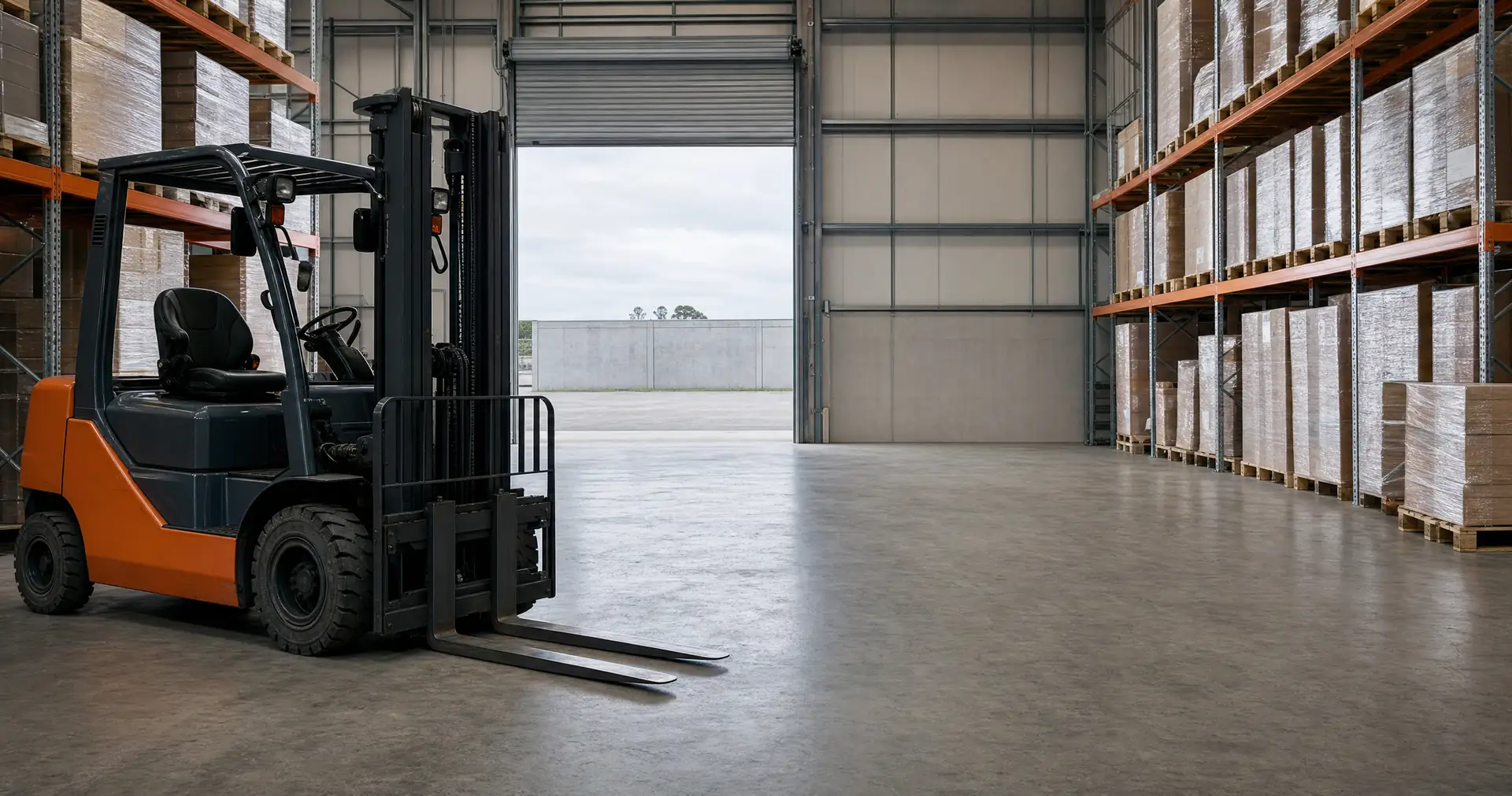
Forklift finance for New Zealand warehouse and logistics operators .
Forklift finance in NZ runs across counterbalance, reach, electric, and LPG units from Crown, Hyster, Toyota, and Linde. Indicative bands $15K to $120K. Specialist funders include Speirs Finance and Crown Forklifts financial services. Rent-to-own and operating lease structures sit alongside chattel mortgage and hire purchase.
→Indicative bands $15K to $120K Used 2-3 tonne LPG counterbalance commonly $15K-$35K. New 2.5 tonne electric counterbalance commonly $40K-$70K. Reach trucks $50K-$90K. Lithium-electric high-spec $80K-$120K.
→F-endorsement on the driver licence is mandatory Under the Health and Safety at Work Act 2015 and AS/NZS 2359, every operator holds a Forklift Operator Certificate (F-endorsement) before operating a forklift in any workplace.
→Speirs Finance carries documented forklift specialism Speirs is the long-running NZ specialist alongside Crown Forklifts financial services, Partners Finance and Lease, Central Group, and ORIX. UDC and Heartland also fund the broader pool.
→Rent-to-own and operating lease are common alongside chattel mortgage Forklift fleets commonly mix purchase (chattel mortgage, hire purchase) and rental (operating lease, rent-to-own) depending on use intensity, end-of-life rotation pattern, and capex appetite.
The landscape
NZ forklift finance sits at the intersection of asset finance and workplace safety regulation.
Forklifts are the most common materials-handling asset across NZ warehouses, distribution centres, manufacturing plants, container yards, and timber and steel merchants. The active fleet covers four broad classes: LPG and diesel counterbalance for indoor and outdoor mixed use, electric counterbalance for indoor warehouse work (lead-acid and lithium battery options), reach trucks for high-rack racked warehouse work, and order pickers and walkie-stackers for low-level pick work. Crown, Hyster, Toyota, and Linde dominate the NZ dealer-supplied pool, with smaller volumes from Komatsu, Mitsubishi, and Nissan units.
The finance pool reflects the dual nature of the asset. Speirs Finance has built documented forklift specialism over decades of NZ asset-finance lending and remains a primary funder. Crown Forklifts operates its own financial services arm covering Crown-branded units across rental and rent-to-own structures. Partners Finance and Lease, Central Group, and ORIX cover the operating lease and full-service rental tier where customers prefer opex over capex. UDC Finance and Heartland Bank fund the broader chattel mortgage and hire purchase pool alongside major bank business lending.
The regulatory overlay is heavier than for general business equipment. WorkSafe administers the Health and Safety at Work Act 2015, under which forklift operation requires a Forklift Operator Certificate (the F-endorsement on the driver licence) per AS/NZS 2359 (Powered industrial trucks). Every operator holds the F-endorsement, refresher training is recommended every 3 years, and workplaces hold a documented forklift management plan covering pedestrian segregation, speed limits, load handling, and inspection routines. NZ Workplace First Aid kit requirements under WorkSafe guidance also typically apply at the operating site.
Used LPG counterbalance
$15K to $35K
New electric counterbalance
$40K to $80K
Reach truck (racked warehouse)
$50K to $90K
Common term
3 to 5 years
Forklift finance scenarios
Four common NZ forklift finance scenarios.
Most forklift finance applications fall into one of four patterns. Each pattern has a typical loan amount, structure, and lender pool.
Single used counterbalance for a small operator
Owner-managed warehouse, lumber yard, or container handling site buying a used 2 to 3 tonne LPG or diesel counterbalance. Commonly Hyster H2.50 or Toyota 8FG25. Chattel mortgage on a 3 to 4 year term.
·Loan amount: $15K to $35K
·Term: 3 to 4 years
New electric counterbalance for indoor warehouse
Distribution centre or manufacturing plant adding a new electric counterbalance for indoor pallet handling. Crown SC, Toyota Traigo, or Linde E-Series. Chattel mortgage or hire purchase on a 5-year term.
·Loan amount: $45K to $80K
·Term: 5 years
Reach truck fleet for racked warehouse
Established 3PL or distribution operator adding 2 to 4 reach trucks for high-rack pallet retrieval. Crown ESR or Toyota Reach. Mixed chattel-mortgage portfolio plus operating lease on the lead unit.
·Loan amount: $200K to $400K
·Term: 4 to 5 years
Operating lease or rent-to-own on a fleet
Shift-intensive warehouse operator preferring opex to capex, rotating units every 3 to 4 years to keep maintenance cost predictable. Operating lease through Crown Forklifts financial services, Partners, or ORIX.
·Monthly rental: $700 to $2,200 per unit
·Structure: Operating lease, full-service common
What forklift buyers borrow for
Six common NZ forklift finance purposes.
Forklift lending volume falls into six common purposes. Each has a typical structure that fits.
LPG and diesel counterbalance
Hyster H2.50, Toyota 8FG25, Linde H25, Crown C-5. 2 to 3.5 tonne capacity for indoor-outdoor mixed use. Chattel mortgage on a 3 to 5 year term. Used units common at the entry tier.
Electric counterbalance (lead-acid or lithium)
Crown SC, Toyota Traigo, Linde E-Series. Indoor warehouse use. Lithium-battery variants run higher capex and longer asset life. Operating lease common where shift intensity drives lithium choice.
Reach trucks for racked warehouse
Crown ESR, Toyota Reach, Linde R-Series. High-rack pallet retrieval up to 12 metres. Specialist application typically warehouse-based with documented racking layout.
Order pickers and walkie-stackers
Low-level order picking, pick-and-pack DC layouts. Crown WAV, Toyota BT, Linde N-Series. Smaller capex per unit but commonly bought in fleets of 4 to 12.
Attachments and safety upgrades
Side-shifters, fork positioners, paper-roll clamps, drum-handlers, blue-spot lights, speed limiters. Asset finance against the attachment alongside the main unit, or unsecured term loan.
Operator F-endorsement training
Forklift Operator Certificate training to F-endorsement standard under HSWA 2015 and AS/NZS 2359. Commonly $400 to $700 per operator. Small unsecured term loan or working-capital draw covers a batch of operators.
Tax, GST, and depreciation
How GST and IRD depreciation typically work on NZ forklifts.
A GST-registered business can typically claim the GST component on a forklift acquired under chattel mortgage as input tax in the relevant GST return, subject to the accountant's confirmation. Where the forklift is acquired under chattel mortgage or hire purchase, the full GST is typically claimable upfront in the next GST return after settlement. Where it is acquired under finance lease or operating lease, GST is typically claimed across the rental payments. IRD publishes asset-class depreciation rates for materials-handling equipment, with forklifts commonly depreciated using a diminishing-value or straight-line rate set out in IRD's general depreciation determinations; the relevant rate depends on the asset class and use pattern. Operator F-endorsement training cost and ongoing safety compliance cost (workplace forklift management plan, NZ Workplace First Aid kit at the operating site under WorkSafe guidance, refresher training every 3 years) are typically deductible against business income. The accountant is the right person to confirm structure choice and depreciation treatment on the specific business position.
Forklift finance bands by class
Indicative NZ forklift finance bands by class and powertrain.
Forklift pricing varies by capacity, powertrain, mast height, and dealer. The bands below are observed across the NZ forklift finance pool in 2026, drawn from new and used dealer market activity.
Class and powertrain
Used (5-8 yr)
New
Common term
LPG counterbalance 2-3 tonne (Hyster, Toyota)
$15K to $30K
$40K to $55K
3 to 5 years
Diesel counterbalance 3-5 tonne (Linde, Komatsu)
$22K to $45K
$55K to $85K
4 to 5 years
Electric counterbalance 2.5 tonne (Crown SC, Toyota Traigo)
$28K to $50K
$45K to $75K
5 years
Lithium-battery electric counterbalance
$45K to $75K
$80K to $120K
5 years
Reach truck (Crown ESR, Toyota Reach)
$35K to $65K
$60K to $90K
4 to 5 years
Order picker / walkie-stacker
$10K to $22K
$22K to $38K
4 to 5 years
Indicative bands only. Actual price depends on age, hours, mast spec, attachments, and dealer. Final rate, fee, and approval decisions are made by the lender after assessment.
Purchase vs lease vs rent-to-own
Chattel mortgage vs operating lease vs rent-to-own on NZ forklifts.
The structure choice tracks shift intensity, end-of-life rotation pattern, and capex appetite. Single-shift operators commonly buy; multi-shift warehouses commonly lease or rent-to-own to keep maintenance cost predictable.
Feature
Chattel mortgage / hire purchase
Operating lease (full-service common)
Rent-to-own (Crown, Speirs)
Typical loan amount
$15K to $120K per unit
$700 to $2,200 monthly per unit
$15K to $90K per unit progressively
GST upfront claim
Yes, full GST in next return
No, claimed across payments
Claimed against rental until ownership transfer
Ownership at end of term
Operator owns from settlement (chattel) or final payment (HP)
Forklift applications carry an operator certification and workplace safety step that other equipment finance applications do not. Established warehouse operators with documented forklift management plans move faster.
01
Day 1 to 5
Define the unit, attachments, and structure
A typical forklift loan is a chattel mortgage on the main unit, with optional asset finance on attachments (side-shifter, fork positioner, paper-roll clamp). Operating lease and rent-to-own alternatives are commonly compared at this stage where shift intensity favours full-service rental.
Documents commonly required
·Forklift quote or sale agreement (dealer)
·Attachment quote (where separate)
·Operating lease quote (where comparing)
02
Day 1 to 7
Submit application with workplace safety documents
Beyond the standard SME application pack, forklift lenders ask for confirmation of operator F-endorsement status across nominated drivers, the workplace forklift management plan under HSWA 2015, and 6 to 12 months of trading data. Specialist lenders such as Speirs Finance run a documented forklift application workflow.
Documents commonly required
·NZBN, business owner ID
·Last 6 months business bank statements
·Operator F-endorsement (Forklift Operator Certificate) for nominated drivers
·Workplace forklift management plan (HSWA 2015)
·AS/NZS 2359 compliance documentation
·NZ Workplace First Aid kit confirmation (per WorkSafe guidance)
·Site layout for operating environment
03
Day 5 to 14
Lender assessment and offer
Lenders assess against three things: the security position on the asset (LVR after deposit and any trade-in), the trading data and serviceability, and the workplace safety profile (F-endorsement coverage, forklift management plan, prior incident record where any). Offers commonly come back with conditions: deposit, attachment financing terms, or service plan inclusion.
04
Week 2 onward
Settle, register PPSR, take delivery
Asset finance settles directly to the dealer or seller. The lender registers a security interest on the Personal Property Securities Register (PPSR). The unit is delivered to the operating site, attachments fitted, and the operator commissioning check completed. Forklift inspection and pre-start checklist embedded in the workplace forklift management plan from day one.
A specialist forklift broker familiar with NZ warehouse and distribution operators commonly tightens the indicative rate band by knowing which lender fits each operator profile and shift pattern.
Worked scenarios
Three NZ forklift finance scenarios.
Real-world structures across single-unit purchase, fleet expansion, and operating lease. Each illustrates how shift intensity, end-of-life rotation pattern, and existing trading data shift the offered rate and structure.
Owner-managed container handling site, single shift
Auckland container yard single-unit purchase
An Auckland owner-managed container yard buying a used 2022 Hyster H2.50 LPG counterbalance. Total project $32,000 ex-GST: $28,000 used Hyster from a regional dealer, $2,500 attachment (side-shifter), $1,500 commissioning and operator F-endorsement refresher for two nominated drivers. 15% deposit ($4,800) from cash flow.
Structure agreed with a forklift specialist broker: chattel mortgage on the main unit and side-shifter ($27,200 after deposit, 4-year term, indicative 10-12% p.a.). Speirs Finance funded the chattel mortgage based on the trading history and the documented workplace forklift management plan under HSWA 2015.
PPSR security interest registered against the Hyster and side-shifter at settlement. Operators held existing F-endorsement; refresher training completed before first use per AS/NZS 2359 and the workplace forklift management plan. NZ Workplace First Aid kit confirmed at the operating site per WorkSafe guidance.
Indicative figures
Total project
$32,000
Hyster H2.50
$28,000
Chattel mortgage after deposit
$27,200
Indicative rate
10-12% p.a.
Established 3PL distribution operator, multi-shift warehouse
Hamilton 3PL reach truck fleet expansion
A Hamilton 3PL distribution operator with 5 years of trading adding 3 reach trucks to support a new contract for a national grocery wholesaler. Total project $260,000 ex-GST: 3 new Crown ESR reach trucks at $82,000 each, $14,000 fleet attachment and signage upgrade. 20% deposit ($52,000) from existing trading.
Existing fleet trading data and the new contract evidence drove lender confidence. Mixed structure: chattel mortgage on 2 of the 3 reach trucks ($131,200 combined after deposit, 5-year term, indicative 8-10% p.a.); operating lease on the lead unit ($1,800 per month over 5 years through Crown Forklifts financial services, full-service inclusive of maintenance).
Workplace forklift management plan under HSWA 2015 amended to reflect the expanded fleet. Three additional operators completed F-endorsement training to AS/NZS 2359 standard before the units went into service. PPSR security interest registered against each chattel-mortgaged reach truck. Heartland Bank funded the chattel mortgage portion.
Indicative figures
Total project
$260,000
Reach trucks (3 units)
$246,000
Combined chattel mortgage
$131,200
Indicative blended rate
8-10% p.a.
Multi-shift distribution centre, lithium-electric rotation
Christchurch DC operating lease on lithium-electric fleet
A Christchurch distribution centre operating 2-shift pallet handling rotating to a lithium-electric counterbalance fleet to support continuous shift use without battery swap downtime. Total package: 4 new lithium-electric Crown SC counterbalance units on a 4-year operating lease. Indicative monthly rental $2,000 per unit ($8,000 monthly) inclusive of full-service maintenance plan.
Operating lease structure preferred over chattel mortgage because end-of-life rotation every 4 years aligns with lithium-battery service life and the multi-shift use pattern. Lessor retains residual risk; lessee returns units at end of term with no balloon obligation. Partners Finance and Lease arranged the lease alongside Crown Forklifts on a back-to-back arrangement.
Workplace forklift management plan under HSWA 2015 covered the lithium-battery handling protocols (charging area ventilation, fire-suppression cover, trained battery handlers). Operators held current F-endorsement under AS/NZS 2359; refresher training completed before lithium-electric units went into service. NZ Workplace First Aid kit upgraded per WorkSafe guidance for lithium-battery operating environments.
Indicative figures
Lease term
4 years
Monthly rental per unit
$2,000
Total monthly cost
$8,000
Structure
Operating lease, full-service
NZ forklift finance lenders
Lenders that fund NZ forklift purchases and fleet rotation well.
Several NZ lenders carry deep familiarity with forklift finance. The shortlist below is editorial.
A used 2 to 3 tonne LPG counterbalance forklift in NZ commonly runs $15,000 to $35,000 depending on age, hours, and mast spec. New 2.5 tonne electric counterbalance commonly runs $40,000 to $75,000. Reach trucks for racked warehouse work commonly run $50,000 to $90,000. Lithium-battery high-spec electric counterbalance runs $80,000 to $120,000. Used pricing varies materially by hours run, residual mast life, and dealer; new pricing varies by attachment spec and battery technology choice.
What is an F-endorsement and is it required for forklift operation in NZ?
A Forklift (F) endorsement is an NZTA-issued endorsement on the driver licence that authorises forklift operation in NZ workplaces, required under the Health and Safety at Work Act 2015 and aligned to AS/NZS 2359 Powered industrial trucks. Every operator holds the F-endorsement before operating a forklift in any workplace. The endorsement is gained through approved operator training (commonly $400 to $700 per operator) covering pre-start checks, load handling, pedestrian segregation, and emergency procedures. NZTA publishes the application and renewal process in full.
Which lenders specialise in NZ forklift finance?
Speirs Finance is the long-running NZ asset-finance specialist with documented forklift specialism, strong on chattel mortgage and hire purchase across counterbalance, reach truck, and order picker classes. Crown Forklifts operates its own financial services arm covering rental and rent-to-own structures. Partners Finance and Lease, Central Group, and ORIX cover the operating lease and full-service rental tier. UDC Finance and Heartland Bank fund the broader chattel mortgage pool alongside the major banks. A specialist forklift broker familiar with NZ warehouse operators commonly tightens the indicative rate band.
What rate range applies to NZ forklift finance in 2026?
Indicative rates on NZ forklift finance commonly sit in the 8% to 14% per annum band depending on structure, security, and operator profile. Chattel-mortgage finance secured by a new unit for an established operator with documented trading sits at the lower end (commonly 8-10%). Used unit finance and smaller-ticket attachments sit in the middle (commonly 10-12%). Higher-tolerance applications (newer operator, older used unit, no F-endorsement coverage at application) sit at the upper end (commonly 12-14%+). Final rate is set by the lender after assessment.
Should a NZ business buy or lease a forklift?
The structure choice tracks shift intensity, end-of-life rotation pattern, and capex appetite. Single-shift owner-operators commonly buy under chattel mortgage or hire purchase, with full GST claim upfront and ownership from settlement. Multi-shift distribution operators commonly lease under operating lease or rent-to-own, with predictable opex and end-of-life rotation embedded in the structure. Lithium-battery electric units commonly suit operating lease where shift intensity drives 4-year rotation. The accountant is the right person to confirm structure choice on the specific business position.
Can GST be claimed on a forklift under chattel mortgage?
A GST-registered business can typically claim the GST component on a forklift acquired under chattel mortgage as input tax in the relevant GST return, subject to the accountant's confirmation. Where the forklift is acquired under chattel mortgage or hire purchase, the full GST is typically claimable upfront in the next GST return after settlement. Where it is acquired under finance lease or operating lease, GST is typically claimed across the rental payments. Attachment finance (side-shifter, fork positioner, paper-roll clamp) typically follows the GST treatment of the main asset finance line. The accountant is the right person to confirm GST timing on the specific position.
How does IRD depreciation work on a NZ forklift?
IRD publishes asset-class depreciation rates for materials-handling equipment under the General Depreciation Determinations. Forklifts are commonly depreciated using a diminishing-value or straight-line rate set out in the relevant determination, with the specific rate depending on the asset class and use pattern (warehouse forklift, container handling, manufacturing plant). Lithium-battery electric units sometimes attract a different rate to lead-acid or LPG units depending on classification. The accountant is the right person to confirm depreciation rate and method on the specific position; IRD publishes the determinations and asset categories in full.
What is the typical forklift loan term in NZ?
NZ forklift chattel mortgages and hire purchase loans commonly run 3 to 5 year terms. Used units typically attract 3 to 4 year terms reflecting remaining asset life; new units typically attract 5 year terms. Operating leases on full-service rental fleets commonly run 3 to 5 years aligned to lithium-battery service life or shift-intensity rotation pattern. The loan term should fit within the expected useful life of the unit for the use case (heavy multi-shift use accelerates end-of-life), and lenders commonly will not write a loan term that exceeds the practical residual life of the asset.
What workplace safety documentation do lenders ask for?
Forklift lenders commonly ask for confirmation of operator F-endorsement status across nominated drivers, the workplace forklift management plan under the Health and Safety at Work Act 2015 (covering pedestrian segregation, speed limits, load handling, pre-start inspection routines), and AS/NZS 2359 alignment documentation. Specialist lenders such as Speirs Finance run a documented forklift application workflow that captures these items as standard. NZ Workplace First Aid kit confirmation at the operating site is also typically requested per WorkSafe guidance, particularly for sites operating lithium-battery electric units.
What attachments are commonly financed alongside a forklift?
Common forklift attachments financed alongside the main unit include side-shifters (fitted as standard on most NZ counterbalance units), fork positioners, paper-roll clamps, drum-handlers, bale clamps, carton clamps, and rotators. Safety upgrades commonly financed include blue-spot lights for pedestrian warning, speed limiters, and seat-belt interlocks. Attachment finance typically follows the GST and depreciation treatment of the main asset finance line; the lender registers a single PPSR security interest covering the unit and fitted attachments where they are funded together.
What happens to a financed forklift if the business closes?
Where the forklift is financed under chattel mortgage or hire purchase and the business closes before the loan is repaid, the lender typically has a security interest registered on the Personal Property Securities Register (PPSR) and can take possession of the unit to recover the outstanding balance. Any shortfall between resale value and balance owing typically falls to the borrower and any personal guarantor. NZ forklifts commonly retain 30-55% of new value over a 5-year hold period depending on hours, condition, and brand; major-dealer brands (Crown, Hyster, Toyota, Linde) typically retain value better than non-mainstream brands.
Can a lithium-battery electric forklift be financed in NZ?
Yes. Lithium-battery electric forklifts (Crown SC lithium, Toyota Traigo lithium, Linde E-Series lithium) are financeable through the same chattel-mortgage and operating lease pool as lead-acid and LPG units. The higher capex (commonly $80,000 to $120,000 for a 2.5 tonne lithium-electric unit) is typically supported by longer asset life, lower maintenance cost, and the absence of battery-swap downtime in multi-shift operation. Operating lease through Crown Forklifts financial services, Partners Finance and Lease, or ORIX is common where shift intensity favours predictable opex; chattel mortgage suits owner-operators preferring asset ownership.
How does forklift finance differ from light commercial vehicle finance?
Forklift finance and light commercial vehicle finance share the same broad asset-finance structures (chattel mortgage, hire purchase, finance lease, operating lease) but differ in three ways. The regulatory overlay is different: forklifts require F-endorsement under HSWA 2015 and AS/NZS 2359, while light commercial vehicles require Class 1 driver licence and COF under the Land Transport Act 1998. The lender pool is more specialist: Speirs Finance and Crown Forklifts financial services dominate the forklift pool, while UDC, Heartland, and MTF cover light commercial vehicles. Asset bands sit at $15K-$120K for forklifts versus $25K-$150K for light commercials, with similar 3 to 5 year terms across both classes.
Can an established forklift fleet operator refinance into better pricing?
Yes. Established warehouse and distribution operators with 2+ years of clean fleet trading and documented workplace forklift management plans commonly refinance into tighter pricing as the fleet builds operating history and equity builds in the asset base. Refinancing is also commonly used to consolidate multiple chattel mortgages into a single facility, to release equity to fund a fleet rotation cycle (lithium-electric upgrade), or to move from a specialist asset-finance lender into a major-bank relationship at scale. Early-repayment fees on the existing loans, the resale or carrying value of each unit, and the current security position across the fleet are the main considerations.
Indicative content only. Not personalised financial advice.
A business loan is a commitment that runs for months or years, and repayments come out of the same operating cash flow as everything else. Before committing, it is worth modelling the weekly and monthly cost against the business's working-capital position, which is what this site is built to help with. Borrowing at a level that stays comfortable through a quiet quarter, not just a strong one, is widely regarded as the safer frame.
What this site is
A calculator and information tool. Not a lender, not a broker, not a registered financial adviser. Nothing here is personalised financial advice.
What the figures show
Modelled estimates based on the inputs you enter. Not a quote. Not an offer of credit. Not a guarantee of approval, rate, or fees.
What the lender decides
Final rates, fees, and approval are set by the lender after a CCCFA-appropriate assessment of the applicant's circumstances and credit decision.
Commercial disclosure
Businessloans.org.nz earns a commission from Prospa when a visitor applies through this site and their application is approved. The commission is paid by Prospa, not by the borrower, and it does not influence the rate Prospa offers. Full disclosure on the partner page.
Tax, GST, and accountant framing
Tax-treatment statements (GST claim timing, interest deductibility, depreciation rates) are general in nature and subject to your accountant's confirmation on the specific business position. For material amounts, professional advice from a registered financial adviser or chartered accountant is widely regarded as the safer frame.