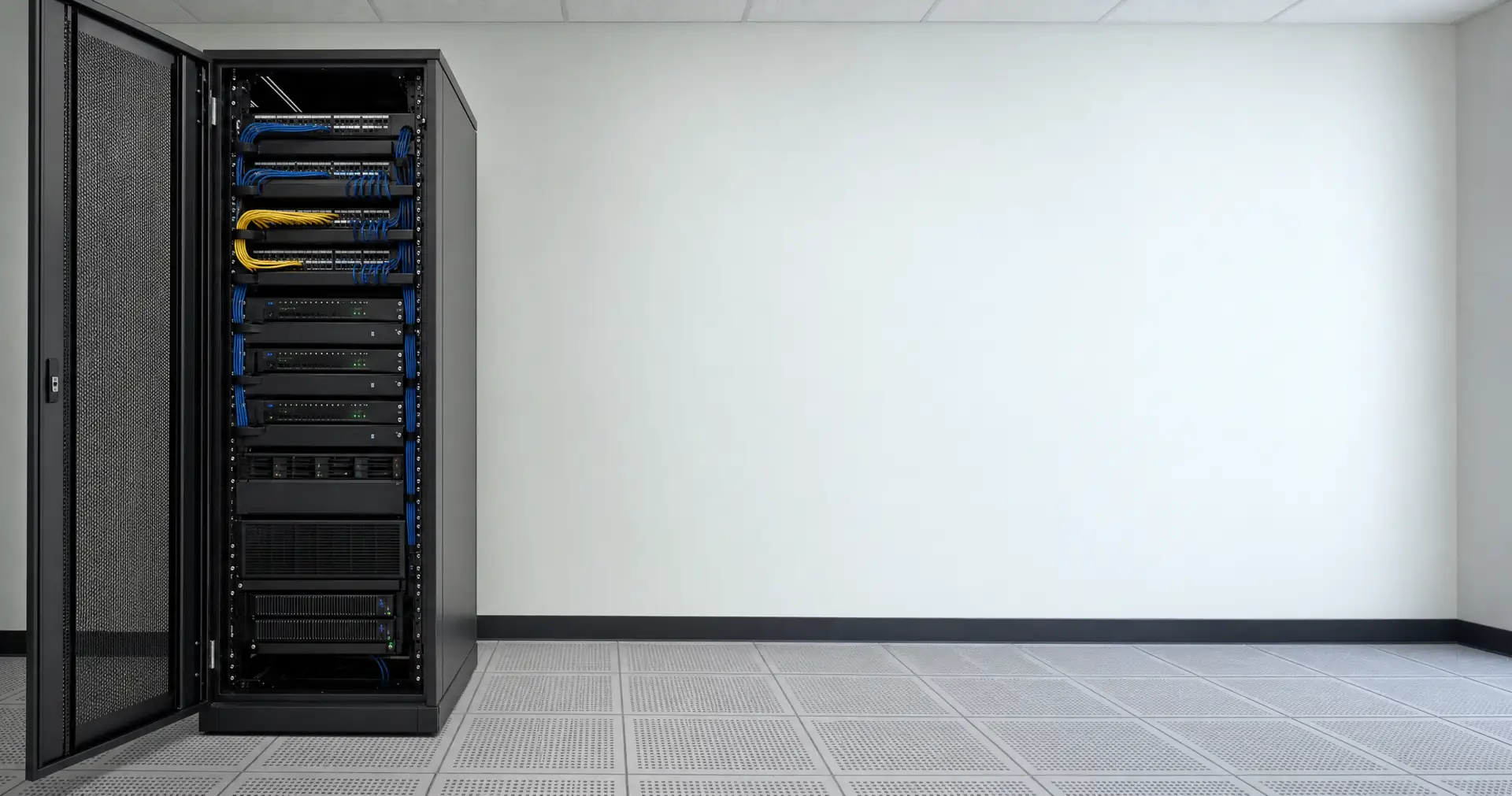
Server and network infrastructure finance for New Zealand on-premises and hybrid environments .
Server, network, and security infrastructure finance covers the on-premises kit that powers NZ businesses still running hybrid or fully on-prem environments. Build sizes commonly $10,000 to $200,000, with supplier captive leasing from HPE Financial Services and Cisco Capital alongside generic NZ asset finance.
What you need to know about NZ server and network infrastructure finance.
→Server build (Dell PowerEdge, HPE ProLiant) commonly $10K to $80K Typical 1U or 2U rack servers for NZ SME on-premises and hybrid environments, with redundancy and licensing pushing the higher end of the band.
→Network and security stack commonly $15K to $80K Cisco, Juniper, or Aruba switches; Palo Alto, Fortinet, or SonicWall firewalls; structured cabling and rack fitout sit alongside the server build.
→IRD applies 40% diminishing-value to IT equipment Server, network, and security infrastructure is typically depreciated under IT equipment categories on the IRD asset depreciation schedule, with a 5 to 7 year refresh cycle being typical in NZ SME environments.
→Supplier captive leasing available from HPE and Cisco HPE Financial Services and Cisco Capital run captive leasing programmes in NZ that bundle hardware, refresh, and support across the infrastructure stack. Generic asset financiers cover the wider supplier mix.
The landscape
Network and server infrastructure finance is a longer-cycle, higher-redundancy build than end-user IT hardware.
New Zealand businesses running on-premises or hybrid infrastructure spend materially differently from those on pure cloud. The on-prem footprint commonly includes one or two rack servers (Dell PowerEdge, HPE ProLiant, Lenovo ThinkSystem, or Supermicro builds for cost-sensitive workloads), a network attached storage unit (Synology or QNAP for SME, NetApp or HPE Nimble for mid-market), a managed switch stack (Cisco Catalyst, Juniper EX, Aruba CX), a perimeter firewall (Palo Alto Networks, Fortinet FortiGate, SonicWall, Sophos), and structured cabling tying the building together. Refresh cycles run 5 to 7 years, materially longer than the 3 to 4 year refresh cycle seen on end-user laptops.
Two finance routes dominate. Generic asset finance from Spinach, Heartland Bank, or a major bank treats the infrastructure build as a chattel mortgage with the borrower owning the kit from settlement. Supplier-side captive leasing from HPE Financial Services and Cisco Capital bundles the hardware, refresh schedule, and sometimes manufacturer support into a per-month rental, with the supplier retaining ownership. Cisco Capital is particularly common for switch, router, and unified communications builds; HPE Financial Services covers ProLiant, Aruba, and Nimble alongside its broader infrastructure portfolio.
The IRD asset depreciation schedule typically applies a 40% diminishing-value rate to IT equipment, including servers, switches, firewalls, and NAS units. New Zealand's Cyber Security Strategy 2024 framework, published by the Department of the Prime Minister and Cabinet, and the GCSB National Cyber Security Centre (NCSC) provide the policy backdrop for sensitive-data businesses. Healthcare, legal, accounting, and financial services applications typically face a higher infrastructure expectation around redundancy, backup, and perimeter security, which lifts the build size and the case for an asset-finance facility rather than a one-off cash purchase.
Small server build
$10K to $40K
Mid-tier infrastructure build
$40K to $120K
Larger on-prem build
$120K to $200K+
Refresh cycle
5 to 7 years
Server and network scenarios
Four common NZ infrastructure finance scenarios.
Most server and network infrastructure applications fall into one of four patterns. Each pattern has a typical loan amount, structure, and lender pool.
New office network and server build
A growing NZ professional services firm or SME fitting out a new office with structured cabling, a managed switch stack, perimeter firewall, and one or two rack servers. Total project commonly $40,000 to $90,000 inclusive of cabling and licensing.
·Loan amount: $40K to $90K
·Term: 5 years
Server and storage refresh at end-of-life
Existing rack servers and NAS units approaching the 5 to 7 year refresh point being replaced with newer Dell PowerEdge, HPE ProLiant, or Synology kit. Often combined with hypervisor licensing renewal (VMware, Hyper-V, Proxmox) at the same time.
·Loan amount: $30K to $80K
·Term: 5 years
Perimeter security and firewall refresh
Replacement of an end-of-support perimeter firewall, switch stack, and wireless network with current Palo Alto, Fortinet, Cisco, or Aruba kit. Common where a sensitive-data business needs to meet a vendor security audit or insurance condition.
·Loan amount: $15K to $60K
·Term: 4 to 5 years
Cisco Capital or HPE supplier captive lease
Cisco Capital or HPE Financial Services bundling hardware plus manufacturer support (Cisco SmartNet, HPE Pointnext) into a per-month rental. The supplier retains ownership; the business expenses the rental and avoids end-of-life asset disposal complexity.
·Structure: Operating lease
·Term: 36 to 60 months
What server and network finance covers
Six common NZ server and network infrastructure loan purposes.
Server and network infrastructure lending volume in NZ falls into six common purposes. Each has a typical structure that fits.
Rack servers
Dell PowerEdge R-series, HPE ProLiant DL-series, Lenovo ThinkSystem, Supermicro builds. 1U or 2U rack form factors. Per-unit $8,000 to $40,000 depending on CPU, memory, and storage configuration.
Network attached storage (NAS)
Synology RackStation, QNAP, NetApp FAS, HPE Nimble, Dell PowerStore. Capacity commonly 16TB to 200TB raw with hardware RAID. Per-unit $5,000 to $50,000 depending on capacity and resilience tier.
Managed switches and routers
Cisco Catalyst, Cisco Meraki, Juniper EX, Aruba CX, Ubiquiti UniFi for cost-sensitive sites. Per-switch $1,500 to $15,000. Stacked switch builds for larger sites commonly $20,000+.
Firewalls and security appliances
Palo Alto Networks PA-series, Fortinet FortiGate, SonicWall, Sophos XGS, Cisco Firepower. Per-unit $3,000 to $40,000 depending on throughput, threat intelligence subscription, and SSL inspection capacity.
Structured cabling and rack fitout
Cat6A or fibre cabling, patch panels, server racks, rack PDUs, UPS units, environmental monitoring. NZ-based cabling specialists (Connetics, Datacom, Spark partners) commonly quote per-point. $5,000 to $40,000 per site.
Hypervisor and licensing
VMware vSphere, Microsoft Hyper-V Datacenter, Proxmox VE, Veeam Backup, Nakivo, plus Microsoft Server CALs. Licensing typically capitalised alongside the hardware build. $5,000 to $30,000 per build.
Tax, GST, and depreciation
How GST, IRD depreciation, and licensing typically work on infrastructure builds.
A GST-registered NZ business can typically claim the GST component on servers, NAS units, switches, firewalls, and structured cabling as input tax in the relevant GST return, subject to the accountant's confirmation. Where the infrastructure is acquired under chattel mortgage, the full GST is typically claimable upfront in the next GST return after settlement. Where it is acquired under finance lease or operating lease (for example via HPE Financial Services or Cisco Capital), GST is typically claimed across the rental payments. IRD commonly applies a 40% diminishing-value rate to IT equipment per the IRD asset depreciation schedule, including servers, switches, firewalls, and NAS units. Hypervisor and backup licensing (VMware, Hyper-V, Veeam) is commonly capitalised alongside the hardware where it forms part of the same project. Structured cabling is sometimes treated as a fitout improvement to the building rather than as IT equipment, with different depreciation treatment; the accountant is the right person to confirm structure choice and depreciation treatment on the specific business position.
Build component bands
Indicative NZ server and network infrastructure finance bands.
Component pricing varies by brand, spec, and reseller. The bands below are observed across the NZ commercial reseller and supplier captive channel in 2026.
Component category
Per-unit band
Typical build qty
Common term
Rack server (PowerEdge, ProLiant)
$8K to $40K
1 to 4 servers
5 years
NAS / storage array
$5K to $50K
1 to 2 units
5 years
Managed switch (Cisco, Aruba, Juniper)
$1.5K to $15K
2 to 8 switches
5 years
Firewall / security appliance
$3K to $40K
1 to 2 units
5 years
Structured cabling (per office floor)
$5K to $40K
1 to 3 floors
5 to 7 years
Hypervisor / backup licensing
$5K to $30K
Per build
5 years
Indicative bands only. Actual price depends on configuration, support tier, and reseller margin. Final rate, fee, and approval decisions are made by the lender after assessment.
Generic finance vs Cisco/HPE captive vs cash
Generic asset finance vs Cisco Capital or HPE Financial Services vs cash purchase.
The structure choice tracks build size, refresh discipline, and bundled-support preference. Owned infrastructure suits businesses keeping kit beyond a typical refresh; supplier captive lease suits businesses prioritising bundled manufacturer support and a structured refresh path.
Hardware returned to supplier under lease return programme
Borrower handles resale, recycling, or e-waste
Refresh discipline
Manual; borrower decides when to refresh
Built into lease; supplier provides new kit at term
Manual; commonly slips beyond useful life
Best fit
Mixed-vendor builds across server, NAS, switch, firewall
Cisco-heavy network or HPE-heavy compute and storage estates
Smaller builds with strong cash position
How it works
A typical NZ server and network infrastructure finance application.
Infrastructure finance applications commonly involve a managed services provider (MSP) or systems integrator alongside the lender, because the build itself is professional-services-led. Generic asset finance moves alongside a documented bill of materials.
01
Day 1 to 14
Define the infrastructure build with the MSP or integrator
A typical server and network build is scoped by a NZ MSP or systems integrator (Datacom, Spark Business, One NZ Business partners, or local specialists) against the business's redundancy, capacity, and security requirements. The output is a documented bill of materials that the lender uses as the basis of the loan amount.
Documents commonly required
·MSP or integrator bill of materials
·Network and rack diagram
·Hypervisor and licensing schedule
·Site readiness assessment
02
Day 5 to 14
Submit application with the standard SME pack
Beyond the standard SME application pack, infrastructure finance lenders ask for the bill of materials, the MSP or integrator engagement letter, and (for supplier captive lease) the supplier-issued lease quote. Generic asset financiers rely on standard trading data; supplier captive lease applications run through the Cisco Capital or HPE Financial Services finance team.
Documents commonly required
·NZBN, business owner ID
·Last 6 months business bank statements
·Last 12 months management accounts
·MSP or integrator bill of materials
·Supplier captive lease quote (where applicable)
·Insurance quote covering the new infrastructure
03
Day 7 to 21
Lender or supplier assessment and offer
Generic asset financiers assess against trading data, the bill of materials, and the resale value of the hardware. Supplier captive lease providers (Cisco Capital, HPE Financial Services) assess against credit bureau data, the supplier-channel relationship, and the bundled support tier selected. Offers commonly come back with conditions: deposit on larger builds, additional security on first-time SME applications, or staged drawdowns tied to MSP delivery milestones.
04
Week 3 to week 8
Settle, deploy, register PPSR (where applicable)
Generic asset finance settles to the reseller and the MSP under the bill of materials; the lender registers a security interest on the Personal Property Securities Register (PPSR). Supplier captive lease delivery moves through the Cisco or HPE shipping and configuration channel without a PPSR security interest because the supplier retains ownership. Cabling and rack fitout, server commissioning, hypervisor build, network configuration, firewall hardening, and backup deployment commonly run over 2 to 6 weeks before handover into production.
A NZ MSP or systems integrator familiar with the lender pool (Datacom, Spark Business, One NZ Business partner network, or local specialists) commonly orchestrates the bill of materials, the supplier captive lease quote where applicable, and the imaging and deployment programme alongside the finance application.
Worked scenarios
Three NZ server and network infrastructure finance scenarios.
Real-world structures across a Wellington legal firm new-office build, an Auckland health-services data-room refresh, and a Christchurch manufacturer Cisco Capital lease. Each illustrates how build size, sensitive-data overlay, and supplier captive availability shift the offered structure.
Lambton Quay legal practice, 35-person new office
Wellington legal firm new-office network and server build
A Lambton Quay legal practice fitting out a new office building with structured cabling, a managed Cisco Catalyst switch stack, a Palo Alto PA-1410 firewall, two HPE ProLiant DL360 rack servers running VMware vSphere, and a Synology RackStation NAS. Total project $98,000 ex-GST: $42,000 servers and NAS, $18,000 switches and firewall, $24,000 structured cabling and rack fitout, $14,000 hypervisor licensing, Veeam Backup, and Microsoft Server CALs.
Structure agreed with Heartland Bank: chattel mortgage on the full build ($98,000, 60-month term, indicative 9-11% p.a.). Full GST claimable in the next GST return after settlement, subject to the accountant's confirmation. IRD depreciation on IT equipment commonly applies a 40% diminishing-value rate per the IRD asset depreciation schedule. Structured cabling treated as a fitout improvement and depreciated on a different schedule.
PPSR security interest registered against the build by Heartland Bank at settlement. Local NZ MSP delivered the build over 5 weeks: structured cabling first, then rack fitout, server commissioning, network and firewall configuration, hypervisor build, and Veeam Backup deployment. New office operational with cutover from the legacy site over a single weekend.
A Newmarket health-services provider refreshing an end-of-support 7-year-old infrastructure stack to meet a vendor security audit and continued PHI (personal health information) handling requirements under the Health Information Privacy Code 2020. Total project $145,000 ex-GST: $58,000 across 3 Dell PowerEdge R750 servers, $32,000 NetApp FAS storage, $22,000 Cisco Catalyst switch stack and Cisco Meraki wireless, $18,000 Fortinet FortiGate firewall pair with high-availability, $15,000 Veeam Backup, VMware vSphere, and Windows Server licensing.
Structure agreed with Spinach (NZ asset financier): chattel mortgage on the full build ($145,000, 60-month term, indicative 10-12% p.a.). Full GST claimable in the next GST return after settlement, subject to the accountant's confirmation. The health-services overlay (sensitive-data handling, audit logging, encryption-at-rest, immutable backup) supported the higher capex on redundant components and the FortiGate HA pair.
PPSR security interest registered against the build by Spinach at settlement. NZ MSP managed the cutover over 4 weekends to maintain continuity of clinical operations. New stack operational with the legacy hardware decommissioned and securely wiped per GCSB NCSC guidance for sensitive-data disposal. New Zealand's Cyber Security Strategy 2024 framework and the Health Information Privacy Code 2020 sat in the background as the reference framework for the build specification.
Christchurch manufacturer Cisco Capital captive lease
A Riccarton manufacturer with a heavily Cisco-standard network refreshing the switch stack, wireless network, and unified communications platform across a 4,000 sqm factory and office combined. Total project $112,000 ex-GST: $58,000 Cisco Catalyst 9300 switch stack across the factory and office, $22,000 Cisco Meraki wireless, $18,000 Cisco Webex unified communications, $14,000 cabling and rack updates.
Structure agreed via Cisco Capital (supplier captive lease) over a 60-month term, bundling Cisco SmartNet 24x7x4 across the entire network for the lease life. Monthly rental approximately $2,500 ex-GST against an indicative blended cost equivalent to 8-10% per annum, with no upfront GST claim because the network is leased rather than owned. Cisco SmartNet provides 4-hour parts replacement on the factory switches, supporting continuous-operation production lines.
Existing 7-year-old Cisco kit returned to Cisco Capital under the lease return programme. New network deployed by a Cisco Gold Partner MSP over 3 weeks of phased cutover. The manufacturer considered chattel mortgage with Heartland Bank as an alternative; Cisco Capital was selected for the bundled SmartNet support and the structured 5-year refresh path matching the factory-floor production cycle.
Indicative figures
Total project
$112,000
Switches and wireless
$80,000
Monthly rental
$2,500 ex-GST
Indicative equivalent rate
8-10% p.a.
NZ server and network infrastructure finance options
Lenders and supplier programmes that fund NZ infrastructure builds well.
Several NZ asset financiers and supplier captive programmes carry familiarity with the server, network, and security infrastructure finance segment. The shortlist below is editorial.
PHI handling rules relevant to NZ health-services infrastructure builds and security baseline.
FAQ
Server and network infrastructure finance, NZ small-business questions answered
What is server and network infrastructure finance in NZ?
Server and network infrastructure finance covers asset-backed lending or leasing for on-premises and hybrid IT infrastructure used by NZ businesses, including rack servers (Dell PowerEdge, HPE ProLiant), network attached storage (Synology, QNAP, NetApp), managed switches (Cisco, Aruba, Juniper), perimeter firewalls (Palo Alto, Fortinet, SonicWall), structured cabling, and hypervisor and backup licensing. The two main routes are generic asset finance (Spinach, Heartland Bank, ANZ business banking) and supplier captive leasing (HPE Financial Services, Cisco Capital).
How much does a typical NZ on-premises infrastructure build cost in 2026?
A small NZ SME server and network build commonly runs $10,000 to $40,000, covering one rack server, a NAS unit, a small switch stack, and a perimeter firewall. A mid-tier infrastructure build for a 25 to 75 person firm commonly runs $40,000 to $120,000 with redundant servers, a managed switch stack, a firewall pair, structured cabling, and hypervisor licensing. Larger on-prem builds for 100+ person firms or sensitive-data environments commonly run $120,000 to $200,000 or more, with redundancy, high-availability firewalls, and tiered storage.
How does the IRD 40% diminishing-value rate apply to servers and network equipment?
IRD commonly applies a 40% diminishing-value rate to IT equipment per the IRD asset depreciation schedule, which typically captures rack servers, NAS units, managed switches, firewalls, and similar infrastructure. Structured cabling is sometimes treated as a fitout improvement to the building rather than as IT equipment, with a different (typically slower) depreciation rate. Hypervisor and backup licensing is sometimes capitalised alongside the hardware where it forms part of the same project, and sometimes expensed where it is subscription-based. The accountant is the right person to confirm the treatment for the specific build.
Can GST be claimed on a server build under chattel mortgage?
A GST-registered NZ business can typically claim the GST component on servers, NAS units, switches, firewalls, and structured cabling as input tax in the relevant GST return, subject to the accountant's confirmation. Where the infrastructure is acquired under chattel mortgage (for example via Spinach or Heartland Bank), the full GST is typically claimable upfront in the next GST return after settlement. Where it is acquired under finance lease or operating lease (HPE Financial Services or Cisco Capital captive lease), GST is typically claimed across the rental payments rather than upfront.
What rate range applies to NZ server and network infrastructure finance in 2026?
Indicative rates on generic asset finance for server and network infrastructure builds commonly sit in the 9% to 13% per annum band depending on structure, security, and trading history. Established firms with multi-year trading and standard mainstream hardware sit at the lower end (commonly 9-11%). Larger or sensitive-data builds sit in the middle (commonly 10-12%). First-time SME applications or builds with thinner resale pools sit higher. Supplier captive lease (HPE Financial Services, Cisco Capital) is priced as a per-month rental rather than a stated rate, with the indicative equivalent commonly sitting in the 7-10% band when bundled support is factored in.
What is the typical loan term for a server and network infrastructure build?
NZ server and network infrastructure finance commonly runs a 5-year term, matching the typical 5 to 7 year refresh cycle for on-prem hardware. Smaller builds (perimeter firewall refresh, switch stack replacement) sometimes run 4-year terms reflecting shorter cycles on perimeter security and access network refreshes. Supplier captive leases (HPE Financial Services, Cisco Capital) commonly run 36 or 60 months, aligning the rental term with the bundled support cycle and the structured refresh path. Structured cabling (where treated as fitout) sometimes carries a longer term reflecting longer useful life.
How does Cisco Capital or HPE Financial Services compare to a generic NZ asset finance lender?
Cisco Capital and HPE Financial Services run supplier captive leasing programmes that bundle hardware with manufacturer support (Cisco SmartNet, HPE Pointnext) and a structured refresh path. The borrower expenses the per-month rental rather than depreciating the asset, the supplier retains ownership, and end-of-life disposal is handled by the supplier under the lease return programme. Generic NZ asset financiers (Spinach, Heartland Bank, ANZ) finance the build under chattel mortgage, with the borrower owning the asset, claiming GST upfront, depreciating on the IRD schedule, and handling end-of-life disposal. The right structure depends on the business position and refresh discipline preference.
Which NZ resellers, MSPs, and integrators typically deliver the build?
NZ MSPs and systems integrators active in the server and network infrastructure space include Datacom (largest NZ-owned IT services provider), Spark Business and One NZ Business partner networks, Theta, Lateral, Computer Concepts, Quanza, plus a wider pool of regional MSPs. Apple-centric SaaS and creative environments commonly use Cyclone for adjacent end-user fleet refresh. The MSP or integrator commonly issues the bill of materials, coordinates the supplier captive lease quote (where applicable), and delivers the build over 2 to 6 weeks. Some lenders ask which MSP is engaged as part of the application risk assessment.
How does endpoint security and the Cyber Security Strategy 2024 affect the build?
New Zealand's Cyber Security Strategy 2024 framework, published by the Department of the Prime Minister and Cabinet, and ongoing GCSB National Cyber Security Centre (NCSC) advisories sit in the background for NZ infrastructure builds, particularly for sensitive-data businesses (legal, accounting, healthcare, financial services). NCSC advisories on supply-chain assurance, perimeter hardening, and incident reporting commonly inform the build specification, and the Privacy Act 2020 plus the Health Information Privacy Code 2020 set the baseline for sensitive-data handling. Lenders sometimes ask about endpoint and perimeter security as part of the risk assessment for sensitive-data businesses.
What happens to financed infrastructure if the business closes or relocates?
Where the infrastructure is financed under chattel mortgage and the business closes before the loan is repaid, the lender typically has a security interest registered on the Personal Property Securities Register (PPSR) and can take possession of the hardware to recover the outstanding balance. NZ business infrastructure typically retains 20-40% of original value over a 5-year hold period depending on brand, condition, and resale market depth; mainstream Cisco, HPE, and Dell hardware commonly retains value better than niche or end-of-life specialist kit. Where the build is on supplier captive lease, the hardware returns to the supplier under the lease return programme; early-termination fees may apply.
Can structured cabling be financed alongside the server and network kit?
Yes, but the cabling treatment depends on whether it is treated as IT equipment or as a fitout improvement to the building. Where the cabling is removable and treated as IT equipment, it is commonly depreciated on the same schedule as servers and switches. Where it is treated as a fitout improvement (in-wall structured cabling permanently installed in a building), it is sometimes depreciated on a slower schedule or treated as building improvement capex. Many NZ businesses split the build: removable IT equipment under chattel mortgage on a 5-year schedule, and structured cabling under building fitout on a longer schedule. The accountant is the right person to confirm the treatment.
How does the build differ for a healthcare, legal, or accounting business?
Sensitive-data businesses (healthcare under the Health Information Privacy Code 2020, legal under fiduciary duties, accounting under client confidentiality, financial services under FMA expectations) commonly run higher-redundancy infrastructure with paired firewalls in high-availability, encrypted-at-rest storage, immutable backup, audit logging, and tighter perimeter security. The build size is materially higher than a non-sensitive-data SME of the same headcount. Lenders sometimes ask about the sensitive-data overlay as part of the application risk assessment because the higher build size and longer refresh cycle support a longer-term loan.
Is hyper-converged infrastructure financed differently to traditional server and SAN builds?
Hyper-converged infrastructure (HCI) such as Nutanix, VMware vSAN, Dell VxRail, or HPE SimpliVity bundles compute, storage, and virtualisation into a single appliance pool, which simplifies the bill of materials but commonly carries higher per-unit capex than the traditional separate server plus SAN approach. NZ lenders treat HCI similarly to traditional infrastructure under chattel mortgage; the resale value of HCI hardware is typically lower than separate server and SAN components, which can affect the loan-to-value position on larger builds. Supplier captive lease through HPE Financial Services is common where the HCI vendor is HPE.
What does the application timeline look like for a $100,000 infrastructure build?
A $100,000 NZ infrastructure build commonly runs 8 to 14 weeks from initial scoping to production handover. Bill of materials and MSP scoping run 1 to 2 weeks. Lender or supplier captive lease application and assessment run 1 to 3 weeks. Hardware delivery from the supplier or reseller runs 2 to 4 weeks depending on stock and configuration. Cabling, rack fitout, server commissioning, hypervisor build, network and firewall configuration, and backup deployment commonly run 2 to 6 weeks of MSP delivery time. Cutover from the legacy environment commonly runs over a single weekend or in phased weekend cutovers.
Indicative content only. Not personalised financial advice.
A business loan is a commitment that runs for months or years, and repayments come out of the same operating cash flow as everything else. Before committing, it is worth modelling the weekly and monthly cost against the business's working-capital position, which is what this site is built to help with. Borrowing at a level that stays comfortable through a quiet quarter, not just a strong one, is widely regarded as the safer frame.
What this site is
A calculator and information tool. Not a lender, not a broker, not a registered financial adviser. Nothing here is personalised financial advice.
What the figures show
Modelled estimates based on the inputs you enter. Not a quote. Not an offer of credit. Not a guarantee of approval, rate, or fees.
What the lender decides
Final rates, fees, and approval are set by the lender after a CCCFA-appropriate assessment of the applicant's circumstances and credit decision.
Commercial disclosure
Businessloans.org.nz earns a commission from Prospa when a visitor applies through this site and their application is approved. The commission is paid by Prospa, not by the borrower, and it does not influence the rate Prospa offers. Full disclosure on the partner page.
Tax, GST, and accountant framing
Tax-treatment statements (GST claim timing, interest deductibility, depreciation rates) are general in nature and subject to your accountant's confirmation on the specific business position. For material amounts, professional advice from a registered financial adviser or chartered accountant is widely regarded as the safer frame.