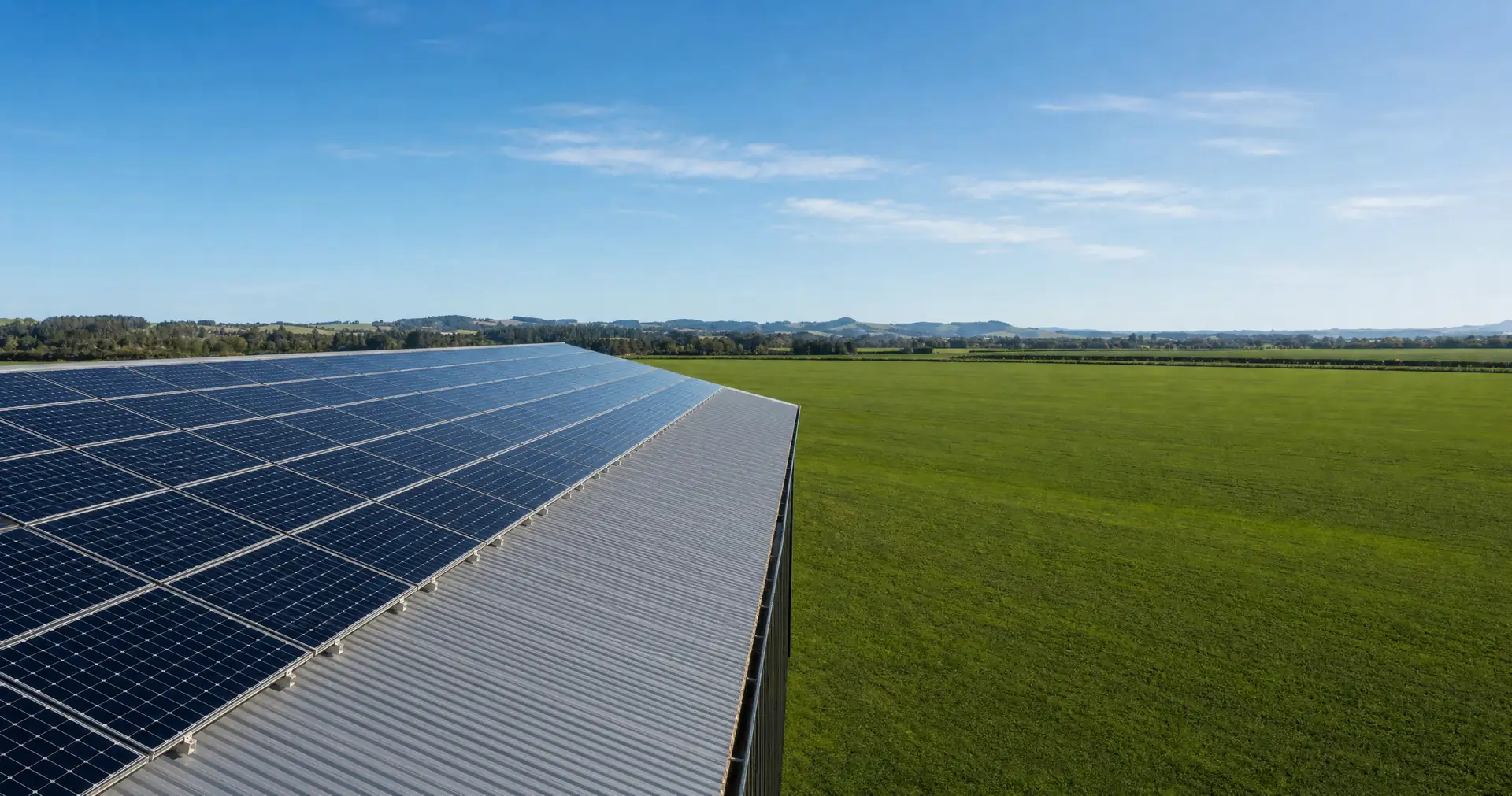
Solar panel and battery finance for New Zealand commercial PV and storage projects .
Commercial solar PV and battery storage finance in NZ runs through two distinct lender pools. Bank green-loan programmes (ANZ Business Green Loan, Westpac Sustainable Business Loan, Kiwibank Sustainable Business Loan, BNZ green-loan adjacent) carry concessional features for qualifying installs. Specialist asset financiers cover the broader equipment-finance route at standard pricing. AS/NZS 4777 grid-connected inverter and AS/NZS 5139 battery standards apply, with EWRB-certified installers required under the Electricity Act 1992.
What you need to know about NZ commercial solar PV and battery finance.
→Commercial install commonly $30K to $500K A small rooftop array on a single-shed business sits at the lower band; a large rooftop or carpark-canopy install on a distribution centre sits at the upper band. Battery storage adds $20K to $200K depending on capacity.
→Bank green-loan programmes carry concessional features ANZ Business Green Loan up to $3 million, Westpac Sustainable Business Loan, BNZ green-loan adjacent, and Kiwibank Sustainable Business Loan publish qualifying-asset criteria with indicative discounts off standard business rates.
→AS/NZS 4777 and AS/NZS 5139 apply Grid-connected inverter installs follow AS/NZS 4777; battery storage systems follow AS/NZS 5139. Installers hold EWRB practising registration under the Electricity Act 1992.
→EECA EnergyWise and ETS context EECA publishes commercial energy-efficiency programmes, business-case templates, and case studies. The Emissions Trading Scheme administered by EPA NZ recognises commercial PV generation in scope where it offsets eligible emissions.
The landscape
Commercial solar finance in NZ has moved into the bank green-loan pool over the last 5 years.
Commercial rooftop solar PV in New Zealand has grown materially since the mid-2010s as panel and inverter costs fell and bank green-loan programmes opened concessional features for qualifying assets. EECA EnergyWise publishes business-case context, and the Energy Efficiency and Conservation Authority maintains commercial case studies covering refrigerated warehousing, manufacturing sheds, and primary-sector cool stores running rooftop PV with grid export. The Electricity Authority publishes generation-data context, and Stats NZ environmental-economic accounts track installed renewables capacity.
Two lender pools commonly fund commercial PV. The bank green-loan pool prices below standard business rates for qualifying assets and is the dominant route where the borrower banks with ANZ, Westpac, BNZ, or Kiwibank and the install meets the published asset-eligibility criteria. The ANZ Business Green Loan (up to $3 million) and the Westpac Sustainable Business Loan are the most-commonly cited published programmes; the Kiwibank Sustainable Business Loan and the BNZ green-loan adjacent products complete the major-bank tier. Specialist asset financiers (UDC Finance, Heartland Bank, Avanti Finance, Prospa) cover the standard-priced equipment-finance route where the borrower sits outside the green-loan eligibility frame.
The regulatory overlay is meaningful. AS/NZS 4777 sets the standard for grid-connected inverter installs; AS/NZS 5139 sets the standard for battery storage systems including residential-and-commercial lithium-ion. Installers hold EWRB (Electrical Workers Registration Board) practising registration under the Electricity Act 1992, with grid-connect installer credentials commonly held alongside. The Sustainable Electricity Association NZ (SEANZ) operates an installer accreditation pathway widely used by NZ solar installers. Lenders commonly request the installer EWRB registration evidence and the AS/NZS 4777 commissioning paperwork as part of the file.
Small commercial install
$30K to $80K
Mid commercial install
$80K to $250K
Large commercial install
$250K to $500K
Common term
5 to 7 years
Commercial solar scenarios
Four common NZ commercial solar PV and battery finance scenarios.
Most commercial solar finance applications fall into one of four patterns. Each pattern has a typical install size, structure, and lender pool.
Small workshop or cafe rooftop array
A single-shed business (cafe, automotive workshop, small manufacturer) installing a 15 kW to 30 kW rooftop array. Total project commonly $30K to $80K. Bank green-loan or standard equipment-finance term loan over 5 to 7 years. Battery rarely added at this scale.
·Loan amount: $30K to $80K
·Term: 5 to 7 years
Mid-size factory or warehouse install
A factory or warehouse of 1,000 to 3,000 sqm installing a 50 kW to 150 kW rooftop array. Total project commonly $80K to $250K. Bank green-loan tier dominant where the borrower banks with ANZ, Westpac, BNZ, or Kiwibank.
·Loan amount: $80K to $250K
·Term: 6 to 7 years
Large distribution centre or canopy install
A distribution centre or carpark-canopy install at 200 kW to 500 kW. Total project commonly $250K to $500K. ANZ Business Green Loan up to $3 million dominant at this scale where eligibility is met. Battery storage commonly added (50 to 200 kWh).
·Loan amount: $250K to $500K
·Term: 7 years
PV plus battery storage retrofit
Existing rooftop PV array adding battery storage to capture peak-period self-consumption or grid-arbitrage opportunity. Battery sizing 30 kWh to 200 kWh. Asset finance on the battery and inverter upgrade where green-loan eligibility is partial.
·Loan amount: $40K to $200K
·Structure: Asset finance or green loan
What commercial solar borrowers fund
Six common NZ commercial solar finance purposes.
Commercial PV and battery finance volume falls into six common purposes. Each has a typical structure that fits.
PV panels and mounting
Tier-1 panels (Trina, Jinko, LG, REC), rooftop or carpark-canopy mounting, DC cabling, isolators. Asset finance or bank green-loan tier. Commonly the largest cost component on a commercial install.
Inverters and grid-connect kit
Fronius, SMA, Enphase, Sungrow inverters. AS/NZS 4777 commissioning paperwork mandatory. Installer EWRB grid-connect credentials confirmed at commissioning. String, central, or microinverter topology depending on roof shading and array size.
Battery storage
Tesla Powerwall, BYD, Pylontech, sonnenBatterie battery systems. AS/NZS 5139 commissioning. Sized for self-consumption shifting or peak-shaving. $20K to $200K depending on kWh and topology (AC- or DC-coupled).
Roof structural reinforcement
Older shed roofs sometimes need purlin reinforcement to carry the array load. Builder or structural engineer cost commonly bundled into the install loan as a pre-install line item. $5K to $30K typical.
EWRB commissioning and inspection
EWRB-certified electrician commissioning, AS/NZS 4777 sign-off, lines-company connection paperwork, smart-meter exchange. Often charged as a fixed fee per install. $2K to $8K commonly bundled into the project finance.
Working-capital top-up during install
A short revolving facility covering progress payments to the installer (commonly 30% on order, 30% on rough-in, 40% on commissioning). Repaid out of the term loan at final commissioning.
Tax, GST, and ETS
How GST, depreciation, and the Emissions Trading Scheme typically work on commercial solar.
A GST-registered NZ business can typically claim the GST component on a commercial solar PV array, battery storage, inverter, and structural reinforcement as input tax in the relevant GST return, subject to the accountant's confirmation. Where the install is acquired under chattel mortgage or term loan, the full GST is typically claimable upfront in the next GST return after settlement. Where it is acquired under finance lease, GST is typically claimed across the rental payments. IRD depreciation rates for commercial solar PV systems and batteries are published in the IRD asset-class schedules; the accountant is the right person to confirm the specific class and rate. The Emissions Trading Scheme (ETS), administered by the Environmental Protection Authority (EPA NZ), recognises emissions reductions from commercial PV that offsets eligible scope-1 or scope-2 emissions; commercial-credit revenue treatment under the ETS is a topic the accountant typically handles alongside the install accounting. EECA publishes business-case templates that frame the indicative payback alongside the finance treatment.
Commercial PV and battery bands
Indicative NZ commercial solar PV and battery finance bands.
Pricing varies by panel tier, inverter topology, roof access, and structural condition. The bands below are observed across the NZ commercial PV finance pool in 2026.
Install size
Indicative all-in cost
Battery option
Common term
Small (10 to 30 kW rooftop)
$30K to $80K
$15K to $40K (10 to 25 kWh)
5 to 7 years
Mid (30 to 100 kW rooftop)
$80K to $250K
$40K to $120K (25 to 80 kWh)
6 to 7 years
Large (100 to 300 kW rooftop)
$200K to $450K
$80K to $200K (50 to 150 kWh)
7 years
Carpark canopy or large industrial (300 kW+)
$400K to $1M+
$150K to $400K (100 kWh+)
7 years
Battery-only retrofit (existing PV)
N/A (PV in place)
$30K to $200K
5 to 7 years
Inverter-only replacement
$8K to $40K
N/A
3 to 5 years
Indicative bands only. Actual cost depends on panel and inverter brand, mounting complexity, roof condition, and installer. Final rate, fee, and approval decisions are made by the lender after assessment.
Bank green loan vs asset finance vs operating lease
ANZ / Westpac / Kiwibank green loan vs UDC / Heartland asset finance vs solar operating lease.
The structure choice tracks borrower banking relationship, install eligibility, balance-sheet preference, and willingness to retain ownership. Each pattern shapes the lender file differently.
Feature
Bank green loan (ANZ Good Energy / Westpac Sustainable / Kiwibank)
Specialist asset finance (UDC, Heartland, Avanti)
Solar operating lease / PPA
Typical loan amount
$30K to $3M (ANZ Business Green Loan ceiling)
$30K to $500K
$50K to $500K (lease term, no purchase)
Indicative pricing position
Concessional discount off standard business rate
Standard equipment-finance pricing
Lease pricing reflects lessor cost of capital plus margin
Eligibility test
Asset must meet bank's qualifying-asset criteria
Standard SME credit assessment
Lessor underwrites the offtaker; install owned by lessor
GST upfront claim
Yes, full GST in next return
Yes, full GST in next return
No, claimed across rental payments
Ownership at end of term
Borrower owns from settlement
Borrower owns from settlement
Lessor retains; option to buy commonly available
AS/NZS 4777 / 5139 evidence required
Yes, at commissioning
Yes, at commissioning
Yes, lessor commissions and retains
EWRB installer registration evidence
Yes
Yes
Yes (lessor responsibility)
How it works
A typical NZ commercial solar PV and battery finance application.
Solar finance applications carry an installer-credentials and standards-compliance step that generic equipment finance does not. Bank green-loan applications add an asset-eligibility step against the published criteria.
01
Day 1 to 14
Define the install scope and select the installer
A typical commercial PV loan combines a term loan or chattel-mortgage-style structure on the panels and inverter with optional asset finance on the battery storage. Installer selection is commonly from the SEANZ-accredited pool (Skysolar, Harrisons Solar, Solarcity, and others); the installer's EWRB practising registration and grid-connect installer credentials are confirmed at this stage.
Documents commonly required
·Installer quote with itemised panel, inverter, mounting, and commissioning lines
·Battery quote (where applicable)
·AS/NZS 4777 commissioning scope letter
·Roof structural assessment (older sheds)
02
Day 7 to 21
Submit application with solar-specific documents
Beyond the standard SME application pack, commercial PV lenders ask for the installer EWRB registration evidence, the AS/NZS 4777 commissioning scope (and AS/NZS 5139 where battery storage is included), the lines-company connection paperwork, and an EECA business-case or payback projection where one has been prepared. Bank green-loan applications add an asset-eligibility check against the published qualifying-asset criteria for the relevant programme (ANZ Business Green Loan, Westpac Sustainable Business Loan, BNZ green loan, Kiwibank Sustainable Business Loan).
Documents commonly required
·NZBN, business owner ID
·Last 12 months business bank statements
·Last 1 to 2 years financial statements
·Installer EWRB registration evidence
·AS/NZS 4777 commissioning scope (and AS/NZS 5139 for battery)
·Lines-company connection paperwork
·EECA business-case or payback projection (where prepared)
·Roof structural assessment (older sheds)
·Insurance quote
03
Day 14 to 28
Lender assessment and offer
Lenders assess against three things: the borrower trading data and serviceability, the install eligibility against any green-loan asset criteria, and the installer credentials and standards-compliance scope. Offers commonly come back with conditions: deposit size, AS/NZS 4777 sign-off as a settlement condition, and progress-payment scheduling tied to installer milestones (commonly 30% on order, 30% on rough-in, 40% on commissioning).
04
Week 4 onward
Settle, commission, and lodge ETS treatment
Asset finance settles directly to the installer in the staged-payment pattern. The lender registers a security interest on the Personal Property Securities Register (PPSR) where the structure includes specific asset security. AS/NZS 4777 commissioning sign-off and lines-company connection paperwork are completed at final commissioning. Smart-meter exchange (where required) is coordinated with the lines company. Where the install offsets eligible ETS-scope emissions, commercial-credit treatment under the Emissions Trading Scheme is lodged with the accountant's involvement at year-end.
Borrowers banking with ANZ, Westpac, BNZ, or Kiwibank commonly start with the green-loan programme application because the published concessional features price below standard equipment finance for qualifying assets. Applications outside the eligibility frame typically place with UDC, Heartland, Avanti, or a vetted SME finance partner instead.
Worked scenarios
Three NZ commercial solar PV and battery finance scenarios.
Real-world structures across small workshop install, mid-size warehouse install, and large distribution centre install with battery storage. Each illustrates how install size, banking relationship, and battery scope shift the indicative offered rate.
Owner-operator workshop, 25 kW rooftop array
Christchurch automotive workshop rooftop install
A Christchurch automotive workshop with 8 years of trading installing a 25 kW rooftop array on the existing shed. Total project $62,000 ex-GST: $48,000 panels and inverter (Fronius), $6,000 mounting and DC cabling, $4,000 EWRB commissioning and AS/NZS 4777 sign-off, $4,000 smart-meter exchange and lines-company connection. Installer selected from the SEANZ-accredited pool. 15% deposit from cash reserves.
Structure agreed with the borrower's primary bank under the Westpac Sustainable Business Loan programme. Term loan ($52,700 after deposit, 6-year term, indicative 7-9% p.a. with the published green-loan discount applied). Roof structural assessment confirmed the existing purlins carried the load with no reinforcement. Quote staged in the standard 30/30/40 pattern.
AS/NZS 4777 commissioning sign-off completed at week 6. Lines-company connection paperwork lodged the same week. PPSR security interest registered against the inverter and battery system. Westpac Sustainable Business Loan funded the project. EECA business-case templates referenced for the payback projection.
Indicative figures
Total project
$62,000
Panels and inverter
$48,000
Term loan after deposit
$52,700
Indicative rate
7-9% p.a.
Established manufacturer, 100 kW rooftop array
Hamilton manufacturing shed mid-size install
A Hamilton light-engineering manufacturer with 12 years of trading installing a 100 kW rooftop array across the main fabrication shed. Total project $185,000 ex-GST: $145,000 panels and inverters (Trina panels, SMA inverters), $18,000 mounting and DC cabling, $12,000 EWRB commissioning and AS/NZS 4777 sign-off, $10,000 lines-company connection and smart-meter upgrade. SEANZ-accredited installer. 20% deposit from existing trading.
Structure agreed under the ANZ Business Green Loan programme: term loan ($148,000 after deposit, 7-year term, indicative 7-8% p.a. with the published Good Energy discount applied). Roof structural assessment confirmed minor purlin reinforcement on a quarter of the array footprint, costed at $8,000 and bundled into the project line items.
AS/NZS 4777 commissioning sign-off completed at week 9. PPSR security interest registered against the inverter set. Lines-company connection completed alongside the smart-meter upgrade. ANZ Business Green Loan funded the project under the published asset-eligibility criteria. EECA case study referenced for the indicative payback.
Indicative figures
Total project
$185,000
Panels and inverters
$145,000
Term loan after deposit
$148,000
Indicative rate
7-8% p.a.
Large distribution centre, 300 kW PV with 150 kWh battery
Auckland distribution centre PV plus battery
An Auckland distribution-centre operator with 20 years of trading installing a 300 kW rooftop array plus a 150 kWh battery storage system to capture peak-period self-consumption and reduce demand charges. Total project $480,000 ex-GST: $290,000 panels and inverters (Trina panels, Sungrow inverters), $130,000 battery storage (BYD, AC-coupled), $30,000 mounting and DC/AC cabling, $18,000 EWRB and AS/NZS 4777 / 5139 commissioning, $12,000 lines-company connection and demand-response integration. 20% deposit from existing trading.
Structure agreed under the ANZ Business Green Loan programme (ceiling $3 million, well within scope): term loan ($384,000 after deposit, 7-year term, indicative 7-8% p.a. with the Good Energy discount applied). The battery component required AS/NZS 5139 commissioning evidence in addition to AS/NZS 4777 for the inverter set.
AS/NZS 4777 and AS/NZS 5139 commissioning sign-off completed at week 14. PPSR security interest registered against the inverter set and battery system. Lines-company connection and demand-response integration completed alongside. ANZ Business Green Loan funded the project. ETS commercial-credit treatment lodged with the accountant at the next year-end. EECA case study referenced for the demand-charge reduction projection.
Indicative figures
Total project
$480,000
PV array
$290,000
Battery storage
$130,000
Indicative rate
7-8% p.a.
NZ commercial solar lenders
Lenders that fund NZ commercial solar PV and battery projects well.
Several NZ lenders carry deep familiarity with the commercial solar finance segment. The shortlist below is editorial.
Indicative shortlist. Final rate, fee, and approval decisions are made by each lender after assessment. Bank green-loan programmes carry their own qualifying-asset criteria published on each lender's programme page.
Where commercial solar finance fits
When commercial solar finance is straightforward, and when it gets harder.
Where it works smoothly
·Borrower banks with ANZ, Westpac, BNZ, or Kiwibank with the install meeting the published green-loan asset-eligibility criteria
·SEANZ-accredited installer with current EWRB practising registration and grid-connect installer credentials
·AS/NZS 4777 commissioning scope confirmed at quote stage; AS/NZS 5139 for battery installs
NZ generation and embedded-generation context relevant to commercial PV.
FAQ
Solar panel and battery finance, NZ small-business questions answered
How much does a commercial solar PV install cost in NZ?
Indicative NZ commercial solar PV installs commonly run $30,000 to $500,000 depending on array size, panel and inverter brand, mounting complexity, and roof condition. A small 15 to 30 kW rooftop array on a workshop or cafe shed sits at the lower band. A mid 50 to 100 kW install on a manufacturing shed or warehouse sits in the $80K to $250K range. A large 200 to 500 kW install on a distribution centre or carpark canopy sits at the upper band, with battery storage adding a further $20K to $200K depending on capacity. Final cost depends on installer quote, panel tier, and any structural reinforcement required on older roofs.
What rate range applies to NZ commercial solar finance in 2026?
Indicative rates on commercial solar PV finance commonly sit in the 7% to 12% per annum band depending on lender pool, install eligibility, and borrower trading profile. Bank green-loan programmes (ANZ Business Green Loan, Westpac Sustainable Business Loan, BNZ green-loan adjacent, Kiwibank Sustainable Business Loan) carry concessional features below the standard business rate for qualifying assets, commonly indicative 7-9%. Specialist asset-finance lenders (UDC, Heartland, Avanti) cover the broader pool at standard equipment-finance pricing, commonly indicative 9-12%. Final rate is set by the lender after assessment.
What is the ANZ Business Green Loan ceiling?
ANZ publishes the Business Green Loan with a ceiling of $3 million for qualifying sustainable assets, with concessional features below ANZ's standard business lending rate. The programme covers a published list of qualifying-asset categories including solar PV, battery storage, low-emission vehicles, energy-efficiency upgrades, and other sustainable capex. Eligibility is tested against the asset and project type rather than the borrower's industry. ANZ's Good Energy programme materials publish the current criteria; the accountant and the bank business banker confirm specific eligibility on a given project.
Does the Westpac Sustainable Business Loan cover commercial solar?
Yes. Westpac Sustainable Business Loan is one of the major-bank concessional-feature programmes covering qualifying sustainable assets including commercial solar PV and battery storage. Like the ANZ Business Green Loan and the Kiwibank Sustainable Business Loan, eligibility is tied to the asset and project type rather than the borrower industry, and the published terms include indicative discounts off the standard business rate. The Westpac business banker confirms specific eligibility on a given project.
What is the difference between AS/NZS 4777 and AS/NZS 5139?
AS/NZS 4777 is the standard for grid-connected inverter installations covering solar PV systems connected to the electricity grid. AS/NZS 5139 is the standard for battery storage systems covering residential and commercial lithium-ion battery installs. A typical commercial PV-plus-battery install requires AS/NZS 4777 commissioning sign-off for the inverter set and AS/NZS 5139 commissioning sign-off for the battery system. Lenders commonly request both sets of commissioning evidence as part of the file. Standards New Zealand publishes the standards and certified installers reference them at commissioning.
Do solar installers need to be EWRB-registered in NZ?
Yes. Solar PV installers carrying out prescribed electrical work in NZ hold registration with the Electrical Workers Registration Board (EWRB) under the Electricity Act 1992, with a current practising licence. Grid-connect installer credentials are typically held alongside the standard electrician registration. The Sustainable Electricity Association NZ (SEANZ) operates a separate installer-accreditation pathway that many commercial solar installers also hold. Lenders commonly request EWRB registration evidence for the installer at the application stage.
Can GST be claimed on a commercial solar PV install in NZ?
A GST-registered NZ business can typically claim the GST component on a commercial solar PV install, including panels, inverters, mounting, battery storage, and EWRB commissioning, as input tax in the relevant GST return, subject to the accountant's confirmation. Where the install is acquired under chattel mortgage or term loan, the full GST is typically claimable upfront in the next GST return after settlement. Where it is acquired under finance lease or operating lease, GST is typically claimed across the rental payments. The accountant is the right person to confirm structure choice on the specific business position.
How does the Emissions Trading Scheme apply to commercial solar?
The Emissions Trading Scheme (ETS), administered by the Environmental Protection Authority (EPA NZ), recognises emissions reductions from commercial PV that offset eligible scope-1 or scope-2 emissions. Larger commercial installs may qualify for commercial-credit treatment under the ETS where the install displaces grid electricity that would otherwise carry emissions cost to the business. The treatment is technical, and the accountant typically handles the year-end ETS-related accounting alongside the install asset accounting. EPA NZ publishes the ETS framework and current participant requirements.
What documents do commercial solar lenders typically ask for?
Beyond the standard SME pack (NZBN, business owner ID, last 12 months business bank statements, last 1 to 2 years financial statements), commercial solar lenders commonly ask for the installer's itemised quote covering panels, inverters, mounting, and commissioning; the installer's EWRB registration evidence; AS/NZS 4777 commissioning scope (and AS/NZS 5139 for battery installs); the lines-company connection paperwork; a roof structural assessment for older sheds; an EECA business-case or payback projection where one has been prepared; and public liability and asset insurance quotes. Bank green-loan applications add an asset-eligibility check against the published programme criteria.
How long does commercial solar finance approval take in NZ?
Commercial solar finance approval timelines typically run 2 to 4 weeks from complete application to offer. Bank green-loan applications (ANZ Business Green Loan, Westpac Sustainable Business Loan, Kiwibank Sustainable Business Loan) commonly run 2 to 3 weeks where the borrower is an existing customer with the bank and the asset clearly meets the qualifying-asset criteria. Specialist asset-finance applications (UDC, Heartland, Avanti) commonly run 1 to 2 weeks for established borrowers on standard scope. Larger or more bespoke installs (300 kW+ rooftop, large battery storage, lines-company connection complexity) commonly run longer.
What is the typical loan term for commercial solar in NZ?
Commercial solar PV finance commonly runs 5 to 7 year loan terms. Smaller installs ($30K to $80K) commonly attract 5 to 6 year terms. Mid installs ($80K to $250K) commonly attract 6 to 7 year terms. Large installs ($250K+) commonly attract 7 year terms reflecting the longer payback profile. Battery storage components are commonly aligned to the same term, although shorter terms are sometimes used where battery technology obsolescence is a concern. The loan term should fit within the expected useful life of the asset, and lenders commonly will not write a loan term that exceeds the practical residual life of the install.
Can a commercial solar install be refinanced into a green loan after install?
Yes, refinancing a commercial solar install from standard equipment finance into a bank green-loan programme after install is widely available where the asset meets the qualifying-asset criteria of the target programme and the borrower is an eligible customer of the relevant bank. The refinance application typically requires the original commissioning paperwork (AS/NZS 4777 and AS/NZS 5139 where applicable), 12 to 24 months of clean repayment history on the existing loan, and the borrower's current trading data. Early-repayment fees on the existing loan and any movement in the published green-loan rate are the main considerations. The accountant is the right person to confirm whole-of-life cost on the specific business position.
What happens if the business closes with a financed solar install?
Where the solar install is financed under term loan or chattel-mortgage-style structure and the business closes before the loan is repaid, the lender typically has a security interest registered on the Personal Property Securities Register (PPSR) covering the inverter and battery components, with the panels and mounting commonly treated as a fixture to the building. The lender's recovery position depends on whether the building is owned by the borrower or leased. Where the building is owned, the install commonly transfers with the property in a sale. Where the building is leased, the lender typically negotiates with the landlord on removal or transfer. Personal guarantees from directors are commonly part of the security stack, and any shortfall typically falls to the personal guarantor. Used commercial PV systems retain meaningful resale value where commissioning paperwork and component warranties are intact.
Can a battery-only retrofit be financed where the PV is already installed?
Yes. Battery-only retrofit finance is widely available in NZ where the PV array is already installed and the borrower is adding battery storage to capture peak-period self-consumption or demand-charge reduction. The retrofit application is typically simpler than a full PV-plus-battery install because the AS/NZS 4777 inverter and grid-connection paperwork are already in place; the new application focuses on the AS/NZS 5139 battery commissioning, the inverter compatibility (AC-coupled or DC-coupled topology), and the battery vendor (Tesla Powerwall, BYD, Pylontech, sonnenBatterie). Bank green-loan programmes commonly cover battery retrofits where the asset meets the qualifying-asset criteria.
How do EECA EnergyWise programmes interact with commercial solar finance?
EECA EnergyWise publishes commercial energy-efficiency programmes, business-case templates, and case studies relevant to commercial solar PV and battery storage. EECA does not directly fund commercial solar in the same way bank green-loan programmes do, but EECA business-case templates are commonly used to frame the indicative payback alongside the finance application. EECA case studies covering refrigerated warehousing, manufacturing sheds, and primary-sector cool stores are commonly cited in commercial PV proposals. The EECA business-case framework supports the indicative payback projection that lenders commonly review as part of the file.
Indicative content only. Not personalised financial advice.
A business loan is a commitment that runs for months or years, and repayments come out of the same operating cash flow as everything else. Before committing, it is worth modelling the weekly and monthly cost against the business's working-capital position, which is what this site is built to help with. Borrowing at a level that stays comfortable through a quiet quarter, not just a strong one, is widely regarded as the safer frame.
What this site is
A calculator and information tool. Not a lender, not a broker, not a registered financial adviser. Nothing here is personalised financial advice.
What the figures show
Modelled estimates based on the inputs you enter. Not a quote. Not an offer of credit. Not a guarantee of approval, rate, or fees.
What the lender decides
Final rates, fees, and approval are set by the lender after a CCCFA-appropriate assessment of the applicant's circumstances and credit decision.
Commercial disclosure
Businessloans.org.nz earns a commission from Prospa when a visitor applies through this site and their application is approved. The commission is paid by Prospa, not by the borrower, and it does not influence the rate Prospa offers. Full disclosure on the partner page.
Tax, GST, and accountant framing
Tax-treatment statements (GST claim timing, interest deductibility, depreciation rates) are general in nature and subject to your accountant's confirmation on the specific business position. For material amounts, professional advice from a registered financial adviser or chartered accountant is widely regarded as the safer frame.