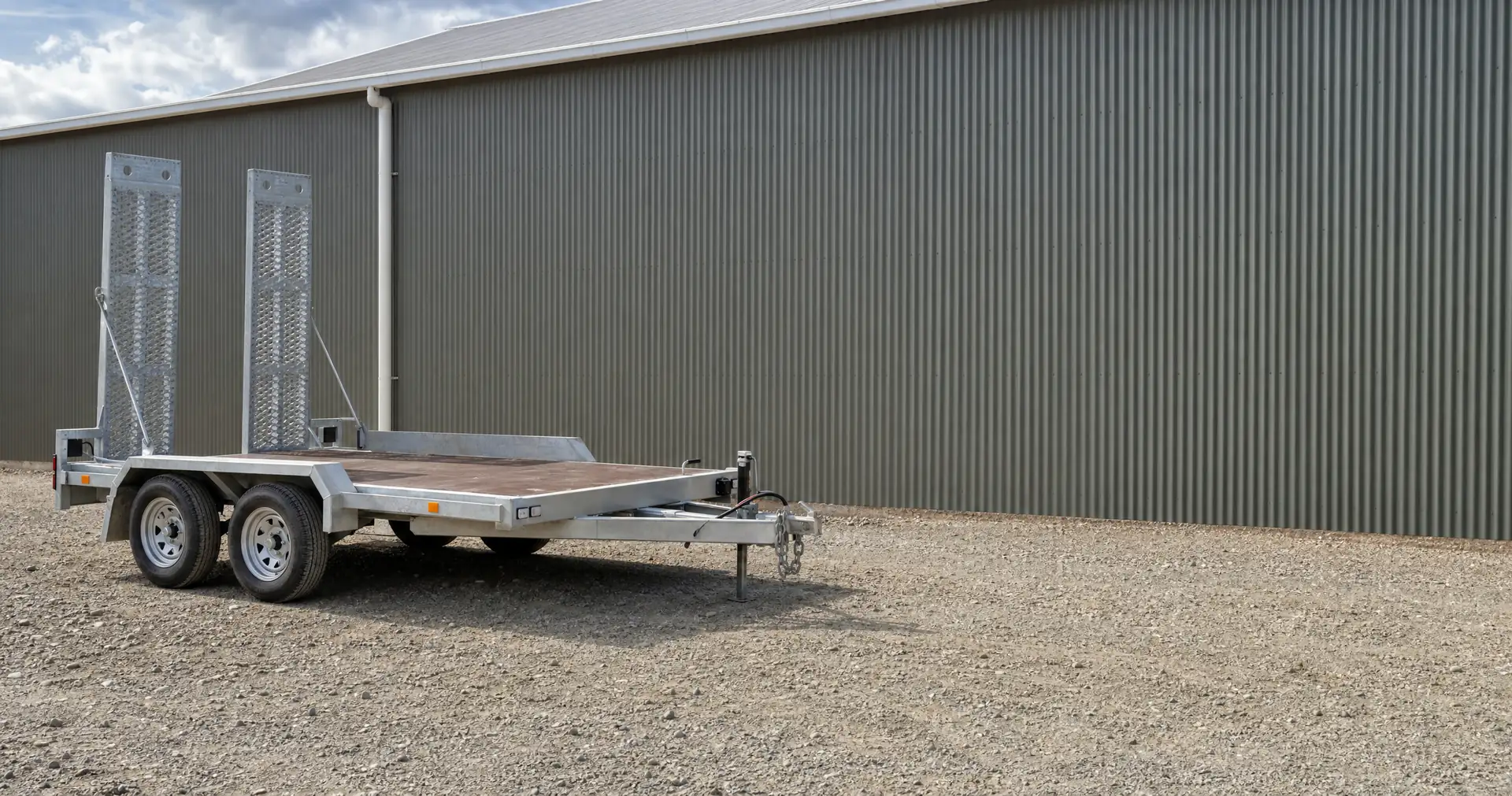
Trailer finance for New Zealand logistics, civil, and trades .
NZ trailer finance covers box, curtainsider, tipper, tanker, and low-loader trailers across logistics, civil, agriculture, and trades. Trailers commonly sit at $20,000 to $200,000 per unit on chattel mortgage, financed alongside the prime mover or rigid truck and registered separately on the PPSR.
NZ trailer finance basics for logistics, civil, and trades.
→Box, curtain, tipper, tanker, low-loader, B-train NZ trailer pool spans utility trailers for trades through to B-train flat-deck and curtainsider sets for line-haul. Each form has a distinct body builder pool and lender posture.
→Trailers commonly $20K to $200K per unit Single-axle box trailers at the low end; B-train flat-deck or curtainsider sets and specialist tankers and low-loaders at the high end. Tipper trailers and curtainsiders commonly sit in the middle.
→NZ body builders Domett, Patchell, Mills-Tui NZ trailer pool dominated by specialist body builders. Domett (Whanganui) covers tipper and curtainsider; Patchell (Rotorua) covers log, livestock, B-train; Mills-Tui (Rotorua) covers fuel tanker and specialist.
→Registered separately on PPSR with NZTA registration Trailers carry their own NZTA registration plate, separate COF inspection cycle (every 6 months for goods service trailers), and separate PPSR registration on chattel-mortgage finance.
What it is
Asset-secured finance for NZ business trailers.
Trailer finance is asset finance specifically against trailers used for business purposes, separate from the truck or prime mover that tows them. The structure mirrors truck finance broadly: chattel mortgage (most common), hire purchase, finance lease, with PPSR registration over each trailer separately and NZTA registration plates issued for each unit. Trailers carry COF inspection requirements every 6 months for goods service trailers, on the same regime as the towing truck.
NZ trailer pool spans a wide range. At the smaller end, box trailers, tandem-axle utility trailers, and trades trailers (tipping, plant, signage) sit at $5,000 to $25,000 on shorter terms (3 to 5 years). In the mid-range, single-axle and tandem curtainsiders for metro and regional distribution, single-axle tippers, and refrigerated trailers sit at $30,000 to $120,000 on 5 to 7 year terms. At the larger end, B-train flat-deck and curtainsider sets for line-haul, dairy and bulk-liquid tankers, and low-loaders for plant transport sit at $120,000 to $200,000 or higher.
NZ specialist body builders dominate the trailer build pool. Domett Truck and Trailer (Whanganui) covers tipper, curtainsider, and specialist builds; Patchell Group (Rotorua) covers log, livestock, and B-train sets; Mills-Tui (Rotorua) covers fuel tanker and specialist; Roadmaster (Hamilton) covers tipper and specialist. Build windows commonly run 4 to 8 months for specialist builds. Finance is commonly drawn in stages tied to body-builder milestones, with PPSR registration confirmed at each stage.
Box / utility trailer
$5K to $25K
Curtainsider single
$45K to $90K
Tipper / tanker / B-train
$80K to $200K+
Common term
5 to 7 years
NZ trailer types
Six common NZ business trailer types funded under chattel mortgage.
NZ trailer finance volume falls across six common forms. Each carries a distinct use case, body builder pool, and finance posture.
Box and curtainsider trailers
Single-axle and tandem-axle curtainsiders for metro and regional distribution. Box trailers for enclosed transport. Common across pallet freight, FMCG distribution, courier line-haul.
·Tier: Mid-range
·Body builders: Domett, Roadmaster, others
Tipper trailers
Single-axle and tandem-axle tippers for aggregate, civil earthworks, demolition, agricultural bulk. Tri-axle and quad-axle tipper trailers at the heavier end. Common across civil contractors and aggregate operators.
·Tier: Mid to large
·Body builders: Domett, Roadmaster, Patchell
Tanker trailers
Dairy tankers (raw milk collection), fuel tankers (refined product distribution), bulk-liquid tankers (chemical, hazardous, food-grade). Specialist build by body builders with tanker capability. Common across dairy collection and fuel distribution.
·Tier: Specialist
·Body builders: Mills-Tui, Patchell
Low-loader and float trailers
Low-loader trailers for plant and machinery transport. Float trailers for civil plant, demolition equipment, and oversize loads. Hydraulic ramp and detachable gooseneck variants. Common across plant hire and civil contractors.
·Tier: Specialist
·Body builders: Domett, specialist NZ builders
Specialist haulage trailers
Livestock crate trailers, log bolster sets, container chassis. Specialist NZ body builders dominate with multi-month build windows. Common across livestock cartage, forestry haulage, and port container drayage.
·Tier: Specialist
·Body builders: Patchell, Domett, specialist
Box and utility trailers for trades
Tandem-axle box trailers, plant trailers, signage trailers, tipping trades trailers. Smaller-ticket asset finance through specialist asset-finance lenders or unsecured term loan. Common across builders, plumbers, electricians, landscapers.
·Tier: Smaller-ticket
·Body builders: NZ trades trailer specialists
Tax, GST, and depreciation
How GST, IRD depreciation, and PPSR typically work on trailers.
A GST-registered business operating trailers can typically claim the GST component on the trailer (and on body builds, signage, and ancillary kit fitted at delivery) as input tax in the relevant GST return, subject to the accountant's confirmation. Where the trailer is acquired under chattel mortgage, the full GST is typically claimable upfront in the next GST return after settlement. Where it is acquired under hire purchase or finance lease, GST is typically claimed across the rental or instalment payments. For specialist trailer builds drawn in stages, GST is typically claimed against each progress invoice as the build progresses. IRD publishes asset-class depreciation rates for trailers separate from the towing truck, on either a diminishing-value or straight-line basis depending on the asset class. PPSR registration is registered separately on each trailer, distinct from the prime mover or rigid truck, and typically held by the lender for the life of the loan. The accountant is the right person to confirm structure choice and depreciation treatment on the specific business position.
What NZ businesses borrow trailers for
Eight common NZ trailer finance use cases.
NZ trailer finance volume falls into eight common purposes across logistics, civil, agriculture, and trades. Each pattern has a typical structure and lender posture.
B-train flat-deck for line-haul
B-train flat-deck or curtainsider set paired with a sleeper-cab prime mover for inter-island and inter-region line-haul. Class 5 driver licence on the towing combination. 6 to 7 year term.
Single-axle curtainsider for metro distribution
Single-axle or tandem curtainsider trailer for metro pallet freight, FMCG, and packaging distribution. Sliding curtain side-load and tail-lift options. 5 year term.
Tipper trailer for civil and aggregate
Tandem or tri-axle tipper trailer for aggregate, civil earthworks, and demolition haul. Often paired with a 6-wheeler or 8-wheeler tipper truck or prime mover.
Dairy tanker for raw milk collection
Specialist dairy tanker for raw milk collection from farm to processor. NZ Food Safety hygiene standards on milk tankers. Common in Waikato and Taranaki dairy regions.
Fuel tanker for refined product
Specialist fuel tanker for refined product distribution from terminal to retail or commercial customer. Hazardous goods compliance under NZTA dangerous goods rules.
Livestock crate for cartage
Tri-axle livestock crate trailer for sheep, cattle, and deer cartage from farm to processor or saleyard. Animal welfare and biosecurity compliance under MPI guidelines.
Low-loader for plant transport
Low-loader trailer for civil plant, demolition equipment, agricultural plant, and oversize loads. Hydraulic ramp and detachable gooseneck variants. Common across plant hire.
Trades trailer for site work
Tandem-axle box trailer, tipping trades trailer, or plant trailer for builders, plumbers, landscapers, and electricians. Smaller-ticket asset finance or unsecured term loan.
Indicative trailer finance bands
Indicative NZ trailer finance bands by trailer type and configuration.
Trailer pricing varies by body builder, axle configuration, body spec, and lead time. The bands below are observed across the NZ trailer finance pool in 2026, drawn from used and new trailer sale activity.
Trailer category
Used (4-7 yr)
New
Common term
Tandem-axle box / utility (trades)
$3K to $12K
$8K to $25K
3 to 5 years
Single-axle curtainsider
$18K to $40K
$45K to $70K
5 years
Tandem-axle curtainsider
$30K to $60K
$60K to $100K
5 to 7 years
Tandem or tri-axle tipper trailer
$40K to $90K
$90K to $160K
5 to 7 years
Dairy tanker (raw milk collection)
$60K to $110K
$140K to $200K
6 to 7 years
Fuel tanker (refined product)
$70K to $130K
$150K to $220K
6 to 7 years
Livestock crate (tri-axle)
$50K to $100K
$130K to $200K
6 to 7 years
B-train flat-deck or curtainsider set
$110K to $200K
$220K to $320K
6 to 7 years
Low-loader / float (4 to 6 axle)
$70K to $150K
$160K to $280K
6 to 7 years
Indicative bands only. Actual price depends on body builder, spec, axle configuration, dealer, and lead time. Final rate, fee, and approval decisions are made by the lender after assessment.
Trailer finance posture
How trailer finance differs from truck finance and why it matters.
Trailer finance carries similar mechanics to truck finance with three distinct differences: separate PPSR registration, separate NZTA registration plate and COF cycle, and a body-builder progress payment pattern on specialist builds.
Feature
Truck (cab/chassis) finance
Trailer (separate unit) finance
Combined truck + trailer package
PPSR registration
On the truck
On the trailer (separate unit)
Separate registrations on each unit
NZTA registration plate
On the truck
On the trailer (separate plate)
Separate plates
COF inspection cycle
Every 6 months on the truck
Every 6 months on the trailer separately
Both inspected on the same 6-month cycle
Body builder progress
Less common (cab/chassis off the dealer floor)
Common (4 to 8 months on specialist builds)
Truck off the floor; trailer staged across body build
Typical loan term
5 to 7 years
5 to 7 years (matches truck term commonly)
Aligned terms across the package
Resale market
Established truck dealer pool
Specialist trailer dealer pool; some bodies more constrained than others
Sold separately or as a package depending on buyer
How it works
A typical NZ trailer finance application.
Trailer finance applications mirror truck finance with one additional dimension: the body-builder progress milestone schedule for specialist builds. Established operators with multi-year fleet trading commonly move faster.
01
Day 1 to 5
Define the trailer spec, body builder, and structure
A typical trailer finance application starts with the dealer or body-builder quote. Specialist builds (livestock crate, log bolster, fuel tanker, dairy tanker, low-loader) commonly book 4 to 8 months ahead with NZ body builders Domett, Patchell, Mills-Tui, or Roadmaster. The progress milestone schedule (commonly 30% on signing, 30% on rough-in, 40% on completion) is part of the file.
Documents commonly required
·Body builder or dealer quote
·Build milestone schedule (specialist builds)
·Trade-in valuation (where applicable)
02
Day 3 to 10
Submit application with trailer-specific documents
Beyond the standard SME application pack, trailer lenders ask for the NZTA Operator Licence under the Land Transport Act 1998 (where applicable), the contract or letter of intent supporting the trailer use case (a milk collection contract for dairy tanker, a log marketer letter for log trailer, a haul subcontract for B-train), and COF status on the existing fleet. Trailers do not carry their own driver licence requirement; the towing combination determines the driver licence class required.
Documents commonly required
·NZBN, business owner ID
·12 to 24 months business bank statements
·Last 2 years financial statements (established fleet)
·NZTA Operator Licence
·Contract or letter of intent (where the trailer funds new work)
·COF status on existing fleet trailers
·Trailer registration and roadworthiness documentation
·Public liability and motor vehicle insurance quotes
03
Day 5 to 14
Lender assessment and offer
Lenders assess the trailer application against four things: the security position on the trailer (LVR after deposit and trade-in), the contract or trading data supporting trailer use, the operator profile (Operator Licence track-record, COF history, prior fleet trading), and the build risk where applicable (body-builder reputation, milestone schedule, completion timeline). Specialist builds commonly attract staged drawdowns tied to milestones with PPSR registration confirmed at each stage.
Trailer finance settles to the dealer or body builder. The lender registers a security interest on the Personal Property Securities Register (PPSR) for the trailer separately from any towing vehicle. NZTA registration plate issued for the trailer. COF inspection scheduled within 6 months of first commercial use. For specialist builds, settlement can run in stages tied to body-builder milestones.
For specialist trailer builds, a body builder with a strong NZ track-record (Domett, Patchell, Mills-Tui, Roadmaster) and a documented milestone schedule commonly tightens the staged finance arrangement and reduces lender concern about build delay risk.
Worked scenarios
Three NZ trailer finance scenarios across logistics, agriculture, and civil.
Indicative structures across a B-train curtainsider for line-haul, a dairy tanker for raw milk collection, and a tipper trailer for civil aggregate. Each illustrates how body-builder choice, contract evidence, and trading history shift the structure and rate.
Established line-haul operator scaling B-train fleet
Auckland-Wellington line-haul B-train curtainsider set
An Auckland line-haul operator with 7 years of trading on a 4-vehicle fleet adding a new B-train curtainsider set to support an expanded national pallet freight contract. Total project $290,000 ex-GST: $280,000 new tandem-axle B-train curtainsider set (commissioned with Domett, 5-month build), $10,000 livery wrap and telematics. The towing prime mover funded separately under existing finance facilities.
Structure agreed with the existing asset-finance lender: chattel mortgage on the B-train set drawn in stages tied to Domett milestones (30% on signing, 30% on rough-in at month 2, 40% on completion at month 5). Total drawdown $238,000 after 18% deposit, 7-year term, indicative 8-10% p.a. UDC Finance funded the chattel mortgage on existing trading history and contract evidence.
NZTA registration plates issued on each trailer of the B-train set. PPSR security interest registered against each trailer separately at completion. First Auckland-Wellington line-haul run within 1 week of body-builder completion at month 5. COF inspection scheduled within 6 months of first commercial use.
Indicative figures
Total project
$290,000
B-train curtainsider set
$280,000
Chattel mortgage after deposit
$238,000
Indicative rate
8-10% p.a.
Dairy collection contractor adding a tanker to support a new processor contract
Waikato dairy tanker for raw milk collection
A Waikato dairy collection contractor with 5 years of trading and 3 existing tankers adding a new tri-axle dairy tanker to support an expanded raw milk collection contract with a Waikato dairy processor. Total project $185,000 ex-GST: $170,000 new tri-axle dairy tanker (commissioned with Patchell, 6-month build), $10,000 hose reel and pump fitout, $5,000 telematics and signage. Trade-in credit of $32,000 on an outgoing 11-year-old single-axle tanker.
Structure agreed with Heartland Bank: chattel mortgage on the new dairy tanker drawn in stages tied to Patchell body-builder milestones. Total drawdown $138,000 after trade-in, 7-year term, indicative 8-10% p.a. NZ Food Safety hygiene certification on the tanker confirmed at body-builder completion. PPSR registered against the tanker at final settlement.
NZTA Operator Licence under the Land Transport Act 1998 maintained on the existing fleet schedule. Tanker tested at body-builder completion against the dairy processor's milk-collection technical requirements. First raw milk collection run scheduled for week 1 after final delivery at month 6. GST claimable on each progress invoice as the body build completes, subject to the accountant's confirmation.
Indicative figures
Total project
$185,000
Trade-in credit
$32,000
Chattel mortgage
$138,000
Indicative rate
8-10% p.a.
Civil contractor replacing an end-of-life tipper trailer
Christchurch civil tipper trailer for aggregate haul
A Christchurch civil contractor with 6 years of trading and a 3-vehicle tipper truck and trailer fleet replacing the oldest tipper trailer at end-of-life. Total project $115,000 ex-GST: $105,000 new tandem-axle tipper trailer (Domett build, 4-month build window), $5,000 telematics upgrade across the fleet, $5,000 livery wrap. Trade-in credit of $18,000 on the outgoing 10-year-old tipper trailer.
Structure agreed with the existing dealer-arranged finance line: chattel mortgage on the new tipper trailer ($87,000 after trade-in, 6-year term, indicative 9-11% p.a.). Existing fleet trading data and ongoing local-government civil aggregate supply contract supported the offer. UDC Finance funded the chattel mortgage on the existing fleet relationship.
NZTA registration plate issued on the new trailer. PPSR security interest registered against the trailer at body-builder completion at month 4. New unit in service within 1 week of completion, partnered with an existing 6-wheeler tipper truck on the contractor fleet.
Indicative figures
Total project
$115,000
Trade-in credit
$18,000
Chattel mortgage
$87,000
Indicative rate
9-11% p.a.
NZ trailer finance lenders
Lenders that fund NZ trailers well across logistics, civil, and agriculture.
Several NZ lenders carry deep familiarity with the trailer finance pool across logistics, civil, agriculture, and trades. The shortlist below is editorial.
Indicative shortlist. Final rate, fee, and approval decisions are made by each lender after assessment. Trailer body builders Domett, Patchell, Mills-Tui, and Roadmaster commonly carry preferred-lender relationships that can streamline staged build finance.
Risk and default
What happens if a financed trailer goes wrong.
Trailer finance carries similar default mechanics to truck finance, with three distinct considerations: separate PPSR registration, body-builder build risk on specialist trailers, and resale market depth that varies by trailer type.
Operator misses repayments on a financed trailer
Where repayments fall behind, the lender typically engages early to restructure (term extension, payment holiday, partial paydown). If arrears continue, the lender can rely on the PPSR security interest registered against the trailer to repossess and sell it. The trailer is repossessed separately from any towing truck (which carries its own PPSR registration). Any shortfall between resale value and balance owing typically falls to the borrower and any personal guarantor.
What happens:Trailer repossessed, PPSR security enforced separately from truck
Specialist body build delayed or cancelled
Specialist trailer builds (livestock crate, log bolster, fuel tanker, dairy tanker, low-loader) commonly run 4 to 8 months at NZ body builders Domett, Patchell, Mills-Tui, or Roadmaster. A delay or cancellation at the body builder mid-build can leave a lender holding partial drawdowns against an incomplete asset. Lenders commonly hold back PPSR registration on staged builds until each milestone completes; lender response to delay typically engagement first, restructure as fallback.
What happens:Staged drawdowns against incomplete asset; restructure required
Trailer written off in a crash with insurance gap
A motor vehicle insurance write-off on a trailer typically pays out market value. Where market value is below the loan balance (common in the early years of a 7-year term on a specialist build), a gap exists. Gap insurance is sometimes available to cover this; without it, the operator carries the residual exposure. Lenders typically require comprehensive motor vehicle insurance covering the trailer as a loan condition.
What happens:Insurance shortfall payable; loan balance still owing
COF failure or roadworthiness issue mid-loan
Trailers carry their own COF inspection cycle every 6 months for goods service trailers. A COF failure that takes the trailer off the road for an extended period reduces operating revenue and can affect repayment capacity. Common COF issues on trailers include brake systems, suspension, lights, coupling, and structural integrity on tipper bodies. Lenders commonly engage early on COF compliance issues.
What happens:Revenue interrupted; repair cost on top of loan balance
Comprehensive motor vehicle insurance covering the trailer, gap insurance where the early-years balance exceeds market value, regular COF compliance, and a body-builder milestone schedule with strong NZ track-record commonly head off the highest-impact default scenarios.
Where trailer finance fits
When NZ trailer finance is straightforward, and when it gets harder.
Where it works smoothly
·Established operator with 2+ years of fleet trading data
·NZTA Operator Licence under the Land Transport Act 1998 in good standing
·Contract or letter of intent supporting the trailer use case
·Trailer within typical age band (under 7 years used, new from major NZ body builder)
·Body builder with strong NZ track-record (Domett, Patchell, Mills-Tui, Roadmaster) and documented milestone schedule
·Deposit of 15-20% of the trailer price from existing trading
·Clean COF compliance history across the existing fleet trailers
Where it gets harder
·First-time operator with no prior fleet trading or Operator Licence history
·Trailer older than 10 years or with no documented service history
·Specialist build with an unfamiliar body builder or no documented milestone schedule
·No contract evidence supporting the specialist trailer use (livestock crate, dairy tanker, fuel tanker)
·COF compliance issues on existing fleet trailers
·Outstanding GST or PAYE arrears at IRD
·Reliance on a single contract relationship without diversification
NZ trailer pricing varies materially by trailer type, body builder, axle configuration, and lead time. Tandem-axle box and utility trailers for trades commonly run $8,000 to $25,000 new. Single-axle curtainsiders commonly run $45,000 to $70,000 new; tandem-axle curtainsiders $60,000 to $100,000. Tipper trailers commonly run $90,000 to $160,000 new. Dairy and fuel tankers commonly run $140,000 to $220,000 new from specialist NZ body builders. B-train flat-deck or curtainsider sets commonly run $220,000 to $320,000 new. Used 4 to 7 year stock typically sits 30-50% below new pricing depending on body type and condition.
Who are the main NZ trailer body builders?
The NZ trailer body builder pool is dominated by specialist builders. Domett Truck and Trailer (Whanganui) builds tipper, curtainsider, and specialist trailers. Patchell Group (Rotorua) builds log, livestock, fuel tanker, and B-train sets. Mills-Tui (Rotorua) builds fuel tanker and specialist trailers. Roadmaster (Hamilton) builds tipper and specialist trailers. Each carries a multi-month build window (commonly 4 to 8 months) and preferred-lender relationships that can streamline staged build finance. Generic curtainsider and refrigerated trailer specialists also operate across NZ alongside the specialist body builders.
What licence is required to tow a NZ trailer?
NZ driver licence requirements track the towing combination weight rather than the trailer weight in isolation, under NZTA driver licence classes. Class 1 covers light vehicle and trailer combinations up to 6,000 kg gross combination weight. Class 2 covers combinations up to 18,000 kg. Class 4 covers heavy rigid vehicle combinations above 18,000 kg. Class 5 covers heavy combination vehicles above 25,000 kg, required for B-train sets and most line-haul prime mover plus trailer combinations. NZTA publishes the licence class progression rules and the combination weight thresholds in full.
Do NZ trailers require a Certificate of Fitness (COF)?
Goods service trailers used commercially require a COF every 6 months under NZTA rules, on the same regime as the towing truck. The COF inspection on a trailer covers structural integrity, brakes, lights, tyres, suspension, coupling (fifth-wheel or pin), and trailer body condition. COF inspections on trailers are conducted at NZTA-approved testing stations separately from the towing truck (although commonly booked in the same visit). NZTA publishes the COF inspection requirements and approved testing stations in full. Lenders commonly check COF compliance history across an existing fleet of trailers as part of the trailer finance application.
What rate range applies to NZ trailer finance in 2026?
Indicative rates on NZ trailer finance commonly sit in the 8% to 12% per annum band depending on structure, security, trailer type, and operator profile. Chattel-mortgage finance secured by a new trailer for an established operator with multi-year trading sits at the lower end (commonly 8-10%). Used trailer finance and specialist builds sit in the middle (commonly 9-11%). First-time operators or applications without strong contract evidence sit at the upper end (commonly 11-12%). Final rate is set by the lender after assessment.
How is GST treated on a NZ trailer under chattel mortgage?
A GST-registered business operating trailers can typically claim the GST component on the trailer (and on the body build, signage, and ancillary kit fitted at delivery) as input tax in the relevant GST return, subject to the accountant's confirmation. Where the trailer is acquired under chattel mortgage, the full GST is typically claimable upfront in the next GST return after settlement. Where it is acquired under hire purchase or finance lease, GST is typically claimed across the rental or instalment payments. For specialist trailer builds drawn in stages, GST is typically claimed against each progress invoice as the build progresses. The accountant is the right person to confirm structure choice and GST timing on the specific business position.
How does IRD trailer depreciation work?
IRD publishes asset-class depreciation rates for trailers separate from the towing truck, on either a diminishing-value or straight-line basis depending on the asset class and election. Different trailer types (tipper, tanker, livestock crate, B-train flat-deck, curtainsider, low-loader, box trailer for trades) sit in different IRD asset classes with corresponding rates. Where the trailer is acquired under chattel mortgage, depreciation is claimed by the borrower as the owner. Where it is acquired under finance lease, the lessor commonly claims depreciation. The accountant is the right person to confirm the IRD depreciation rate that applies to the specific trailer and use case on the business position.
How does specialist trailer build finance work in NZ?
Specialist NZ trailer builds (livestock crate, log bolster, fuel tanker, dairy tanker, low-loader, B-train set) are commonly financed in stages tied to body-builder progress milestones. A typical schedule pays 30% on signing, 30% on rough-in (around month 2), and 40% on completion (around month 4 to 8 depending on build complexity). Lenders such as UDC Finance, Heartland Bank, and specialist asset-finance providers carry familiarity with NZ body builders Domett, Patchell, Mills-Tui, and Roadmaster, and commonly stage drawdowns to match the build schedule. Existing contract evidence (a milk processor agreement, log marketer letter, fuel distributor contract) materially supports the application.
Does a trailer carry its own PPSR registration?
Yes. Trailers carry their own PPSR registration separate from any towing vehicle when financed under chattel mortgage or hire purchase. The lender registers a security interest on the Personal Property Securities Register against the trailer specifically, identified by VIN or chassis number. Where a trailer is paired with a truck under separate finance facilities (or with the same lender across separate loans), PPSR registrations on each unit are independent. This affects default mechanics: a lender can repossess a trailer separately from a towing truck if arrears apply only to the trailer finance.
How long does a NZ trailer finance application take?
Dealer-stock trailer finance applications commonly settle within 5 to 14 days for established operators with multi-year trading and clean Operator Licence status. Specialist trailer builds run on a longer timeline tied to the body-builder schedule (4 to 8 months total), with finance staged across milestones. Application assessment itself typically runs 5 to 14 days regardless of build timeline; the staged settlements then follow body-builder milestones. First-time operators or applications with limited contract evidence commonly take longer through additional underwriting. Manufacturer captive finance through trailer dealer networks can sometimes settle dealer-stock units within 3 to 5 days for clean files.
What documents does a NZ trailer finance application require?
A typical NZ trailer finance application pack includes: the body-builder or dealer quote, the milestone schedule for specialist builds, NZBN and business owner ID, last 12 to 24 months business bank statements, last 2 years financial statements (for established fleets), the NZTA Operator Licence under the Land Transport Act 1998 (where applicable), COF status on existing fleet trailers, the contract or letter of intent supporting trailer use, and motor vehicle and public liability insurance quotes. Specialist builds add the body-builder reputation evidence and milestone schedule. Established operators with multi-year trading commonly move through assessment faster.
What happens to a financed trailer if the business closes?
Where the trailer is financed under chattel mortgage and the business closes before the loan is repaid, the lender typically has a security interest registered on the Personal Property Securities Register (PPSR) against the trailer specifically and can take possession of the trailer to recover the outstanding balance. The trailer is repossessed separately from any towing truck (which carries its own PPSR registration on its own loan). Any shortfall between resale value and balance owing typically falls to the borrower and any personal guarantor. Specialist trailers (dairy tanker, livestock crate, log bolster) commonly hold value better than generic curtainsider trailers because rebuild capacity is constrained, while generic box trailers and trades trailers commonly carry weaker resale on a 5-year hold.
Can a trailer be financed alongside the towing truck on a single facility?
Yes. Mid-fleet and large-fleet operators commonly fund a truck and trailer combination under a single facility with separate PPSR registrations against each unit, or under separate chattel mortgages with aligned terms. Major banks (ANZ, BNZ, ASB, Westpac) and specialist asset-finance lenders (UDC, Heartland) all support multi-unit facility structures. The benefit is administrative simplicity and aligned end-of-term rotation; the consideration is that cross-collateralisation can sometimes complicate the sale of the trailer separately from the truck. The right structure depends on the fleet rotation pattern and the operator's preference for relationship simplicity versus per-asset flexibility.
How does trailer finance for civil and trades differ from line-haul trailer finance?
Civil and trades trailer finance commonly sits at smaller ticket sizes ($5,000 to $80,000) with shorter terms (3 to 5 years) reflecting tipper trailer, plant trailer, and box trailer use cases. Line-haul trailer finance sits at larger ticket sizes ($90,000 to $320,000) with longer terms (5 to 7 years) reflecting curtainsider, B-train, and specialist haulage builds. Civil trailers commonly settle through dealer-arranged finance or asset-finance lenders against existing fleet relationships. Line-haul trailers commonly involve specialist body builders with multi-month builds and staged finance tied to milestones. The application document pack and lender posture differ accordingly between the two patterns.
Indicative content only. Not personalised financial advice.
A business loan is a commitment that runs for months or years, and repayments come out of the same operating cash flow as everything else. Before committing, it is worth modelling the weekly and monthly cost against the business's working-capital position, which is what this site is built to help with. Borrowing at a level that stays comfortable through a quiet quarter, not just a strong one, is widely regarded as the safer frame.
What this site is
A calculator and information tool. Not a lender, not a broker, not a registered financial adviser. Nothing here is personalised financial advice.
What the figures show
Modelled estimates based on the inputs you enter. Not a quote. Not an offer of credit. Not a guarantee of approval, rate, or fees.
What the lender decides
Final rates, fees, and approval are set by the lender after a CCCFA-appropriate assessment of the applicant's circumstances and credit decision.
Commercial disclosure
Businessloans.org.nz earns a commission from Prospa when a visitor applies through this site and their application is approved. The commission is paid by Prospa, not by the borrower, and it does not influence the rate Prospa offers. Full disclosure on the partner page.
Tax, GST, and accountant framing
Tax-treatment statements (GST claim timing, interest deductibility, depreciation rates) are general in nature and subject to your accountant's confirmation on the specific business position. For material amounts, professional advice from a registered financial adviser or chartered accountant is widely regarded as the safer frame.