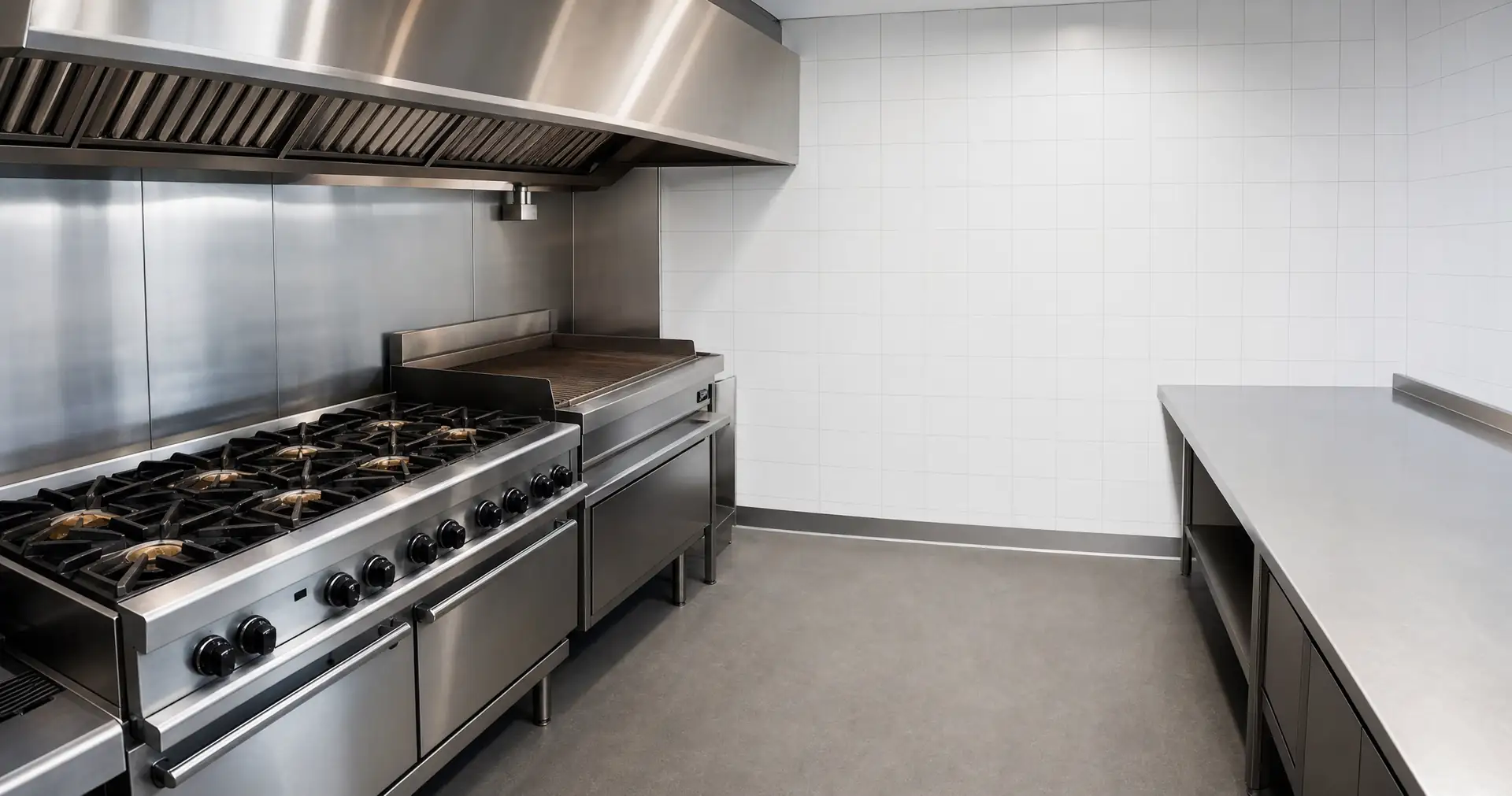
Commercial kitchen finance for New Zealand restaurants, hotels, and food service operators .
Commercial kitchen fitouts cover combi ovens, cooklines, prep benches, dishwashers, walk-in coolers, fryers, and salamanders. A full restaurant kitchen commonly runs $30,000 to $200,000+ ex-GST depending on cuisine, cover count, and brand tier. SilverChef Rent-Try-Buy and Southern Hospitality finance are the dominant NZ specialist routes.
What you need to know about NZ commercial kitchen finance.
→Full kitchen fitout commonly $30K to $200K+ Cafe and bistro at $30K-$80K, mid-size restaurant $80K-$150K, flagship and hotel $150K-$200K+. Depends on cuisine, cover count, and brand tier across combi, cookline, dish, and refrigeration.
→SilverChef Rent-Try-Buy and Lease-to-Keep dominate SilverChef is the NZ specialist hospitality equipment finance leader, with a 12-month Rent-Try-Buy flexible product and a 4 to 5 year Lease-to-Keep structure. Southern Hospitality runs in-house finance as the largest NZ kitchen distributor.
→Major brands sit at the dealer level Rational iCombi Pro and Convotherm 4 dominate combi ovens. Hobart and Winterhalter dominate dishwashers. Walk-in coolers commonly Skope, Williams Refrigeration, or Comcater-supplied. Cookline brands include Garland, Waldorf, Goldstein, Cobra.
→Food Act 2014 and MPI Verifier shape design A Food Control Plan or National Programme registered with a local MPI Verifier dictates separation of raw and ready-to-eat zones, dishwasher temperature standards, and refrigeration monitoring. Kitchen design is signed off through the Food Act process.
The landscape
NZ hospitality kitchens carry a deeper finance pattern than coffee equipment alone.
Commercial kitchen capex is materially higher than coffee equipment alone because the asset list is longer, brand tiering matters more, and refrigeration and ventilation carry their own subcontractor dependencies. Restaurant Association of New Zealand context shows hospitality fitouts commonly absorb a substantial share of the total project cost (frequently 40 to 60 percent of a full restaurant build). Stats NZ business demography places several thousand restaurants, cafes, takeaways, and hotel food-service operations as active NZ trading entities at any time.
The major-brand pool is concentrated. Rational and Convotherm dominate the combi oven category that anchors most modern NZ kitchens; a Rational iCombi Pro 10-1/1 commonly runs $25,000 to $35,000 new. Hobart and Winterhalter dominate dishwashers; a pass-through Hobart or Winterhalter PT-M sits at $10,000 to $18,000 new. Cookline brands include Garland, Waldorf, Goldstein, and Cobra at the dealer-supported tier. Walk-in coolers and freezers are commonly Skope, Williams Refrigeration, or Comcater-supplied builds. Prep benches and saladettes commonly Skope, Bromic, or Atosa.
Two specialist hospitality finance routes lead the NZ market. SilverChef offers a 12-month Rent-Try-Buy flexible product (rent the equipment for up to 12 months, then return, continue, or buy at a credit-applied price), and a 4 to 5 year Lease-to-Keep structure for operators with longer hold intent. Southern Hospitality, the largest NZ commercial kitchen distributor, runs in-house finance alongside its supply network. Generic asset financiers (Heartland Bank, UDC Finance, Spinach, Prospa) cover independent purchases through any dealer. Major banks (ANZ, BNZ, ASB, Westpac) cover larger restaurant groups and hotel chains.
Cafe / bistro kitchen
$30K to $80K
Mid-size restaurant
$80K to $150K
Flagship / hotel kitchen
$150K to $200K+
Common term
4 to 5 years
Commercial kitchen scenarios
Four common NZ commercial kitchen finance scenarios.
Most commercial kitchen applications fall into one of four patterns. Each pattern has a typical loan amount, structure, and lender or supplier pool.
New restaurant full kitchen fitout
Greenfield restaurant fitout including combi oven, gas cookline, prep benches, dishwasher, walk-in cooler, and fryer setup. Total $80K-$150K ex-GST. Chattel mortgage or Lease-to-Keep on a 4 to 5 year term, often packaged through Southern Hospitality or SilverChef.
·Loan amount: $80K to $150K
·Term: 4 to 5 years
New concept Rent-Try-Buy short-term flex
New restaurant or food concept with uncertain trading volume choosing SilverChef Rent-Try-Buy on the combi oven and dishwasher. 12 months of flexibility before commit-or-return. Suits operators wanting to validate a concept before locking 5-year capex.
·Equipment value: $40K to $100K
·Term: 12 months Rent-Try-Buy
Established restaurant kitchen replacement
Established restaurant replacing a 10 to 15 year old combi oven, cookline, or dishwasher at end-of-life. Trade-in credit on outgoing equipment. Standalone chattel mortgage or Lease-to-Keep on the new asset.
·Loan amount: $25K to $50K
·Term: 4 to 5 years
Hotel or institutional flagship kitchen
Hotel, conference centre, or institutional food-service flagship kitchen serving high cover counts. Multiple combi banks, dual cooklines, walk-in cooler and freezer, multiple dishwashers. Combined chattel mortgage and lease across the asset stack.
·Loan amount: $200K to $500K+
·Term: 5 years
What kitchens finance under the fitout package
Six common NZ commercial kitchen equipment categories.
Commercial kitchen finance volume falls into six common categories. Each has a typical price band and structure that fits.
Combi ovens
Rational iCombi Pro, Convotherm 4, Unox Cheftop. 6-1/1, 10-1/1, and 20-1/1 grid sizes. Steam, convection, and combination cooking modes. Most-financed single asset in a NZ restaurant kitchen. $20K to $45K new depending on size and spec.
Cooklines and ranges
Garland, Waldorf, Goldstein, Cobra. Gas open-burner ranges, char-grills, salamanders, pasta cookers, planchas. Custom cookline bench fabricated to the kitchen layout. $20K to $60K depending on configuration and length.
Dishwashers
Hobart Premax, Winterhalter PT-M, Meiko M-iClean. Pass-through, hood-type, and conveyor configurations. Temperature compliance under Food Act 2014. $8K to $30K depending on size and throughput.
Refrigeration and walk-in
Skope, Williams Refrigeration, Bromic, Atosa, Foster. Walk-in coolers and freezers, prep saladettes, refrigerated drawers, blast chillers. Custom-built walk-in $15K to $40K; saladettes and drawers $4K to $10K each.
Fryers and specialised cooking
Frymaster, Henny Penny, Rational VarioCookingCenter, sous vide circulators, induction wok burners. Fryer banks at $5K to $15K; specialist cooking platforms $20K to $50K.
Prep benches and stainless fabrication
Stainless steel prep benches, undershelves, sinks, hand-wash stations, mobile workstations. Custom-fabricated to kitchen layout by NZ stainless fabricators. $15K to $40K across a full kitchen.
GST, IRD depreciation, and Food Act
How GST, IRD depreciation, and Food Act 2014 compliance interact with kitchen finance.
A GST-registered hospitality operator can typically claim the GST component on combi ovens, cooklines, dishwashers, refrigeration, and stainless fabrication as input tax in the relevant GST return, subject to the accountant's confirmation. Where the equipment is acquired under chattel mortgage, the full GST is typically claimable upfront in the next GST return after settlement. Where it is acquired under hire purchase, the same upfront GST treatment generally applies because legal title passes at the start. Where it is acquired under operating lease or a SilverChef Rent-Try-Buy product (which is structured as a rental), GST is typically claimed across the rental payments rather than upfront. IRD publishes asset-class depreciation rates; commercial kitchen equipment commonly sits across several asset classes (refrigeration, cooking equipment, stainless fabrication) each with its own published rate. Separately, the Food Act 2014 (administered by MPI through local-authority Verifiers) shapes kitchen design through Food Control Plan or National Programme requirements, including separation of raw and ready-to-eat zones, dishwasher temperature standards, refrigeration monitoring, and hand-wash station placement. The accountant is the right person to confirm depreciation treatment, and the local MPI Verifier the right person to confirm Food Act compliance, on the specific business position.
Commercial kitchen equipment bands
Indicative NZ commercial kitchen finance bands.
Pricing varies by brand tier, size, customisation, and dealer. The bands below are observed across the NZ commercial kitchen pool in 2026, drawn from published dealer pricing and used equipment market activity.
Indicative bands only. Actual price depends on size, customisation, dealer, and import lead time. Final rate, fee, and approval decisions are made by the lender after assessment.
Three commercial kitchen finance routes
Chattel mortgage vs SilverChef Rent-Try-Buy vs Lease-to-Keep.
The structure choice tracks ownership preference, GST treatment, concept maturity, and capital outlay tolerance. Each route suits a different operator profile.
Return, continue rental, or buy with 75% rental credit
Operator owns at end of lease (residual cleared)
GST treatment
Full GST claimable upfront
GST claimed across rental payments
GST claimed across rental payments
Best fit operator profile
Established operator with clear hold intent
New concept with uncertain trading volume
Established operator wanting bundled rental and ownership
Flexibility to exit
Early-repayment fees may apply
Return at month 12 with no penalty
Lease break fees apply
Cash-flow shape
Fixed monthly repayment, lower over term
Higher monthly rental in months 1-12
Fixed monthly rental over 4 to 5 years
A chattel mortgage is typically chosen by established operators prioritising upfront GST recovery and clear ownership; Rent-Try-Buy suits new concepts prioritising flexibility to validate trading volume; Lease-to-Keep suits operators prioritising bundled rental simplicity with eventual ownership. The right structure depends on the operator's capital position and concept maturity.
How it works
A typical NZ commercial kitchen finance application.
Commercial kitchen applications carry a kitchen designer or distributor specification step that smaller hospitality finance applications do not. Established restaurant operators with trading data move faster.
01
Day 1 to 14
Define the kitchen layout and equipment list
A typical commercial kitchen fitout starts with a kitchen designer or distributor (Southern Hospitality, Stoddart, Comcater, Plant & Food NZ) producing a layout drawing and itemised equipment list aligned to the cuisine, cover count, and Food Act 2014 requirements. Defining the spec upfront lets the supplier issue a single quote covering combi, cookline, dish, refrigeration, and stainless. Lenders can then size each finance tranche correctly.
Documents commonly required
·Kitchen designer drawing and equipment list
·Cuisine and cover count brief
·Restaurant lease and floor plan
·Food Control Plan or National Programme draft
02
Day 7 to 21
Submit application with hospitality-specific documents
Beyond the standard SME application pack, hospitality finance lenders ask for the restaurant lease (or letter of intent on a new site), Food Act 2014 verification status with the local MPI Verifier, the kitchen designer specification, 12 months of bank statements for established operators, and project budget for greenfield builds. Liquor Licence (where applicable) is held separately under the Sale and Supply of Alcohol Act 2012 and not finance-bearing.
Documents commonly required
·NZBN, business owner ID
·Last 12 months business bank statements (existing operator)
·Restaurant lease or letter of intent
·Food Act 2014 registration or planned MPI Verifier engagement
·Kitchen designer specification and equipment list
·Project budget (greenfield)
·Insurance quote covering kitchen equipment
03
Day 14 to 28
Lender or supplier assessment and offer
Specialist hospitality lenders (SilverChef, Southern Hospitality finance) layer hospitality experience over the standard credit assessment. Generic asset financiers (Heartland, UDC, Spinach) assess on trading data, security position, and operator experience. Major banks cover larger restaurant groups with relationship-managed credit. Offers commonly come back with conditions: deposit, additional security, insurance requirements, or staged drawdowns tied to fitout milestones.
04
Week 4 to 12
Settle, install, MPI verification, open
Asset finance settles directly to the supplier or distributor. The lender registers a security interest on the Personal Property Securities Register (PPSR) on chattel-mortgage purchases; SilverChef retains title on Rent-Try-Buy and Lease-to-Keep products. The supplier installs and commissions the equipment. The local MPI Verifier signs off the Food Control Plan or National Programme, including separation of raw and ready-to-eat zones, dishwasher temperature, and refrigeration monitoring. The restaurant opens with the kitchen in service from day one of trading.
A hospitality finance broker or kitchen designer familiar with the NZ commercial kitchen market commonly tightens the indicative rate band and reduces the documentation cycle versus a direct application to a generic SME lender.
Worked scenarios
Three NZ commercial kitchen finance scenarios.
Real-world structures across new restaurant full fitout, new concept Rent-Try-Buy, and established restaurant equipment replacement. Each illustrates how operator profile, capital position, and concept maturity shift the offered structure.
Experienced operator opening 50-cover bistro
Auckland Ponsonby new bistro full kitchen fitout
An experienced hospitality operator (10 years prior trading at a Wellington venue) opening a 50-cover bistro on Ponsonby Road, Auckland. Total kitchen fitout $115,000 ex-GST: $32,000 Rational iCombi Pro 10-1/1, $36,000 Waldorf 3.6m gas cookline with char-grill and salamander, $15,000 Hobart hood-type dishwasher, $18,000 walk-in cooler 3m x 3m, $14,000 stainless prep benches and saladettes. 20% deposit ($23,000) from operator capital.
Structure agreed with Southern Hospitality finance: combined chattel mortgage on the full fitout ($92,000 after deposit, 5-year term, indicative 9-11% p.a.). Southern Hospitality install and commissioning included; Rational and Hobart manufacturer warranties apply at the equipment level.
PPSR security interest registered against each asset at settlement. Auckland Council MPI Verifier signed off the Food Control Plan covering raw-vs-ready-to-eat separation, dishwasher temperature, and refrigeration monitoring. Bistro trading from week 8 of fitout, with the kitchen meeting Food Act 2014 compliance from day one.
Indicative figures
Total kitchen fitout
$115,000
Combi oven (iCombi Pro)
$32,000
Chattel mortgage after deposit
$92,000
Indicative rate
9-11% p.a.
New operator validating concept with 12-month flex
Queenstown new pop-up concept Rent-Try-Buy
A first-time hospitality operator opening a 30-seat seasonal concept in central Queenstown wanting to validate cuisine and cover count before locking 5-year capex. Equipment value $58,000 ex-GST: $28,000 Convotherm 4 6-1/1 combi oven, $16,000 compact gas range and salamander, $10,000 pass-through Winterhalter PT-M dishwasher, $4,000 prep saladette.
Structure agreed with SilverChef Rent-Try-Buy: 12-month flexible rental on the combi, dishwasher, and saladette. Monthly rental indicative band; SilverChef retains title throughout. Cookline financed separately through a Heartland Bank chattel mortgage ($16,000, 5-year term, indicative 10-12% p.a.) because the bespoke gas range is a custom build outside SilverChef's rental pool.
No PPSR registered against the SilverChef rental equipment because title remains with SilverChef. PPSR registered against the cookline. Queenstown Lakes District Council MPI Verifier signed off the National Programme. After 9 months of strong trading the operator commits to buy the SilverChef equipment using the 75% rental credit, converting to chattel mortgage with the GST claimable on the residual purchase price.
Indicative figures
Equipment under Rent-Try-Buy
$42,000
Cookline (chattel mortgage)
$16,000
Rent-Try-Buy term
12 months
Buy-out rental credit
75% applied
Established restaurant, 8 years trading, oven at end-of-life
Christchurch established restaurant combi replacement
An established Christchurch restaurant with 8 years of trading replacing a 12-year-old combi oven that has reached economic end-of-life. Total project $34,000 ex-GST: $30,000 new Rational iCombi Pro 10-1/1, $4,000 install, recommissioning, and integration with existing extraction. Trade-in credit of $5,500 on the outgoing combi.
Existing 8 years of trading data and consistent monthly turnover materially tightened the indicative rate band. SilverChef Lease-to-Keep on the new combi: $24,500 financed after trade-in, 5-year term, indicative 9-11% p.a. SilverChef retains title until the residual is cleared at end of term.
Christchurch City Council MPI Verifier confirmed that the new combi maintains the existing Food Control Plan compliance (cooking temperature monitoring, separation of raw and ready-to-eat zones unchanged). Outgoing combi traded with Southern Hospitality. Restaurant traded through a 4-day install window with reduced menu; full service resumed week 1 after recommissioning.
Indicative figures
Total project
$34,000
Trade-in credit
$5,500
Lease-to-Keep amount
$24,500
Indicative rate
9-11% p.a.
NZ commercial kitchen finance routes
Lenders and suppliers that fund NZ commercial kitchens well.
Several NZ specialist routes fund commercial kitchen equipment cleanly. The shortlist below is editorial.
How much does a NZ commercial kitchen fitout cost in 2026?
A full commercial kitchen fitout in NZ commonly runs $30,000 to $200,000+ ex-GST depending on cuisine, cover count, and brand tier. Smaller cafe and bistro fitouts (combi oven, compact cookline, pass-through dishwasher, prep benches) sit at $30,000 to $80,000. Mid-size casual dining restaurants serving 50 to 100 covers run $80,000 to $150,000. Flagship restaurant and hotel kitchens with multiple combi ovens, dual cooklines, walk-in cooler and freezer, and multiple dishwashers run $150,000 to $200,000+. Brand tier (Rational and Hobart at the upper end, Convotherm and Winterhalter mid, alternative brands lower) materially shifts the band.
What lenders fund commercial kitchen purchases in NZ?
Specialist hospitality finance routes lead the NZ commercial kitchen pool. SilverChef offers Rent-Try-Buy 12-month flexible products and Lease-to-Keep 4 to 5 year structures across most kitchen equipment categories. Southern Hospitality, the largest NZ commercial kitchen distributor, runs in-house finance alongside its supply network. Generic asset financiers (Heartland Bank, UDC Finance, Spinach) cover independent purchases through any dealer. Prospa covers unsecured top-up for smaller-ticket prep benches and fittings. Major banks (ANZ, BNZ, ASB, Westpac) cover larger restaurant groups and hotel chains.
How does SilverChef Rent-Try-Buy work?
SilverChef Rent-Try-Buy is a 12-month flexible rental product covering most NZ commercial kitchen equipment categories. The operator rents the equipment for up to 12 months at a published monthly rate, then has three options at any time within the 12 months: return the equipment with no penalty, continue rental on a month-to-month basis, or buy the equipment with 75% of paid rental applied as credit against the purchase price. SilverChef retains title throughout the rental period. The product suits new concepts wanting to validate cuisine and cover count before committing to 4 to 5 year capex. SilverChef publishes the product terms in full.
What is SilverChef Lease-to-Keep and how does it differ?
SilverChef Lease-to-Keep is a 4 to 5 year structured lease covering NZ commercial kitchen equipment. The operator pays a fixed monthly rental over the lease term, with a small residual payment at the end clearing title. SilverChef retains title until the residual is cleared. Lease-to-Keep suits operators with clearer hold intent than Rent-Try-Buy candidates but who prefer rental cash-flow shape over chattel-mortgage cash-flow shape. GST is claimed across the rental payments rather than upfront. SilverChef publishes the product terms in full.
Can GST be claimed upfront on commercial kitchen equipment under chattel mortgage?
A GST-registered hospitality operator can typically claim the full GST component on combi ovens, cooklines, dishwashers, refrigeration, and stainless fabrication acquired under chattel mortgage as input tax in the next GST return after settlement, subject to the accountant's confirmation. Where the equipment is acquired under hire purchase, the same upfront GST treatment generally applies because legal title passes at the start. Where it is acquired under operating lease or a SilverChef Rent-Try-Buy or Lease-to-Keep product (which are structured as rentals with title retained by the lessor), GST is typically claimed across the rental payments rather than upfront. The accountant is the right person to confirm the structure choice and GST timing on the specific business position.
What IRD depreciation rate applies to commercial kitchen equipment?
IRD publishes asset-class depreciation rates that vary by category. Commercial kitchen equipment commonly sits across several asset classes: refrigeration equipment, cooking equipment, dishwashers, and stainless steel fabrication. Each class carries its own published diminishing-value or straight-line rate, and the IRD asset-class look-up is the authoritative reference. The accountant is the right person to confirm the rate that applies to each line item on a kitchen fitout. Depreciation is calculated against the GST-exclusive cost of the asset, not the GST-inclusive cost. On disposal, any gain or loss against the depreciated book value is brought to account.
How does the Food Act 2014 affect commercial kitchen design and finance?
The Food Act 2014, administered by MPI through local-authority Verifiers, requires most NZ food businesses to operate under a Food Control Plan (higher-risk operations such as restaurants and cafes) or a National Programme (lower-risk operations such as packaged-food retail). The kitchen design must support the registered plan, including separation of raw and ready-to-eat zones, dishwasher temperature compliance (typically 60 degrees C wash, 82 degrees C rinse for sanitation), refrigeration monitoring, and hand-wash station placement. Lenders do not generally underwrite Food Act compliance but commonly check that registration is in place or planned. The local MPI Verifier signs off the kitchen at commissioning and conducts ongoing verification visits.
What is the typical loan term for commercial kitchen equipment?
Commercial kitchen equipment on chattel mortgage commonly runs 4 to 5 year loan terms. Combi ovens, cooklines, dishwashers, and walk-in coolers all attract 4 to 5 year terms reflecting useful life. Smaller-ticket items (prep benches, hand-wash stations, mobile workstations) sometimes attract shorter 3 to 4 year terms. SilverChef Rent-Try-Buy operates on a 12-month flexible rental basis; SilverChef Lease-to-Keep runs 4 to 5 years. The loan term should fit within the expected useful life of the equipment for the cuisine and cover count; high-throughput restaurants wear equipment faster than lower-volume venues.
What rate range applies to NZ commercial kitchen finance in 2026?
Indicative rates on commercial kitchen finance commonly sit in the 9% to 13% per annum band depending on structure, security, and operator profile. Chattel-mortgage finance secured by new dealer-supplied equipment for an established restaurant operator sits at the lower end (commonly 9-11%). SilverChef Rent-Try-Buy is structured as rental with a published monthly rate rather than a quoted interest rate. Generic unsecured term loans on smaller fittings sit at the upper end (commonly 12-15%). Final rate is set by the lender after assessment.
What happens to financed kitchen equipment if the restaurant closes?
Where equipment is financed under chattel mortgage and the restaurant closes before the loan is repaid, the lender typically has a security interest registered on the Personal Property Securities Register (PPSR) and can take possession of the equipment to recover the outstanding balance. Any shortfall between resale value and balance owing typically falls to the borrower and any personal guarantor. Used commercial kitchen equipment (combi ovens, dishwashers, refrigeration) typically retains 40-60% of value over a 5-year hold period; bespoke fabrication holds less. SilverChef Rent-Try-Buy and Lease-to-Keep equipment is returned to SilverChef on default rather than sold to clear a balance, because title remains with SilverChef.
Can a commercial kitchen fitout be financed in stages tied to fitout milestones?
Yes. Larger commercial kitchen fitouts ($100K+) are commonly financed in stages tied to fitout milestones, particularly where the build sequence includes structural work (extraction, plumbing, electrical) before equipment install. Specialist hospitality finance lenders (SilverChef, Southern Hospitality finance) and asset financiers (Heartland, UDC) can structure staged drawdowns: a deposit drawdown on order, a progress drawdown on delivery, and a final drawdown on commissioning. The MPI Verifier sign-off (Food Control Plan) is commonly the trigger for the final drawdown to release. The kitchen designer or distributor coordinates the drawdown schedule with the lender.
How does Food Act 2014 verification affect kitchen finance approval?
Lenders do not directly underwrite Food Act 2014 compliance but commonly check that Food Control Plan or National Programme registration is in place or planned with the local MPI Verifier as part of the application file. Established operators provide the existing registration; greenfield operators provide evidence of MPI Verifier engagement and the draft plan. A kitchen design that does not support the registered plan (for example missing raw-vs-ready-to-eat separation, insufficient dishwasher temperature, no refrigeration monitoring) creates Food Act compliance risk that can affect operating viability and therefore loan serviceability. The local MPI Verifier is the authoritative reference on plan compliance.
Are used commercial kitchen items financeable in NZ?
Yes. Used commercial kitchen equipment (3 to 7 year old combi ovens, dishwashers, walk-in coolers, cooklines) is widely financeable through generic asset financiers (Heartland Bank, UDC Finance, Spinach) and through dealer trade-in programmes via Southern Hospitality. SilverChef Rent-Try-Buy and Lease-to-Keep cover both new and ex-rental refurbished equipment in their rental pool. The indicative rate band on used equipment commonly sits 1 to 3 percentage points above new equivalent because the security position is weaker. Used equipment with documented service history (dealer-supplied) finances more cleanly than equipment bought from private sellers.
Can an established restaurant refinance a commercial kitchen loan?
Yes. Established restaurants with 18 to 36 months of clean trading history commonly refinance existing kitchen equipment loans into tighter pricing, particularly where the original loan was written at a higher rate during a greenfield application or at a peak rate-cycle point. Refinancing is also commonly used to consolidate multiple equipment loans (combi, cookline, dish, refrigeration) into a single facility, or to release equity to fund a kitchen upgrade or second-site fitout. Early-repayment fees on the original loans, the resale or carrying value of the existing equipment, and the security position across the asset stack are the main considerations.
Indicative content only. Not personalised financial advice.
A business loan is a commitment that runs for months or years, and repayments come out of the same operating cash flow as everything else. Before committing, it is worth modelling the weekly and monthly cost against the business's working-capital position, which is what this site is built to help with. Borrowing at a level that stays comfortable through a quiet quarter, not just a strong one, is widely regarded as the safer frame.
What this site is
A calculator and information tool. Not a lender, not a broker, not a registered financial adviser. Nothing here is personalised financial advice.
What the figures show
Modelled estimates based on the inputs you enter. Not a quote. Not an offer of credit. Not a guarantee of approval, rate, or fees.
What the lender decides
Final rates, fees, and approval are set by the lender after a CCCFA-appropriate assessment of the applicant's circumstances and credit decision.
Commercial disclosure
Businessloans.org.nz earns a commission from Prospa when a visitor applies through this site and their application is approved. The commission is paid by Prospa, not by the borrower, and it does not influence the rate Prospa offers. Full disclosure on the partner page.
Tax, GST, and accountant framing
Tax-treatment statements (GST claim timing, interest deductibility, depreciation rates) are general in nature and subject to your accountant's confirmation on the specific business position. For material amounts, professional advice from a registered financial adviser or chartered accountant is widely regarded as the safer frame.