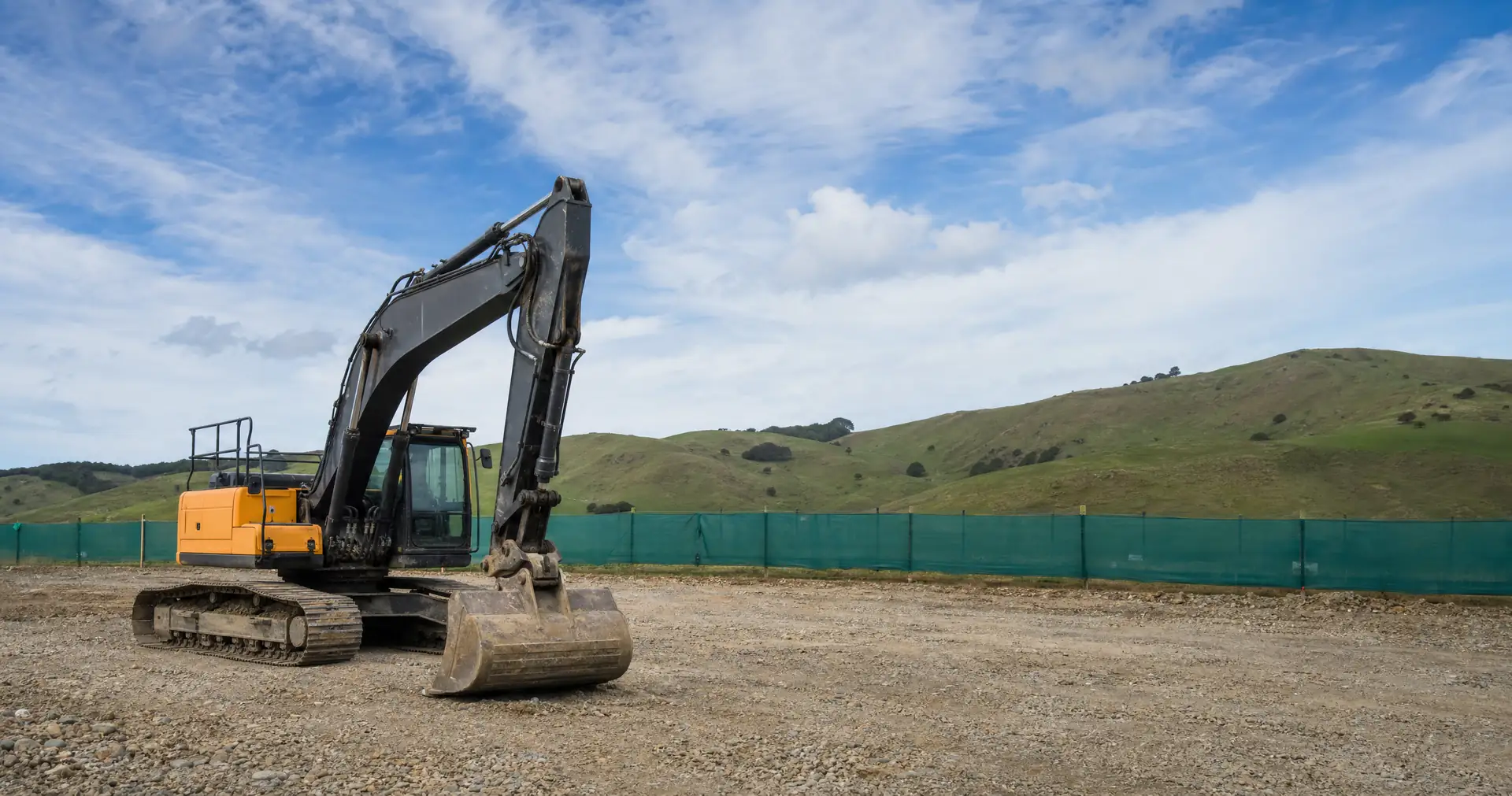
Excavator and earthmoving finance for New Zealand civil and site contractors .
Earthmoving plant finance in NZ runs from a 1.7 tonne mini-excavator on a domestic landscape build through to 30 tonne tracked excavators, 25 tonne articulated dump trucks, and dozers on subdivision and roading work. CablePrice (Caterpillar), Goughs (Komatsu), and AB Equipment (Hitachi) dominate the dealer pool.
What you need to know about NZ excavator and earthmoving finance.
→Mini-excavator (1.7-5 tonne) commonly $30K to $90K Kubota U17, U27, U35, and Yanmar SV mini-excavators dominate the small-tonne pool used by landscapers, drainlayers, and small-site builders.
→Mid-size tracked excavator (8-14 tonne) commonly $120K to $260K Caterpillar 308, 313, Komatsu PC88, PC138, Hitachi ZX135 are the dominant NZ civil-contractor mid-tonne picks for subdivision and infrastructure work.
→WorkSafe operator certification expected on plant above 5 tonne Site PCBUs running excavators above 5 tonne typically expect operator competency evidence under the Health and Safety at Work Act 2015 and Approved Code of Practice for Excavation.
→CablePrice (CAT), Goughs (Komatsu), AB Equipment (Hitachi) NZ dealer pool is concentrated among three principal franchises plus Kubota Construction NZ for the small-tonne segment.
The landscape
Earthmoving plant finance overlays heavy capex with WorkSafe site competency obligations.
New Zealand's earthmoving plant pool reflects two demand cycles. Subdivision and residential construction drive mid-tonne excavator and skid-steer demand, with civil contractors running 8 to 14 tonne machines on driveway, drainage, and site preparation work. Roading, infrastructure, and quarry work drive the 20 to 30 tonne excavator, articulated dump truck, and dozer demand, with NZTA and council civil-works contracts shaping the larger-fleet capex pattern.
Three structures dominate earthmoving plant lending. A chattel mortgage on the machine secures the loan against the asset and is the cheapest tier; UDC Finance, Heartland Bank, Whiting Financial, and Speirs Finance all participate. A finance lease suits operators preferring fixed monthly rentals across the asset life. Manufacturer captive finance (Caterpillar Financial Services, Komatsu Financial) commonly runs alongside dealer promotions on new plant, sometimes with deferred-payment or low-deposit structures during quiet sales periods.
Operator profile and site competency materially shape the application. Civil contractors carrying Site Safe membership, WorkSafe operator competency records, and prequalification with Tier 1 head contractors (Fulton Hogan, Downer, Higgins, Fletcher Construction) commonly access tighter pricing. Subdivision and residential earthmoving operators with documented contract pipelines (council subdivisions, group home builders, infrastructure subcontracts) similarly tighten the lender file.
Mini-excavator (1.7-5 tonne)
$30K to $90K
Mid-size excavator (8-14 tonne)
$120K to $260K
20-30 tonne excavator
$280K to $500K
Term loan term
5 to 7 years
Earthmoving finance scenarios
Four common NZ earthmoving plant finance scenarios.
Most earthmoving plant applications fall into one of four patterns. Each pattern has a typical loan amount, structure, and lender pool.
Mini-excavator entry for landscape or drainlayer
Landscape, drainlayer, or small-site builder buying a Kubota U27 or U35 mini-excavator with tilting hitch and bucket set. Total project commonly $45K-$80K including plant trailer. Chattel mortgage on a 5 year term.
·Loan amount: $40K to $75K
·Term: 5 years
Mid-tonne CAT or Komatsu for subdivision work
Civil contractor adding a Caterpillar 313 or Komatsu PC138 (13 tonne) for subdivision and earthworks runs. Tilting hitch, GPS-ready, hydraulic thumb. Class 4 or 5 truck-and-trailer commonly bought alongside for plant transport.
·Loan amount: $180K to $260K
·Term: 5 to 7 years
20-30 tonne plant for roading or quarry
Roading or quarry contractor commissioning a 25 tonne CAT 325 or Komatsu PC290. Often bundled with an articulated dump truck (CAT 730, Volvo A30) for site haul. Capital outlay materially higher; longer 6 to 7 year terms reflect asset life.
·Loan amount: $400K to $1.2M combined
·Term: 6 to 7 years
Working capital for fuel, RUC, parts
Established earthmoving operator drawing on a revolving facility to smooth the gap between progress claims under Construction Contracts Act 2002 and weekly diesel, Road User Charges on float trucks, and parts spend. Repaid out of certified progress payments.
·Limit: $30K to $120K
·Structure: Revolving line of credit
What earthmoving operators borrow for
Six common NZ earthmoving plant loan purposes.
Earthmoving lending volume falls into six common purposes. Each has a typical structure that fits.
Tracked excavators (1.7 to 30 tonne)
Caterpillar, Komatsu, Hitachi, Kubota, Volvo, JCB. Tilting hitch, hydraulic thumb, bucket set, GPS prep. Chattel mortgage on a 5-7 year term. Used machines 3-7 years old common at the entry tier.
Articulated dump trucks and rigid dumpers
CAT 730, Volvo A30, Bell B30 articulated dumpers for quarry and large civil sites. Site dumpers (Thwaites, Terex) at the smaller end. Asset finance on a 5-7 year term tracking site-haul utilisation.
Dozers and motor graders
Caterpillar D6, Komatsu D65 dozers and CAT 140M, John Deere 770G graders for roading, subdivision pad work, and bulk earthworks. Larger asset values; commonly 6-7 year terms.
Wheel loaders and skid-steer loaders
Caterpillar 950, Volvo L90, Komatsu WA320 wheel loaders for quarry and stockpile work. Bobcat and Caterpillar 246 skid-steers for tight-site demolition and landscape. Asset finance on a 5-year term.
Plant trailers and float decks
Tandem and tri-axle plant trailers, low-loader float decks for excavator transport between sites. Often paired with the primary excavator purchase. Asset finance on a 5-year term.
Working capital for civil contractors
Revolving facility covering fuel, RUC on float trucks, oil and parts, and the gap between certified progress claims under Construction Contracts Act 2002 and supplier payment cycles.
Tax, GST, and depreciation
How GST, IRD earthmoving plant depreciation, and FBT typically work on excavators and earthmoving plant.
A GST-registered earthmoving or civil contractor can typically claim the GST component on excavators, dump trucks, dozers, loaders, and plant trailers as input tax in the relevant GST return, subject to the accountant's confirmation. Where the asset is acquired under chattel mortgage, the full GST is typically claimable upfront in the next GST return after settlement. Where it is acquired under finance lease or operating lease, GST is typically claimed across the rental payments. IRD publishes earthmoving plant depreciation rates within the construction asset class, with diminishing-value and straight-line options commonly applied to excavators, dump trucks, dozers, loaders, and graders. FBT considerations are typically limited because earthmoving plant is purpose-built work equipment with no private-use scope, but the accountant remains the right person to confirm structure choice, depreciation schedule, and any FBT or private-use apportionment on the specific business position. Road User Charges (RUC) on diesel float trucks transporting plant between sites are an operating cost separate from the finance treatment of the plant itself.
Earthmoving plant bands
Indicative NZ earthmoving plant finance bands.
Plant pricing varies by tonnage, attachments, age, and dealer. The bands below are observed across the NZ earthmoving plant finance pool in 2026.
Large excavator 20-30 tonne (CAT 325, Komatsu PC290, Hitachi ZX300)
$200K to $360K
$360K to $560K
6 to 7 years
Articulated dump truck (CAT 730, Volvo A30)
$280K to $480K
$580K to $850K
6 to 7 years
Dozer (CAT D6, Komatsu D65)
$200K to $380K
$420K to $700K
6 to 7 years
Skid-steer loader (Bobcat S630, CAT 246)
$45K to $80K
$85K to $130K
5 years
Indicative bands only. Actual price depends on hours, attachments, condition, and dealer. Final rate, fee, and approval decisions are made by the lender after assessment.
Mini-excavator vs mid-tonne vs large plant
Mini-excavator vs mid-tonne civil plant vs 20-30 tonne plant.
The structure choice tracks site profile, contract pipeline, and capex appetite. Mini-excavators suit drainlayers, landscapers, and small-site builders; mid-tonne plant suits subdivision and infrastructure civil contractors; 20-30 tonne plant suits roading and quarry work.
Feature
Mini-excavator (1.7-5 tonne)
Mid-tonne excavator (8-14 tonne)
20-30 tonne excavator + dump truck
Typical asset value
$30K to $90K
$120K to $260K
$400K to $1.2M combined
Typical operator
Drainlayer, landscaper, small-site builder
Civil contractor, subdivision earthworks
Roading contractor, quarry operator
WorkSafe competency expectation
Operator competency under HSWA 2015
Operator certification typically expected
Operator certification, plant-specific competency, Site Safe Gold Card common
Typical loan term
5 years
5 to 7 years
6 to 7 years
Plant transport
Tandem trailer behind a ute
Tri-axle plant trailer behind Class 4 truck
Low-loader float deck behind heavy combination
Lender comfort
Strong with documented landscape or drainlayer pipeline
Strong with Tier 1 head-contractor prequalification
A typical NZ earthmoving plant finance application.
Earthmoving plant applications carry a WorkSafe operator competency and Construction Contracts Act 2002 contract-pipeline step that smaller equipment finance applications do not. Established civil contractors with multi-year fleet trading move faster.
01
Day 1 to 7
Define the plant spec and structure
A typical earthmoving plant loan is a chattel mortgage on the primary machine, with optional asset finance on attachments (tilting hitch, hydraulic thumb, bucket set), the plant trailer or float deck, and a small working-capital line covering fuel, RUC, and parts.
Documents commonly required
·Plant quote or sale agreement (CablePrice, Goughs, AB Equipment, Kubota Construction)
·Attachment quotes
·Plant trailer or float deck quote
02
Day 3 to 14
Submit application with civil-contractor documents
Beyond the standard SME application pack, earthmoving lenders ask for evidence of WorkSafe operator competency under the Health and Safety at Work Act 2015, contract-pipeline evidence (Tier 1 head-contractor prequalifications, council civil contracts, subdivision works contracts), and 12 to 24 months of trading data for an established civil contractor.
Documents commonly required
·NZBN, business owner ID
·12 to 24 months business bank statements
·Last 2 years financial statements (established contractor)
·Contract or letter of intent supporting plant utilisation
·Public liability and plant insurance quotes
03
Day 7 to 21
Lender assessment and offer
Lenders assess against three things: the security position on the plant (LVR after deposit and any trade-in), the contract pipeline supporting plant utilisation under Construction Contracts Act 2002 progress-payment cycles, and the operator profile (WorkSafe competency, prior fleet trading, Tier 1 prequalifications). Offers commonly come back with conditions: deposit, additional security, or staged drawdowns where the plant is on order from the dealer.
04
Week 2 onward
Settle, register PPSR, take delivery
Asset finance settles directly to the dealer (CablePrice, Goughs, AB Equipment, Kubota Construction) on plant collection or delivery. The lender registers a security interest on the Personal Property Securities Register (PPSR) for each financed asset. Plant insurance and operator competency confirmation in place before first site use. First plant deployment commonly within 1 to 4 weeks of settlement on dealer-stock units.
A heavy plant finance broker familiar with CablePrice, Goughs, AB Equipment, and the Tier 1 civil contractor prequalification framework commonly tightens the indicative rate band and reduces the documentation cycle versus a direct application to a generic SME lender.
Worked scenarios
Three NZ earthmoving plant finance scenarios.
Real-world structures across mini-excavator entry, mid-tonne civil contractor expansion, and 20-30 tonne quarry-tier acquisition. Each illustrates how operator profile, contract pipeline, and trading history shift the offered rate.
Drainlayer, single-operator entry to mechanised drainage
Hawke's Bay drainlayer mini-excavator entry
A Hawke's Bay drainlayer with 4 years of hand-dig and hire-plant trading buying a first owned excavator package. Total project $78,000 ex-GST: $58,000 new Kubota U35-4 mini-excavator, $7,000 tilting hitch and bucket set (mud, trench, GP), $13,000 tandem plant trailer with electric brakes. 15% deposit ($11,700) from existing trading.
Structure agreed with a plant finance broker: chattel mortgage on the Kubota and attachments ($55,250 after deposit, 5-year term, indicative 9-11% p.a.), separate chattel mortgage on the trailer ($11,050 after deposit, 5-year term, indicative 9-11% p.a.). UDC Finance funded the package based on existing trading and an upcoming subdivision drainage subcontract.
WorkSafe operator competency confirmed via existing hire-plant operating record and a 1-day Kubota dealer familiarisation session. PPSR security interest registered against the Kubota and trailer at settlement. First subdivision drainage run within 2 weeks of plant delivery from Kubota Construction NZ Hawke's Bay branch.
Indicative figures
Total project
$78,000
Kubota U35-4 + attachments
$65,000
Chattel mortgage (plant)
$55,250
Indicative blended rate
9-11% p.a.
Civil contractor adding mid-tonne plant for subdivision contract
Auckland civil contractor mid-tonne expansion
An Auckland civil contractor with 7 vehicles and 3 existing excavators adding a Caterpillar 313 GC (13 tonne) and a CAT 246D3 skid-steer to support a new 4-stage subdivision contract. Total project $345,000 ex-GST: $245,000 new CAT 313 GC with tilting hitch and bucket set, $90,000 new CAT 246D3 skid-steer with bucket and forks, $10,000 GPS prep. 20% deposit ($69,000).
Existing 5 years of trading data, Site Safe membership, and Tier 1 head-contractor prequalifications with Fulton Hogan and Downer materially tightened the indicative rate band. Chattel mortgage on the CAT 313 ($196,000 after deposit, 7-year term, indicative 8-10% p.a.). Chattel mortgage on the skid-steer ($72,000 after deposit, 5-year term, indicative 8-10% p.a.). Heartland Bank funded the package on the existing fleet relationship.
WorkSafe operator competency evidenced for both machines via existing operator records. PPSR security interest registered against each asset at settlement. Plant delivered through CablePrice Auckland branch over a 4-week window. First subdivision earthworks run within 6 weeks of order.
Indicative figures
Total project
$345,000
CAT 313 GC
$245,000
CAT 246D3 skid-steer
$90,000
Indicative rate
8-10% p.a.
Quarry operator commissioning excavator and articulated dump truck
Otago quarry operator 25 tonne plant package
An Otago quarry operator with 12 years of trading commissioning a 25 tonne excavator and articulated dump truck package to support an expanded aggregate supply contract with a roading head contractor. Total package $1,180,000 ex-GST: $520,000 new Komatsu PC290LC-11 with rock bucket, $620,000 new Komatsu HM300-5 articulated dump truck, $40,000 commissioning, training, and telematics setup. 15% deposit ($177,000) from existing operating cash.
Established quarry trading data and a 5-year aggregate supply contract drove lender confidence. Chattel mortgage on the PC290 ($442,000 after deposit, 7-year term, indicative 8-10% p.a.), separate chattel mortgage on the HM300 ($527,000 after deposit, 7-year term, indicative 8-10% p.a.). Komatsu Financial funded the package alongside Heartland heavy equipment.
WorkSafe operator certification evidenced for both machines; supplementary plant-specific competency training delivered by Goughs at quarry handover. PPSR security interest registered against each asset at settlement. Plant delivered over an 8-week build window through Goughs Cromwell. First aggregate haul within 2 weeks of final commissioning.
Indicative figures
Total package
$1,180,000
Komatsu PC290 excavator
$520,000
Komatsu HM300 dump truck
$620,000
Indicative blended rate
8-10% p.a.
NZ earthmoving plant lenders
Lenders that fund NZ earthmoving and civil contractors well.
Several NZ lenders carry deep familiarity with the earthmoving plant finance segment. The shortlist below is editorial.
Indicative shortlist. Final rate, fee, and approval decisions are made by each lender after assessment. Manufacturer captives (Caterpillar Financial Services, Komatsu Financial) commonly run alongside the dealer offer on new plant.
Where earthmoving plant finance fits
When earthmoving plant finance is straightforward, and when it gets harder.
Where it works smoothly
·Established civil or earthmoving contractor with 2+ years of fleet trading
·Tier 1 head-contractor prequalifications (Fulton Hogan, Downer, Higgins, Fletcher Construction) or council civil contracts
·WorkSafe operator competency evidence under the Health and Safety at Work Act 2015
·Site Safe membership and Gold Card operator records
·Plant within typical age band (under 7 years for used, new from CablePrice, Goughs, AB Equipment, Kubota Construction)
·Deposit of 15-25% of the plant price from existing fleet trading
Where it gets harder
·First-time operator with no prior fleet trading or contract pipeline
·Plant older than 10 years or with high hours and limited service history
·WorkSafe enforcement notices or HSWA 2015 prosecutions on the existing operator profile
·Specialist or modified plant with limited NZ secondary market
·Reliance on a single contract relationship without diversification
NZ construction sector framework covering procurement, safety, and contractor relationships referenced in the file.
FAQ
Excavator and earthmoving finance, NZ small-business questions answered
How much does an excavator cost to finance in NZ in 2026?
NZ excavator finance commonly sits in the $30,000 to $500,000 band depending on tonnage and spec. A new Kubota U27 mini-excavator runs around $55,000 to $75,000; a new Caterpillar 313 mid-tonne excavator runs around $245,000 to $290,000; a new Komatsu PC290 25 tonne excavator runs around $480,000 to $560,000. Used 3 to 7 year machines commonly sit at 50-70% of the new price depending on hours and condition. Articulated dump trucks, dozers, and motor graders carry their own bands at the upper tier of the earthmoving plant pool.
What licence or certification is required to operate an excavator in NZ?
There is no NZTA driver licence requirement for operating an excavator on a private site, but operators are expected to hold demonstrable competency under the Health and Safety at Work Act 2015 and the WorkSafe Approved Code of Practice for Excavation. Site PCBUs (Persons Conducting a Business or Undertaking) typically expect operator competency evidence on plant above 5 tonne, often via a Site Safe Passport, Gold Card, or NZQA-aligned plant operator unit standards. Civil Contractors NZ and Site Safe both publish operator competency frameworks. Plant transported on public roads still requires Class 4 or 5 driver licences for the float truck depending on combination weight.
What rate range applies to NZ excavator and earthmoving plant finance in 2026?
Indicative rates on NZ earthmoving plant finance commonly sit in the 8% to 13% per annum band depending on structure, security, and operator profile. Chattel mortgage on new mid-tonne or larger plant for an established civil contractor with Tier 1 head-contractor prequalifications sits at the lower end (commonly 8-10%). Used plant and mid-band operator profiles sit in the middle (commonly 10-12%). First-time operators or specialised plant sit at the upper end (commonly 11-13%+). Final rate is set by the lender after assessment.
How does the WorkSafe operator competency requirement affect a finance application?
NZ earthmoving lenders commonly ask for evidence of WorkSafe operator competency on plant above 5 tonne as part of the application pack, alongside Site Safe membership and any Tier 1 head-contractor prequalifications. The Health and Safety at Work Act 2015 places duties on PCBUs to ensure operator competency, and lenders treat documented competency as a positive operator-profile indicator. Operators with WorkSafe enforcement notices, HSWA 2015 prosecutions, or repeated site safety breaches commonly face tighter pricing or additional security conditions on the loan.
Can GST be claimed on an excavator under chattel mortgage?
A GST-registered earthmoving or civil contractor can typically claim the GST component on excavators, dump trucks, dozers, loaders, and plant trailers as input tax in the relevant GST return, subject to the accountant's confirmation. Where the plant is acquired under chattel mortgage, the full GST is typically claimable upfront in the next GST return after settlement. Where it is acquired under finance lease, GST is typically claimed across the rental payments. The structure choice affects cash-flow timing more than total cost over the life of the loan. The accountant is the right person to confirm structure choice on the specific business position.
How does IRD depreciation work on earthmoving plant?
IRD publishes depreciation rates within the construction and earthmoving asset class, with diminishing-value and straight-line options commonly applied to excavators, dump trucks, dozers, motor graders, and skid-steer loaders. Excavators and earthmoving plant commonly attract depreciation rates that reflect typical NZ working life of 7 to 10 years for primary machines. Specialist attachments (tilting hitches, hydraulic thumbs, bucket sets, GPS systems) may attract their own rates. The accountant is the right person to confirm the applicable IRD rate, the diminishing-value vs straight-line election, and any pooled-asset treatment on the specific business position.
What lenders specialise in NZ excavator and earthmoving plant finance?
UDC Finance, Heartland Bank heavy equipment team, Whiting Financial, Speirs Finance, and Real Asset Finance are the long-standing NZ specialist asset-finance lenders for the earthmoving plant pool. Manufacturer captives Caterpillar Financial Services and Komatsu Financial commonly run alongside dealer offers on new plant, sometimes with deferred-payment or low-deposit promotional structures. Major banks ANZ and BNZ business banking cover larger relationship-managed civil contractor accounts at the upper tier. A heavy plant finance broker familiar with CablePrice, Goughs, AB Equipment, and Kubota Construction NZ commonly tightens the indicative rate band.
What is the typical loan term for an excavator?
NZ excavator finance commonly runs 5 to 7 year loan terms. Mini-excavators (1.7 to 5 tonne) commonly attract 5 year terms reflecting typical working life and resale dynamics. Mid-tonne excavators (8 to 14 tonne) commonly attract 5 to 7 year terms depending on hours and contractor utilisation. 20 to 30 tonne excavators and articulated dump trucks commonly attract 6 to 7 year terms reflecting longer asset life and the higher capex involved. The loan term should fit within the expected useful life of the plant for the use case, and lenders commonly will not write a loan term that exceeds the practical residual life of the asset.
How do Tier 1 head-contractor prequalifications affect the application?
Tier 1 head-contractor prequalifications with Fulton Hogan, Downer, Higgins, Fletcher Construction, HEB, Brian Perry Civil, and similar materially support a finance application. Lenders treat prequalification as evidence of operator competency, financial standing, and contract pipeline, and commonly tighten the indicative rate band where the operator presents current prequalifications alongside the application. Civil contractors building toward prequalified status commonly use the prequalification process itself to professionalise the operator profile, which then supports tighter finance pricing on subsequent plant purchases.
What happens to financed plant if the contractor business closes?
Where the plant is financed under chattel mortgage and the contractor business closes before the loan is repaid, the lender typically has a security interest registered on the Personal Property Securities Register (PPSR) and can take possession of the plant to recover the outstanding balance. Any shortfall between resale value and balance owing typically falls to the borrower and any personal guarantor. Used NZ earthmoving plant typically retains 45-70% of value over a 5 to 7 year hold period depending on hours, condition, and service history; well-maintained Caterpillar, Komatsu, and Kubota plant commonly hold value better than less common dealer-supported brands.
Can specialist attachments (hitches, thumbs, bucket sets) be financed alongside the excavator?
Yes. NZ asset-finance lenders commonly bundle the primary excavator with attachments (tilting hitches, hydraulic thumbs, mud buckets, trench buckets, GP buckets, GPS prep) under a single chattel mortgage or as a small separate asset finance line. Tilting hitch and hydraulic thumb add commonly $8,000 to $25,000 to the package; full bucket sets and GPS prep add $5,000 to $20,000. Lenders treat the attachment bundle as part of the working asset because attachments materially affect productivity and resale value across the plant working life.
How does the Construction Contracts Act 2002 affect earthmoving working capital?
The Construction Contracts Act 2002 sets out the progress-payment, payment-schedule, and 5% retentions framework that shapes earthmoving and civil contractor cash flow. Civil contractors commonly draw on a working-capital line of credit to smooth the gap between certified progress claims (commonly monthly) and supplier or subcontractor payment cycles (commonly 7 to 30 days). The 5% retention held by the head contractor until practical completion further tightens working capital on each contract. Working-capital lines of credit are commonly sized to cover one full progress-claim cycle plus a buffer for fuel, RUC on float trucks, and parts spend.
Can used heavy plant be financed in NZ?
Yes. Used NZ earthmoving plant is financeable through specialist asset-finance lenders including UDC Finance, Heartland Bank heavy equipment, Whiting Financial, Speirs Finance, and Real Asset Finance. Plant within 7 years of age and under typical hour bands (commonly under 8,000 hours for mid-tonne, under 12,000 hours for large excavators) commonly attracts mainstream pricing. Older or higher-hour plant commonly attracts tighter loan-to-value ratios, shorter terms, or specialist lender pricing. CablePrice, Goughs, and AB Equipment used-plant divisions provide service history and inspection records that materially support used-plant finance applications.
How do manufacturer captive finance offers (CAT Financial, Komatsu Financial) compare to bank lenders?
Caterpillar Financial Services and Komatsu Financial commonly run alongside CablePrice and Goughs new-plant offers, often with deferred-payment, low-deposit, or seasonal-payment structures during quiet sales periods. Captive finance can be cheaper than mainstream lender pricing where a manufacturer subsidy is in play, particularly on dealer demonstrator stock or model-changeover units. Captive finance terms are typically tied to the specific dealer, plant, and promotional period; mainstream lender finance through UDC, Heartland, Whiting, Speirs, or Real Asset Finance offers more flexibility on multi-brand fleets and used-plant additions.
Indicative content only. Not personalised financial advice.
A business loan is a commitment that runs for months or years, and repayments come out of the same operating cash flow as everything else. Before committing, it is worth modelling the weekly and monthly cost against the business's working-capital position, which is what this site is built to help with. Borrowing at a level that stays comfortable through a quiet quarter, not just a strong one, is widely regarded as the safer frame.
What this site is
A calculator and information tool. Not a lender, not a broker, not a registered financial adviser. Nothing here is personalised financial advice.
What the figures show
Modelled estimates based on the inputs you enter. Not a quote. Not an offer of credit. Not a guarantee of approval, rate, or fees.
What the lender decides
Final rates, fees, and approval are set by the lender after a CCCFA-appropriate assessment of the applicant's circumstances and credit decision.
Commercial disclosure
Businessloans.org.nz earns a commission from Prospa when a visitor applies through this site and their application is approved. The commission is paid by Prospa, not by the borrower, and it does not influence the rate Prospa offers. Full disclosure on the partner page.
Tax, GST, and accountant framing
Tax-treatment statements (GST claim timing, interest deductibility, depreciation rates) are general in nature and subject to your accountant's confirmation on the specific business position. For material amounts, professional advice from a registered financial adviser or chartered accountant is widely regarded as the safer frame.