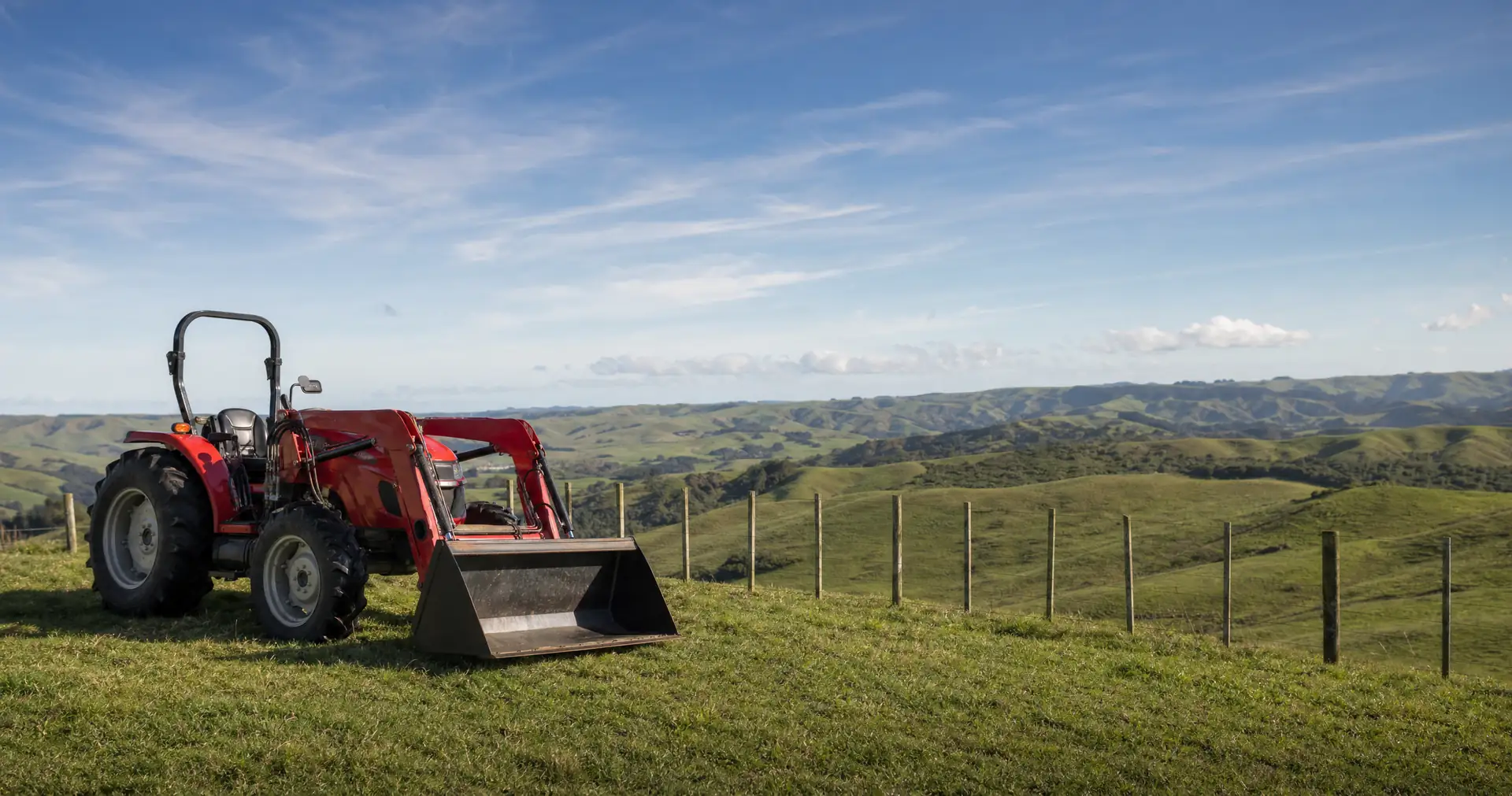
Tractor finance for New Zealand farmers and agricultural contractors .
NZ tractor finance runs from a 40 horsepower Kubota L-Series on a lifestyle block through to 300+ horsepower John Deere 8R and Case IH Magnum tractors on dairy and arable farms. Power Farming (Kubota agriculture, Deutz-Fahr), Norwood (Kubota M-Series, Case IH, McCormick), and Cervus / John Deere Financial dominate the dealer pool.
→Compact tractor (40-75 HP) commonly $40K to $90K Kubota L-Series, John Deere 5E, Massey Ferguson 4700, New Holland Boomer dominate the lifestyle-block and small-farm pool sold through Power Farming and Norwood.
→Mid-HP utility (90-150 HP) commonly $130K to $260K John Deere 6M, Case IH Maxxum, New Holland T6, Massey Ferguson 6S, and Kubota M7 are the dominant NZ dairy and mixed-farming workhorse picks.
→ROPS compliance under HSWA 2015 expected on all in-use tractors Roll-Over Protective Structure (ROPS) and seatbelt fitment are core WorkSafe compliance items on agricultural tractors under the Health and Safety at Work Act 2015 and Approved Code of Practice for Tractors.
→Power Farming (Kubota ag, Deutz-Fahr), Norwood (Case IH), Cervus (John Deere) NZ ag tractor dealer pool is concentrated among three principal franchises, supplemented by AGCO (Massey Ferguson, Fendt, Valtra) regional dealers.
The landscape
Tractor finance overlays farm capex with WorkSafe ROPS compliance and IRD agricultural depreciation.
New Zealand's tractor pool reflects four primary demand cycles. Dairy farms (Waikato, Taranaki, Canterbury, Southland) drive mid-horsepower 90 to 150 HP demand for feed, effluent, and pasture work. Sheep and beef farms (Hawke's Bay, Wairarapa, King Country, Otago) drive a mix of utility and 4WD tractor demand for tracks, fencing, and water reticulation. Arable and contracting operations (Canterbury, Manawatu, Southland) drive the 180 to 320 HP demand for cultivation, baling, and harvest work. Lifestyle block and small-farm operators across the country drive the 40 to 75 HP compact tractor pool.
Three structures dominate tractor lending. A chattel mortgage on the tractor secures the loan against the asset and is the cheapest tier; UDC Finance, Heartland rural agribusiness, and Rabobank-aligned brokers all participate. A finance lease suits operators preferring fixed monthly rentals across the asset life. Manufacturer captive finance (CNH Industrial Capital for Case IH and New Holland, John Deere Financial, Kubota Credit, AGCO Finance) commonly runs alongside dealer promotions on new tractors, sometimes with deferred-payment, harvest-payment, or zero-deposit structures during shoulder seasons.
Operator profile and farm trading data materially shape the application. Established dairy, sheep and beef, or arable operators with multi-year financial accounts, Fonterra or other supply contracts, and clean Overseer or farm environment plan records commonly access tighter pricing. Farm succession structures, including parent-child equity partnerships and Maori incorporation farms, carry their own structural overlays that experienced rural lenders and brokers familiar with farm equity transitions handle routinely.
Compact tractor (40-75 HP)
$40K to $90K
Mid-HP utility (90-150 HP)
$130K to $260K
Arable / contracting (180-320 HP)
$280K to $600K
Term loan term
5 to 7 years
Tractor finance scenarios
Four common NZ tractor finance scenarios.
Most tractor applications fall into one of four patterns. Each pattern has a typical loan amount, structure, and lender pool.
Compact tractor for lifestyle block or small farm
Lifestyle block or small-farm operator buying a Kubota L-Series, John Deere 5E, or Massey Ferguson 4700 (40 to 75 HP) with front-end loader and basic implement set. Total project commonly $55K-$95K. Chattel mortgage on a 5 year term.
·Loan amount: $50K to $85K
·Term: 5 years
Mid-HP utility for dairy or mixed farming
Dairy or sheep and beef farm replacing or adding a 90 to 150 HP tractor. John Deere 6M, Case IH Maxxum, New Holland T6, Massey Ferguson 6S, or Kubota M7. Front-end loader, mid-mount mower deck, and PTO implement bundle commonly included.
·Loan amount: $150K to $260K
·Term: 5 to 7 years
Arable or contracting 180-320 HP tractor
Arable farm or agricultural contractor commissioning a 200 to 300 HP John Deere 7R, Case IH Magnum, Fendt Vario, or New Holland T7. Often bundled with cultivation and seeding implements; harvest-tier capex.
·Loan amount: $300K to $580K
·Term: 6 to 7 years
Working capital for seasonal cash flow
Established farm operator drawing on a seasonal facility to smooth the gap between Fonterra milk payment cycles, livestock sale proceeds, and weekly fuel, fertiliser, and feed spend. Repaid out of milk and livestock revenue.
·Limit: $50K to $250K
·Structure: Seasonal line of credit
What farmers and contractors borrow for
Six common NZ tractor and ag implement loan purposes.
Tractor and ag implement lending volume falls into six common purposes. Each has a typical structure that fits.
Tractors (40 to 320 HP)
John Deere, Case IH, New Holland, Massey Ferguson, Kubota, Deutz-Fahr, Fendt, Valtra. Front-end loader, cab spec, transmission choice, and PTO power shape the price. Chattel mortgage on a 5-7 year term.
Cultivation and seeding implements
Plough, power harrow, disc cultivator, seed drill, direct drill, fertiliser spreader. Asset finance against each implement. $20K-$180K depending on width and spec; often bundled with the primary tractor.
Hay, silage, and baling equipment
Mowers, rakes, tedders, round and square balers, wrappers, silage wagons. Asset finance on a 5-7 year term. Hay-and-silage capex commonly bundled with mid-HP or arable tractor purchase.
Effluent, irrigation, and water
Slurry tankers, effluent applicators, irrigators, water pumps, water-tank trailers. Important on dairy and intensive horticulture operations. Asset finance staged across components where appropriate.
Trailers, loaders, and ag vehicles
Tipping trailers, livestock trailers, multi-purpose trailers, telehandlers, side-by-side ATVs. Often financed alongside the primary tractor, particularly on mixed and contracting operations.
Seasonal working capital
Seasonal line of credit covering the gap between Fonterra milk payment cycles, livestock sale proceeds, and weekly fuel, fertiliser, and feed spend. Common across dairy, sheep and beef, and arable operations.
Tax, GST, and depreciation
How GST, IRD agricultural equipment depreciation, and FBT typically work on tractors and ag implements.
A GST-registered farm or agricultural contractor can typically claim the GST component on tractors, ag implements, trailers, and effluent or irrigation kit as input tax in the relevant GST return, subject to the accountant's confirmation. Where the asset is acquired under chattel mortgage, the full GST is typically claimable upfront in the next GST return after settlement. Where it is acquired under finance lease or operating lease, GST is typically claimed across the rental payments. IRD publishes agricultural equipment depreciation rates within the agriculture asset class, with diminishing-value and straight-line options commonly applied to tractors, balers, harvesters, cultivation equipment, and effluent kit. FBT considerations are typically limited because farm tractors are purpose-built work equipment with no private-use scope, but the accountant remains the right person to confirm structure choice, depreciation schedule, and any FBT or private-use apportionment on lifestyle block use cases. Road User Charges (RUC) on diesel farm vehicles are managed through the Off-Road Use exemption framework where applicable, separate from the finance treatment of the tractor itself.
Tractor and implement bands
Indicative NZ tractor and ag implement finance bands.
Tractor pricing varies by horsepower, cab spec, transmission, loader inclusion, and dealer. The bands below are observed across the NZ tractor finance pool in 2026.
Asset category
Used (3-7 yr)
New
Common term
Compact tractor 40-50 HP (Kubota L, JD 5E)
$30K to $50K
$50K to $75K
5 years
Utility tractor 60-90 HP (Massey 4700, Kubota M5)
$50K to $90K
$80K to $140K
5 to 7 years
Mid-HP 90-150 HP (JD 6M, Case Maxxum, NH T6)
$110K to $190K
$170K to $290K
5 to 7 years
High-HP 150-200 HP (JD 6R, Case Puma, Fendt 700)
$170K to $280K
$260K to $400K
6 to 7 years
Arable / contracting 200-320 HP (JD 7R/8R, Case Magnum, Fendt 900)
$280K to $480K
$420K to $750K
6 to 7 years
Round baler (McHale, Krone, JD)
$40K to $90K
$110K to $200K
5 to 7 years
Front-end loader (bundled or aftermarket)
$8K to $18K
$18K to $35K
5 years
Indicative bands only. Actual price depends on hours, attachments, cab spec, and dealer. Final rate, fee, and approval decisions are made by the lender after assessment.
Compact vs mid-HP vs arable / contracting
Compact tractor vs mid-HP utility vs arable / contracting tractor.
The structure choice tracks farm operation type, contract pipeline, and capex appetite. Compact tractors suit lifestyle blocks and small farms; mid-HP utility tractors suit dairy and sheep and beef workhorse use; arable and contracting tractors suit cultivation, harvest, and on-hire contracting operations.
Feature
Compact tractor (40-75 HP)
Mid-HP utility (90-150 HP)
Arable / contracting (180-320 HP)
Typical asset value
$40K to $90K
$130K to $260K
$280K to $600K
Typical operator
Lifestyle block, small farm, viticulture
Dairy, sheep and beef, mixed farming
Arable farm, agricultural contractor
WorkSafe / ROPS expectation
ROPS and seatbelt fitment under HSWA 2015
ROPS, seatbelt, PTO guarding under HSWA 2015
ROPS, seatbelt, full operator competency, contracting H&S system
Cultivation, seeding, baling, sprayers, large trailers
Lender comfort
Strong with farm trading or stable lifestyle income
Strong with dairy or sheep and beef trading data
Strongest with arable or contracting trading and contract pipeline
How it works
A typical NZ tractor finance application.
Tractor applications carry a farm trading data and ROPS compliance step that smaller equipment finance applications do not. Established farm operators with multi-year financial accounts move faster.
01
Day 1 to 7
Define the tractor spec and structure
A typical tractor loan is a chattel mortgage on the primary tractor, with optional asset finance on implements (front-end loader, mower, baler, cultivation kit), trailers, and a seasonal working-capital line covering fuel, fertiliser, and feed spend.
Documents commonly required
·Tractor quote or sale agreement (Power Farming, Norwood, Cervus, AGCO dealer)
·Implement quotes
·Loader and trailer quotes
02
Day 3 to 14
Submit application with farm trading documents
Beyond the standard SME application pack, tractor lenders ask for evidence of ROPS compliance under the Health and Safety at Work Act 2015, supply contract evidence (Fonterra, Open Country, Synlait, livestock processor), 12 to 24 months of farm financial accounts, and current Overseer or farm environment plan records where applicable.
Documents commonly required
·NZBN, business owner ID
·12 to 24 months business bank statements
·Last 2 years farm financial statements
·Fonterra, Open Country, Synlait, or livestock processor supply contract
·Overseer or farm environment plan records
·ROPS compliance evidence on existing fleet
·WorkSafe operator competency for high-HP tractors and contracting operations
·Public liability and farm vehicle insurance quotes
03
Day 7 to 21
Lender assessment and offer
Lenders assess against three things: the security position on the tractor (LVR after deposit and any trade-in), the farm trading and supply contract evidence supporting tractor utilisation, and the operator profile (farm trading history, ROPS compliance, contracting H&S system where relevant). Offers commonly come back with conditions: deposit, additional security, or seasonal-payment structures aligned to milk or livestock revenue cycles.
04
Week 2 onward
Settle, register PPSR, take delivery
Asset finance settles directly to the dealer (Power Farming, Norwood, Cervus, AGCO regional dealer) on tractor collection or delivery. The lender registers a security interest on the Personal Property Securities Register (PPSR) for each financed asset. ROPS compliance and tractor insurance in place before first farm use. First farm deployment commonly within 1 to 4 weeks of settlement on dealer-stock units.
A rural finance broker familiar with Power Farming, Norwood, Cervus, and the Rabobank-aligned and Heartland rural agribusiness lender pool commonly tightens the indicative rate band and aligns the repayment structure to milk or livestock revenue seasonality.
Worked scenarios
Three NZ tractor finance scenarios.
Real-world structures across compact tractor lifestyle entry, mid-HP dairy farm replacement, and arable contractor expansion. Each illustrates how farm trading data, supply contract evidence, and operator profile shift the offered rate.
Lifestyle block owner, first owned tractor
Wairarapa lifestyle block compact tractor entry
A Wairarapa lifestyle block owner with 12 hectares of pasture and a small breeding cattle operation buying a first owned tractor package. Total project $72,000 ex-GST: $58,000 new Kubota L4060HSTC compact tractor (45 HP) with front-end loader, $9,000 mid-mount mower deck and PTO slasher, $5,000 tipping trailer. 20% deposit ($14,400) from off-farm income.
Structure agreed with a rural finance broker: chattel mortgage on the Kubota and implements ($57,600 after deposit, 5-year term, indicative 9-11% p.a.). UDC Finance funded the package on a combination of the off-farm income evidence and the breeding cattle operation cash flow.
ROPS and seatbelt fitment confirmed at delivery from Power Farming Masterton. PPSR security interest registered against the Kubota and implements at settlement. First farm use within 1 week of delivery.
Indicative figures
Total project
$72,000
Kubota L4060 + loader
$58,000
Chattel mortgage
$57,600
Indicative blended rate
9-11% p.a.
Dairy farm replacing 11-year-old utility tractor
Waikato dairy farm mid-HP tractor replacement
A Waikato dairy farm milking 480 cows with 5 years of consistent Fonterra supply replacing an 11-year-old 110 HP utility tractor at end-of-economic-life. Total project $235,000 ex-GST: $215,000 new John Deere 6M120 (120 HP) with front-end loader and PTO bundle, $20,000 effluent applicator upgrade. Trade-in credit of $42,000 on the outgoing tractor.
Established Fonterra supply contract, 5 years of dairy financial accounts, and current farm environment plan records under the Waikato Regional Council framework materially tightened the indicative rate band. Chattel mortgage on the John Deere ($173,000 after trade-in, 7-year term, indicative 7-9% p.a.). Heartland rural agribusiness team funded the package alongside John Deere Financial seasonal-payment alignment.
ROPS, seatbelt, and PTO guarding confirmed at delivery from Cervus John Deere Hamilton. PPSR security interest registered against the new tractor at settlement. First milk-tanker-track and effluent run within 2 weeks of delivery.
Indicative figures
Total project
$235,000
JD 6M120
$215,000
Trade-in credit
$42,000
Chattel mortgage
$173,000
Indicative rate
7-9% p.a.
Arable farm and contracting operator scaling cultivation capacity
Canterbury arable contractor 250 HP tractor expansion
A Canterbury arable farm and contracting operator with 14 years of trading and 800 hectares of arable plus 1,200 hectares of contract cultivation work commissioning a new high-HP tractor. Total project $560,000 ex-GST: $480,000 new Case IH Magnum 250 (250 HP) with full GPS guidance and ISOBUS, $80,000 5-furrow reversible plough and 4-metre power harrow combination. 20% deposit ($112,000) from existing trading cash.
Established arable trading data, contract cultivation pipeline, and CNH Industrial Capital seasonal-payment structure drove lender confidence. Chattel mortgage on the Case IH ($384,000 after deposit, 7-year term, indicative 7-9% p.a.), separate chattel mortgage on the cultivation implements ($64,000 after deposit, 5-year term, indicative 8-10% p.a.). CNH Industrial Capital funded the tractor; Heartland rural agribusiness funded the implement bundle.
ROPS, full operator competency, and contracting H&S management plan in place. PPSR security interest registered against each asset at settlement. Tractor delivered through Norwood Ashburton over a 6-week build window. First cultivation contract within 2 weeks of delivery.
Indicative figures
Total project
$560,000
Case IH Magnum 250
$480,000
Cultivation implements
$80,000
Indicative blended rate
7-10% p.a.
NZ tractor and ag finance lenders
Lenders that fund NZ tractor and ag implement purchases well.
Several NZ lenders carry deep familiarity with the rural and agricultural asset finance segment. The shortlist below is editorial.
Indicative shortlist. Final rate, fee, and approval decisions are made by each lender after assessment. Manufacturer captives (John Deere Financial, CNH Industrial Capital, Kubota Credit, AGCO Finance) commonly run alongside the dealer offer on new tractors.
Where tractor finance fits
When tractor finance is straightforward, and when it gets harder.
Where it works smoothly
·Established dairy, sheep and beef, arable, or horticulture operator with 2+ years of farm financial accounts
·Fonterra, Open Country, Synlait, or livestock processor supply contract in place
·Current Overseer or farm environment plan records under the relevant Regional Council framework
·ROPS compliance evidence on existing tractor fleet under the Health and Safety at Work Act 2015
·Tractor within typical age band (under 7 years for used, new from Power Farming, Norwood, Cervus, or AGCO regional dealer)
·Deposit of 15-25% of the tractor price from existing farm trading
Where it gets harder
·First-year farm operator with no prior trading data
·Tractor older than 12 years or with high hours and limited service history
·WorkSafe enforcement notices or HSWA 2015 ROPS or PTO breaches on the existing fleet
·Outstanding farm environment plan or nutrient-management compliance issues
·Reliance on a single supply contract without diversification
How much does a tractor cost to finance in NZ in 2026?
NZ tractor finance commonly sits in the $40,000 to $600,000 band depending on horsepower and spec. A new Kubota L4060 compact tractor runs around $50,000 to $75,000; a new John Deere 6M120 mid-HP tractor runs around $200,000 to $260,000; a new Case IH Magnum 250 high-HP tractor runs around $420,000 to $520,000. Used 3 to 7 year tractors commonly sit at 50-70% of the new price depending on hours, condition, and cab specification. Implements (loaders, mowers, balers, cultivation kit) carry their own bands and are commonly bundled with the primary tractor purchase.
What is ROPS and why does it matter for tractor finance?
ROPS (Roll-Over Protective Structure) is a tractor cab or roll-bar structure designed to protect the operator in the event of tractor rollover. ROPS fitment, alongside a seatbelt, is a core WorkSafe compliance item under the Health and Safety at Work Act 2015 and the Approved Code of Practice for Tractors. Tractor rollover is a leading cause of NZ farm fatality, and WorkSafe has run sustained farm safety campaigns on ROPS retrofitting and seatbelt use. Lenders commonly check ROPS compliance evidence on existing fleet as part of the application; non-compliant operators face tighter pricing or additional conditions.
What rate range applies to NZ tractor finance in 2026?
Indicative rates on NZ tractor finance commonly sit in the 7% to 12% per annum band depending on structure, security, and operator profile. Chattel mortgage on a new mid-HP or high-HP tractor for an established farm operator with strong supply contract evidence sits at the lower end (commonly 7-9%). Used tractor finance and mid-band operator profiles sit in the middle (commonly 9-11%). First-year operators or specialised tractor configurations sit at the upper end (commonly 10-12%+). Final rate is set by the lender after assessment. Manufacturer captives (John Deere Financial, CNH Industrial Capital) commonly run promotional rates on new tractors during shoulder seasons.
How does seasonal-payment alignment work on a tractor loan?
NZ rural lenders and manufacturer captives commonly offer seasonal-payment structures aligned to dairy milk payment cycles (Fonterra advance and final payment timing) or arable harvest revenue. The structure shapes the loan repayment to lower monthly amounts during low-revenue months and higher amounts during high-revenue months, smoothing serviceability across the year. Heartland rural agribusiness, John Deere Financial, and CNH Industrial Capital all publish seasonal-payment options. The structure is particularly common on mid-HP and high-HP tractor finance for operators with concentrated revenue cycles.
Can GST be claimed on a tractor under chattel mortgage?
A GST-registered farm or agricultural contractor can typically claim the GST component on tractors, ag implements, trailers, and effluent or irrigation kit as input tax in the relevant GST return, subject to the accountant's confirmation. Where the asset is acquired under chattel mortgage, the full GST is typically claimable upfront in the next GST return after settlement. Where it is acquired under finance lease, GST is typically claimed across the rental payments. The structure choice affects cash-flow timing more than total cost over the life of the loan. The accountant is the right person to confirm structure choice on the specific business position.
How does IRD agricultural equipment depreciation work?
IRD publishes depreciation rates within the agriculture asset class, with diminishing-value and straight-line options commonly applied to tractors, balers, harvesters, cultivation implements, effluent applicators, and irrigation kit. Tractors commonly attract depreciation rates that reflect typical NZ farm working life of 10 to 15 years for primary machines. Implements often attract their own rates depending on the asset class. Pooled-asset treatment may be available for low-value items. The accountant is the right person to confirm the applicable IRD rate, the diminishing-value vs straight-line election, and any pooled-asset treatment on the specific business position.
What lenders specialise in NZ tractor and ag finance?
Heartland Bank rural agribusiness team, UDC Finance, and Rabobank-aligned brokers are the principal NZ specialist lenders for tractor and ag finance. Manufacturer captives John Deere Financial, CNH Industrial Capital (Case IH, New Holland), Kubota Credit, and AGCO Finance commonly run alongside dealer offers on new tractors. ANZ Agribusiness, ASB Rural, and BNZ Agribusiness cover larger relationship-managed farm accounts. A rural finance broker familiar with Power Farming, Norwood, Cervus, and AGCO regional dealers commonly tightens the indicative rate band and aligns repayment to milk and livestock revenue seasonality.
What is the typical loan term for a tractor?
NZ tractor finance commonly runs 5 to 7 year loan terms. Compact tractors (40 to 75 HP) commonly attract 5 year terms reflecting typical lifestyle and small-farm working life. Mid-HP tractors (90 to 150 HP) commonly attract 5 to 7 year terms depending on hours and farm utilisation. High-HP arable and contracting tractors (180 to 320 HP) commonly attract 6 to 7 year terms reflecting longer asset life and the higher capex involved. The loan term should fit within the expected useful life of the tractor for the farm use case.
How do supply contracts (Fonterra, Open Country, Synlait) affect a finance application?
NZ rural lenders commonly ask for supply contract evidence (Fonterra, Open Country, Synlait, livestock processor) as part of the application pack. The supply contract sets the income flow that supports loan serviceability, with milk production data, payout forecasts, and contract type (open milk supply, share-supplier, contract-supplier) all factoring into the lender assessment. Established suppliers with multi-year clean trading commonly access tighter pricing; new entrants and operators changing supply contracts mid-year commonly see additional documentation requirements.
What happens to a financed tractor if the farm changes hands?
Where the tractor is financed under chattel mortgage and the farm changes hands before the loan is repaid, the lender typically has a security interest registered on the Personal Property Securities Register (PPSR) and the loan must be settled or formally transferred as part of the farm sale. Common patterns include settling the chattel mortgage out of sale proceeds, transferring the loan to the incoming operator with lender approval, or restructuring the loan within a farm equity-partnership transition. Used NZ tractors typically retain 50-70% of value over a 5 to 7 year hold period depending on hours, condition, and service history; well-maintained John Deere, Case IH, and Kubota tractors commonly hold value better than less common dealer-supported brands.
Can implements (loader, mower, baler) be financed alongside the tractor?
Yes. NZ asset-finance lenders commonly bundle the primary tractor with implements (front-end loader, mid-mount mower, PTO slasher, round baler, square baler, plough, power harrow, seed drill, fertiliser spreader) under a single chattel mortgage or as separate asset finance lines. Front-end loader bundled with new tractors adds commonly $18,000 to $35,000 to the package; baler and cultivation kit add $40,000 to $200,000 depending on width and spec. Lenders treat the implement bundle as part of the working asset because implements materially affect productivity and resale value across the farm operating cycle.
How do manufacturer captive offers (John Deere Financial, CNH Industrial Capital) compare to bank lenders?
John Deere Financial, CNH Industrial Capital (Case IH, New Holland), Kubota Credit, and AGCO Finance commonly run alongside dealer new-tractor offers, often with promotional rates, deferred-payment, harvest-payment, or zero-deposit structures during shoulder seasons. Captive finance can be cheaper than mainstream lender pricing where a manufacturer subsidy is in play, particularly on dealer demonstrator stock or model-changeover units. Captive finance is typically tied to the specific dealer, tractor, and promotional period; mainstream lender finance through Heartland, UDC, or Rabobank-aligned brokers offers more flexibility on multi-brand fleets, used-tractor additions, and farm-wide working capital alignment.
Can used tractors be financed in NZ?
Yes. Used NZ tractors are financeable through specialist asset-finance lenders including Heartland, UDC Finance, and Rabobank-aligned brokers. Tractors within 7 years of age and under typical hour bands (commonly under 6,000 hours for mid-HP, under 10,000 hours for high-HP) commonly attract mainstream pricing. Older or higher-hour tractors commonly attract tighter loan-to-value ratios, shorter terms, or specialist lender pricing. Power Farming, Norwood, Cervus, and AGCO regional dealers all run used-tractor divisions with service history and inspection records that materially support used-tractor finance applications.
How does farm environment plan compliance affect a tractor application?
Many NZ Regional Councils (Waikato, Canterbury, Otago, Southland, Horizons) require farm environment plans or nutrient-management plans for intensive farming operations under regional plan rules. Rural lenders commonly check farm environment plan status and Overseer records as part of the operator profile assessment, and outstanding compliance issues can affect loan terms. Established operators with current plans, clean nutrient records, and demonstrable on-farm management practices commonly access tighter pricing because the lender has reduced regulatory and reputational risk on the file.
Indicative content only. Not personalised financial advice.
A business loan is a commitment that runs for months or years, and repayments come out of the same operating cash flow as everything else. Before committing, it is worth modelling the weekly and monthly cost against the business's working-capital position, which is what this site is built to help with. Borrowing at a level that stays comfortable through a quiet quarter, not just a strong one, is widely regarded as the safer frame.
What this site is
A calculator and information tool. Not a lender, not a broker, not a registered financial adviser. Nothing here is personalised financial advice.
What the figures show
Modelled estimates based on the inputs you enter. Not a quote. Not an offer of credit. Not a guarantee of approval, rate, or fees.
What the lender decides
Final rates, fees, and approval are set by the lender after a CCCFA-appropriate assessment of the applicant's circumstances and credit decision.
Commercial disclosure
Businessloans.org.nz earns a commission from Prospa when a visitor applies through this site and their application is approved. The commission is paid by Prospa, not by the borrower, and it does not influence the rate Prospa offers. Full disclosure on the partner page.
Tax, GST, and accountant framing
Tax-treatment statements (GST claim timing, interest deductibility, depreciation rates) are general in nature and subject to your accountant's confirmation on the specific business position. For material amounts, professional advice from a registered financial adviser or chartered accountant is widely regarded as the safer frame.