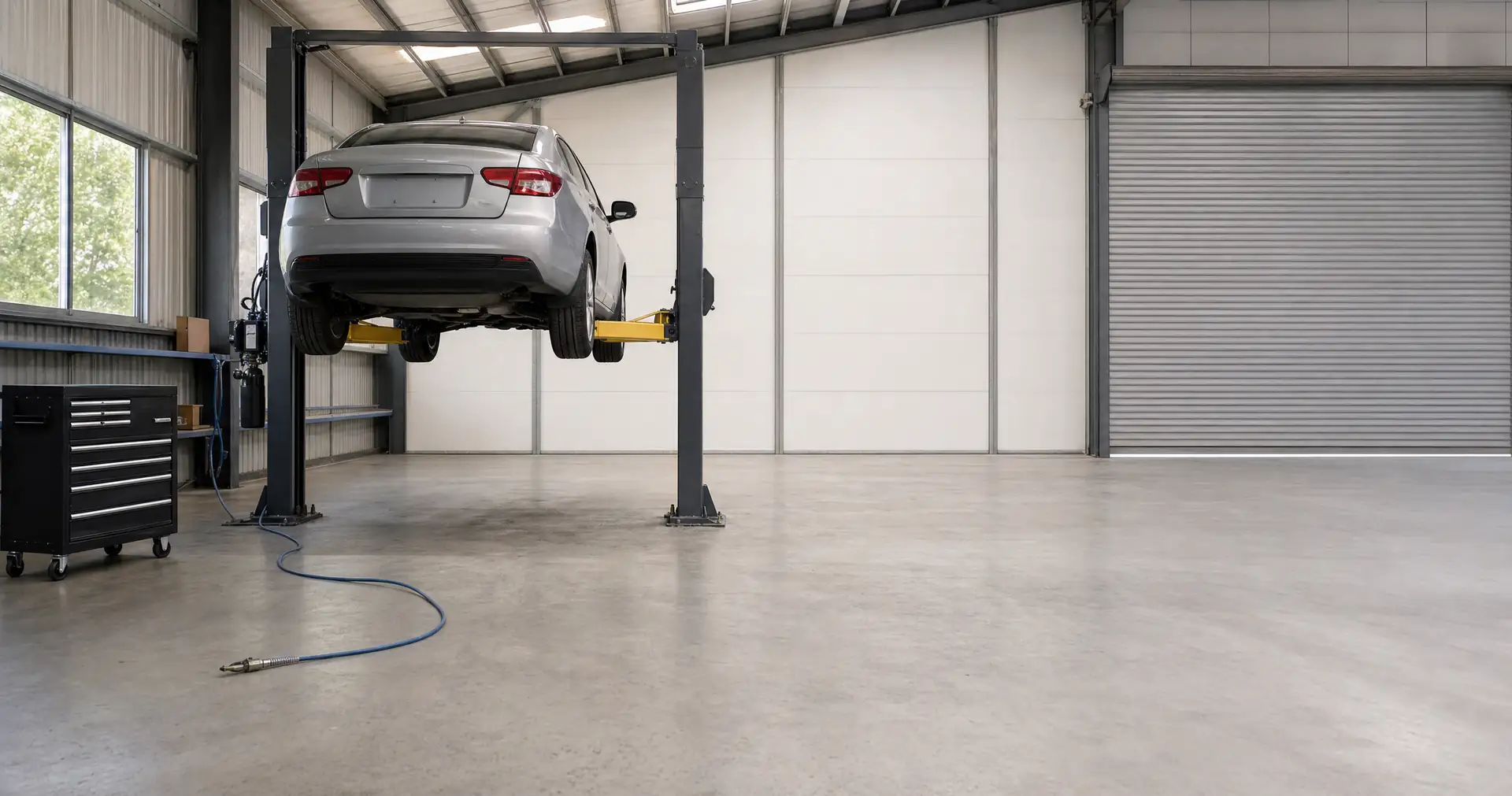
Business loans for New Zealand automotive workshops.
Workshops, panel beaters, tyre shops, and dealerships borrow against tooling-heavy capex and (for dealers) floorplan stock. Lenders commonly weight MTA membership, NZTA Repairer Certification, lease length, and the technician profile of the operation.
What you need to know about automotive finance in NZ.
→Tooling and hoists are the largest single spend workshop equipment commonly $40K to $200K, financed via chattel mortgage on 5 to 7-year terms.
→Panel and paint capex is materially higher spray booths, frame machines, and prep bays push panel-beater capex into $200K to $700K territory.
→Dealer floorplan is its own product used-vehicle stock typically funded via specialist floorplan facilities (UDC, Heartland), not standard term loans.
→NZTA RC and MTA membership matter NZTA Repairer Certification, MTA membership, and AA / VTNZ partnerships all feed the lender review.
The landscape
Tooling-heavy, regulation-bound, with a distinct dealer floorplan layer.
New Zealand automotive is a long-established small-business segment. Stats NZ Business Demography figures show a sustained population of registered motor vehicle services and trades operators across workshops, panel and paint, parts, and used-vehicle retail. The 4.5 million-vehicle NZ fleet (NZTA Motor Vehicle Register data) supports a steady servicing and repair demand profile.
The structures that fit automotive most cleanly are chattel-mortgage equipment finance for tooling and hoists, dedicated floorplan finance for used-vehicle dealers, a term loan for premises fit-out, and a line of credit for parts inventory and slow-paying account customers. Lenders that play in this space include UDC Finance, Heartland Bank, MTF Finance, Avanti Finance, the major banks for property-secured operators, and a small number of dealer-floorplan specialists.
Lender posture on automotive is shaped by NZTA regulatory requirements and operator profile. Workshops doing WoF testing must be NZTA-approved Vehicle Inspectors (VI) under the Vehicle Inspection Notice. Panel beaters working on structural repairs must be NZTA Repairer Certified (RC). Used-vehicle dealers must be Registered Motor Vehicle Traders (RMVT) under the Motor Vehicle Sales Act 2003. Lapses in any of these registrations typically stop a finance application; current registration supports it. MTA membership, while voluntary, is widely treated as a positive operator signal.
Workshop hoist and tooling
$40K to $200K
Panel and paint capex
$200K to $700K
Dealer floorplan facility
$250K to $5M+
Parts working capital
$30K to $250K
Sub-segments
How NZ automotive operators borrow, by sub-segment.
Automotive is not one segment; it is several. Each sub-segment has its own typical loan amounts, common purposes, and regulatory framing.
Independent workshops
General mechanical, WoF testing where NZTA approved, servicing and diagnostics. Capex tied to hoists (2-post and 4-post), scan tools (Bosch, Snap-on), wheel alignment, brake lathes, and air-conditioning kit. MTA membership common.
·Loan amount: $40K to $200K
·Term: 5 to 7 years
Panel and paint
Collision repair, structural and cosmetic. Capex significantly higher than mechanical: spray booths, frame machines (Car-O-Liner, Celette), measuring systems, prep bays, paint mixing stations. NZTA RC required for structural work.
·Loan amount: $200K to $700K
·Term: 5 to 8 years
Used-vehicle dealers
Floorplan-driven. Stock funded via specialist floorplan facilities with revolving lines secured against the vehicle assets. RMVT registration mandatory under MVSA 2003. Carjam and PPSR checks are part of the daily operation.
·Loan amount: $250K to $5M+
·Term: revolving / 1 to 5 years
Tyre and exhaust shops
Specialty workshops with specific tooling: tyre changers, balancers, alignment rigs, exhaust pipe benders. Common capex profile sits between general workshops and panel and paint. Franchise and chain models common (Tony's, Hamilton Tyre, Beaurepaires).
·Loan amount: $60K to $250K
·Term: 4 to 6 years
Auto electrical and EV specialists
Battery, alternator, ECU diagnostics, and increasingly EV servicing. Capex tied to high-voltage diagnostic equipment, battery testing rigs, and EV-specific tooling. Growing sub-segment as the NZ EV fleet expands.
·Loan amount: $50K to $180K
·Term: 4 to 6 years
Franchised dealership service
Manufacturer-tied service departments (Toyota, Ford, Mitsubishi). Capex often part-funded by manufacturer arrangements with dealer principal contributions. Specific tooling and diagnostic systems mandated by the manufacturer.
·Loan amount: $200K to $1M+
·Term: 5 to 10 years
Common reasons
What NZ automotive businesses borrow for.
The bulk of NZ automotive lending volume falls into six common purposes. Each has a typical structure that fits.
01
Hoists, lifts, and core tooling
Two-post and four-post hoists, wheel alignment rigs, brake lathes, scan tools, air-conditioning recovery kit. Largest single spend most workshops face. Chattel mortgage on a 5 to 7-year term.
02
Spray booth and frame machine
Panel and paint specialty capex. Spray booths $80K to $200K+, frame machines $40K to $150K. Chattel mortgage with longer terms (6 to 8 years) reflecting asset life.
03
Dealer floorplan stock
Used-vehicle dealers fund stock through specialist floorplan facilities with revolving lines. Each vehicle drawn down on stock-in and repaid on sale. UDC Finance and Heartland Bank are the typical providers.
04
Premises fit-out and bay extension
Concrete pour for additional hoist bays, lighting, ventilation, oil and waste containment. Term loan against personal property or, where lease length supports it, an unsecured fit-out loan.
05
Parts inventory and working capital
Parts buffer stock, slow-paying account customers (insurer-funded panel work), pre-financial-year-end inventory build. Line of credit suits the recurring cycle.
06
Diagnostic technology refresh
EV-capable scan tools, ADAS calibration rigs, and OEM-specific diagnostic systems. Smaller-ticket chattel mortgage with shorter terms (3 to 5 years) reflecting technology obsolescence cycles.
Eligibility quirks
What automotive lenders ask that other industries don't.
Beyond the standard NZBN, trading history, and turnover questions, NZ automotive lenders commonly ask about NZTA registrations, MTA membership, technician profile, and (for dealers) floorplan history.
NZTA registrations
Vehicle Inspector approval (for WoF), Repairer Certification (for structural panel work), and Registered Motor Vehicle Trader status (for dealers) all feed the lender review. Lapsed registration typically stops a finance application.
MTA membership and supplier history
Motor Trade Association membership is voluntary but widely treated as a positive operator signal. Lender reviews commonly ask about parts supplier accounts (Repco, Supercheap Trade, AAA Auto) and payment history.
Technician profile
Number of qualified technicians, apprentice mix, and continuity of senior staff matter. Single-technician workshops are widely viewed as higher-risk than multi-technician operations.
Floorplan history (dealers)
Used-vehicle dealers face a separate review around floorplan stock turnover, days on lot, and Carjam history of stock-in patterns. PPSR registration on every floorplan-funded vehicle is standard practice.
Capex by sub-segment and region
Indicative automotive capex bands by NZ region.
Auckland and Wellington capex commonly runs 10-20% above regional NZ pricing for the same equipment specification, primarily driven by installation and consenting costs. The bands below are observed across NZ automotive applications in 2026.
Sub-segment
Auckland
Wellington / Christchurch
Regional NZ
Single-bay workshop fit-out
$50K to $110K
$45K to $95K
$40K to $85K
Multi-bay workshop (3 to 5 hoists)
$130K to $260K
$115K to $230K
$95K to $200K
Panel and paint shop fit-out
$300K to $700K
$260K to $620K
$220K to $560K
Tyre / exhaust specialty
$80K to $230K
$70K to $200K
$60K to $180K
Used-vehicle dealer floorplan facility
$500K to $5M+
$400K to $4M+
$300K to $3M+
EV / auto electrical specialist
$70K to $180K
$60K to $160K
$50K to $140K
Indicative bands only. Actual cost depends on equipment specification, building condition, and consenting timeline. Premium specialty operators can run materially higher.
Worked scenarios
Three NZ automotive finance scenarios.
Real-world structures across an Auckland workshop, a Wellington panel and paint shop, and a Christchurch used-vehicle dealer, illustrating how the regional cost profile and operator track record shift the offered rate.
Mechanical workshop
Auckland independent workshop expansion
A West Auckland independent workshop adding two hoists, an alignment rig, and an EV-capable scan tool to support growing EV servicing demand. Total project $140K ex-GST. Operator MTA member with 9 years trading and four technicians on staff.
Structure: $140K chattel mortgage on equipment at indicative 11% across 6 years (asset life aligned to expected hoist replacement). Operator's clean trading history and MTA membership tightened the rate band. Indicative weekly ~$555. GST claim of around $21,000 typically claimable in the next return, subject to the accountant's confirmation.
Indicative figures
Asset value
$140,000
Term
6 years
Indicative rate
11% p.a.
Weekly indicative
~$555
GST claim (indicative)
~$21,000
Collision repair
Wellington panel and paint shop
A Lower Hutt-based collision repairer upgrading the spray booth and adding a second frame machine to expand insurer-referred capacity. Total project $360K ex-GST: $180K spray booth, $120K frame machine, $60K prep bay and consumable kit. NZTA Repairer Certified, AA Repair Centre status.
Structure: $360K chattel mortgage on equipment at indicative 10% across 7 years (longer term reflects asset life). Insurer-referral panel work and AA Repair Centre status tightened the rate. Indicative weekly ~$1,200.
Indicative figures
Total project
$360,000
Term
7 years
Indicative rate
10% p.a.
Weekly indicative
~$1,200
GST claim (indicative)
~$54,000
Used-vehicle dealer
Christchurch used-vehicle dealer floorplan
A 6-year-old Christchurch used-vehicle dealer (RMVT registered) increasing floorplan capacity to support a move to a larger 40-vehicle yard. Existing floorplan facility $800K, new facility $2M to support up to 60 vehicles. Average days on lot 32 days.
Structure: $2M revolving floorplan facility with each vehicle drawn down on stock-in (typical advance 80% of trade value) and repaid on sale. Indicative interest in the 8% to 11% per annum range with a per-vehicle fee. Strong stock turnover and clean Carjam history of inventory tightened the facility terms.
Indicative figures
Facility
$2,000,000
Advance per vehicle
~80% of trade
Indicative rate
8% to 11% p.a.
Avg days on lot
32 days
Vehicle capacity
up to 60
Structure × purpose
Which loan structure fits which automotive purpose.
No single structure suits every automotive purpose. The matrix below maps the four common structures to the most common purposes.
Feature
Equipment finance
Floorplan facility
Term loan
Line of credit
Hoists, alignment rigs, scan tools
Best fit
No
Possible (combined)
No
Spray booth, frame machine
Best fit
No
Possible (combined)
No
Used-vehicle stock
No
Best fit
No
No
Premises fit-out and bay extension
Equipment portion only
No
Best fit
No
Parts inventory and slow accounts
No
No
Marginal (term too long)
Best fit
Diagnostic technology refresh (3-5 yr)
Best fit
No
Possible
No
Regulatory framing
Automotive-specific regulatory and tax items lenders weigh.
Automotive operators sit under several NZ regulatory frameworks that lenders verify before disbursing. Workshops carrying out Warrant of Fitness inspections must be NZTA-approved Vehicle Inspectors under the Vehicle Inspection Notice 2007, with each inspector authorised individually. Panel beaters and collision repairers carrying out structural work must be NZTA Repairer Certified (RC) under the Land Transport Rule: Vehicle Repair 1998. Used-vehicle dealers must be Registered Motor Vehicle Traders (RMVT) under the Motor Vehicle Sales Act 2003 and may be members of the Motor Industry Association or VIA. Lapsed certification typically stops a finance application; current certification supports it.
Motor Trade Association (MTA) membership is voluntary but widely treated as a positive operator signal in the NZ market. Lenders commonly ask about MTA membership status, parts supplier accounts (Repco, Supercheap Trade, AAA Auto), and AA / VTNZ Repair Centre or Approved Repairer status where applicable. Each of these signals tightens the operator-experience portion of the lender review.
IRD depreciation rates relevant to automotive vary by category. Workshop equipment commonly depreciates at 13% diminishing value, hoists and lifts at 13.5%, paint booths at 13%, computer-based diagnostic systems faster at 30% to 40% reflecting technology obsolescence, and motor vehicles used in the business at 30%. The accountant's confirmation is the standard last step on the depreciation schedule and the diminishing-value vs straight-line election. GST on equipment purchases is typically claimable in the next return after settlement under chattel mortgage, subject to the accountant's confirmation that the operator is GST-registered and the asset qualifies. Used-vehicle dealers operating under the second-hand goods GST margin scheme have specific GST treatment on stock that differs from input-tax claims, and the accountant's confirmation is the standard last step on this election.
Personal Property Securities Register (PPSR) registration on financed assets is standard practice across automotive finance and dealer floorplan. Carjam reports are commonly part of the stock-in process for used-vehicle dealers, surfacing PPSR registrations, security interests, odometer history, and write-off status. Fringe benefit tax (FBT) commonly applies where business vehicles are also used by directors or employees for private purposes, and the accountant's confirmation is the standard last step on FBT exposure.
Lenders to know
NZ lenders that fund automotive well.
Automotive is supported by a mix of asset finance specialists (for tooling), dealer floorplan specialists, alternative SME lenders (for working capital), and the major banks (for property-secured larger projects).
How do New Zealand workshops commonly finance hoists and tooling?
A typical NZ workshop equipment package runs $40,000 to $200,000 depending on bay count and tooling specification. Operators commonly fund this through chattel mortgage against the equipment, with terms of 5 to 7 years aligned to commercial-grade tooling life. UDC Finance, Heartland Bank, and MTF Finance are typical lenders. Some operators also use equipment supplier finance offers from Snap-on or Bosch as an alternative path.
How does dealer floorplan finance work in New Zealand?
Dealer floorplan is a revolving facility where each used-vehicle stock unit is drawn down on stock-in (typically 80% to 90% of trade value) and repaid on sale, with PPSR registration on each vehicle. Facilities commonly carry interest in the 8% to 11% per annum range plus per-vehicle fees. UDC Finance and Heartland Bank are the typical NZ floorplan providers. RMVT registration under the Motor Vehicle Sales Act 2003 is mandatory.
What eligibility questions do automotive lenders ask that other industries do not?
Beyond the standard NZBN, trading history, and turnover questions, NZ automotive lenders commonly ask about NZTA Vehicle Inspector approval (for WoF testing), Repairer Certification (for structural panel work), RMVT registration (for dealers), MTA membership status, technician count and continuity, and parts supplier account history. Used-vehicle dealers also face floorplan-specific review around stock turnover and days on lot.
What rate range applies to NZ automotive finance in 2026?
Indicative rates on automotive finance commonly sit in the 7% to 18% per annum band depending on structure and operator profile. Asset-secured chattel mortgages on workshop equipment sit at the lower end. Floorplan facilities for established dealers sit in the 8% to 11% range. Unsecured working capital sits at the upper end. Final rate is set by the lender after assessment.
Is GST claimable on workshop equipment purchases?
A GST-registered automotive business can typically claim the GST component on equipment purchases as input tax in the relevant GST return, subject to the accountant's confirmation. Where the equipment is acquired under chattel mortgage, the full GST is typically claimable upfront. Used-vehicle dealers operating under the second-hand goods margin scheme have specific GST treatment on stock that differs from input-tax claims; the accountant's confirmation is the standard last step.
How does NZTA Repairer Certification affect panel and paint finance?
Panel beaters and collision repairers carrying out structural work must be NZTA Repairer Certified under the Land Transport Rule: Vehicle Repair 1998. Lenders commonly ask for current RC evidence before disbursing on equipment finance, and AA Repair Centre or insurer-approved repairer status further tightens the operator profile. Lapsed RC typically stops a panel and paint finance application.
What deposit do NZ automotive lenders typically require?
For equipment finance, deposits commonly run 0% to 20% of the asset value depending on lender and operator profile. Established workshops with multi-year MTA membership and stable trading history can commonly access zero-deposit asset finance on standard tooling categories. Floorplan facilities for new dealers may require a 10% to 20% equity contribution alongside the facility.
Can a single-technician workshop access asset finance?
Single-technician workshops are widely viewed as higher-risk than multi-technician operations because key-person continuity becomes the dominant credit factor. Asset finance is typically still available but commonly with tighter conditions: a personal guarantee, sometimes a property-backed guarantee, and a slightly higher indicative rate band. Trading history and MTA membership materially help the application.
How does Carjam fit into used-vehicle dealer finance?
Carjam reports are commonly part of the dealer stock-in process, surfacing PPSR registrations, prior security interests, odometer history, write-off status, and registration history. Floorplan lenders typically require a clean Carjam report before drawing down on stock-in, and Carjam-checked stock turnover patterns feed the lender review of dealer operations. This is widely treated as a baseline operational hygiene check across NZ used-vehicle retail.
Can I refinance my workshop loan to a better rate after trading?
Often yes, particularly after 12 to 24 months of clean trading and repayments where the financial profile has strengthened. Refinancing is commonly used to consolidate multiple automotive loans (tooling + fit-out + working capital) into a single facility, or to move from alternative-lender pricing to major-bank pricing once trading history supports it. Early-repayment fees on the original loan are the main consideration.
How does EV-capable diagnostic equipment fit into a workshop finance plan?
EV-capable scan tools, high-voltage diagnostic equipment, and ADAS calibration rigs are increasingly part of NZ workshop tooling as the EV fleet expands. These items typically carry shorter chattel mortgage terms (3 to 5 years) reflecting technology obsolescence cycles. Some equipment suppliers offer tied finance with replacement options at end of term, which is widely worth comparing against standard chattel mortgage pricing.
Is operating lease an option for workshop tooling?
Operating lease is available across some categories of workshop equipment, particularly diagnostic technology where short replacement cycles favour rental over ownership. Cash-flow simpler than chattel mortgage but no GST claimed upfront and no asset on the balance sheet. The right structure depends on the operator's priorities, subject to the accountant's confirmation on the specific business position.
How does franchised dealership service finance differ from independent?
Franchised dealership service departments (Toyota, Ford, Mitsubishi, Mazda) commonly carry manufacturer-tied finance arrangements where part of the equipment cost is funded through manufacturer programmes alongside dealer-principal contributions. Specific tooling and diagnostic systems are mandated by the manufacturer. The trade-off is reduced independence on equipment selection in exchange for manufacturer support and brand-driven service demand.
Indicative content only. Not personalised financial advice.
A business loan is a commitment that runs for months or years, and repayments come out of the same operating cash flow as everything else. Before committing, it is worth modelling the weekly and monthly cost against the business's working-capital position, which is what this site is built to help with. Borrowing at a level that stays comfortable through a quiet quarter, not just a strong one, is widely regarded as the safer frame.
What this site is
A calculator and information tool. Not a lender, not a broker, not a registered financial adviser. Nothing here is personalised financial advice.
What the figures show
Modelled estimates based on the inputs you enter. Not a quote. Not an offer of credit. Not a guarantee of approval, rate, or fees.
What the lender decides
Final rates, fees, and approval are set by the lender after a CCCFA-appropriate assessment of the applicant's circumstances and credit decision.
Commercial disclosure
Businessloans.org.nz earns a commission from Prospa when a visitor applies through this site and their application is approved. The commission is paid by Prospa, not by the borrower, and it does not influence the rate Prospa offers. Full disclosure on the partner page.
Tax, GST, and accountant framing
Tax-treatment statements (GST claim timing, interest deductibility, depreciation rates) are general in nature and subject to your accountant's confirmation on the specific business position. For material amounts, professional advice from a registered financial adviser or chartered accountant is widely regarded as the safer frame.