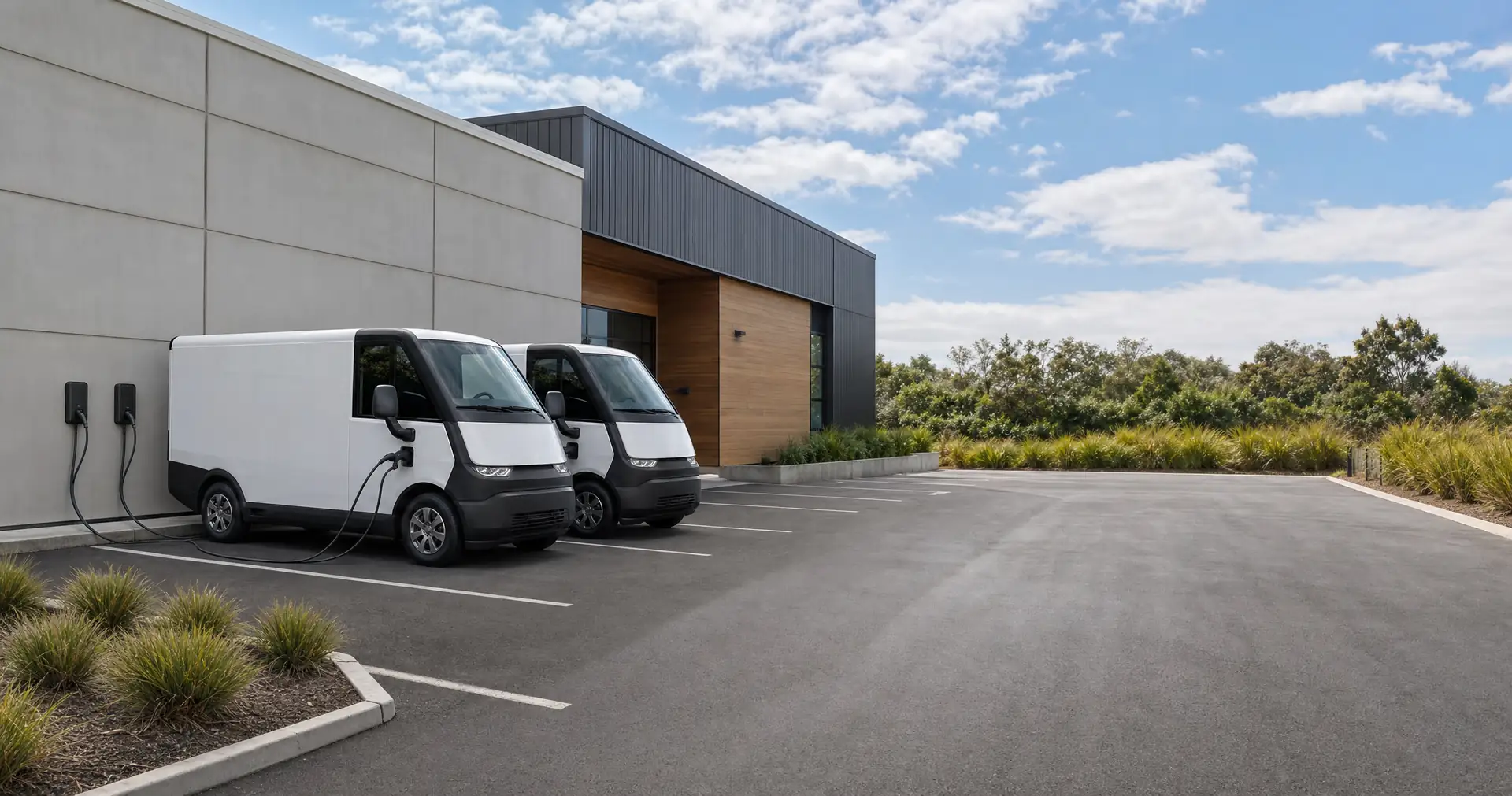
EV fleet finance for New Zealand business operators .
Asset finance for an electric vehicle fleet sits inside the same chattel-mortgage framework as petrol and diesel vehicles, with two extra layers: green-labelled lending products from ANZ, Westpac, and BNZ, and the EV-specific Road User Charges treatment under the Road User Charges Act 2012.
→Per-vehicle commonly $50K to $120K Tesla Model 3 and Y, BYD Atto 3 and Seal, Polestar 2 and 4, and electric vans (Mercedes eVito and eSprinter, Renault Master E-Tech, LDV eDeliver) cover most NZ business EV fleet projects.
→Green-labelled facilities exist at ANZ and Westpac ANZ Business Green Loan (publicly cited up to $3 million for qualifying low-emissions assets) and Westpac Sustainable Business Loan are the two main NZ green business lending products as published.
→EV utes remain limited in NZ in 2026 LDV eT60 and Ford F-150 Lightning are the most commonly considered. Trade-focused EV ute supply is materially thinner than the diesel ute pool dominated by Hilux and Ranger.
→RUC applies to light EVs from 1 April 2024 Road User Charges apply to electric light vehicles under the Road User Charges Act 2012. The RUC differential rules (no fuel-excise offset on EVs) sit alongside IRD low-emissions depreciation guidance.
The landscape
EV fleet finance in NZ has reshaped around three product anchors and the post-2024 RUC settings.
New Zealand business EV adoption ran hard between 2021 and 2023 under the Clean Car Discount and Clean Car Standard; the Clean Car Discount ended on 31 December 2023, and Road User Charges were extended to electric light vehicles from 1 April 2024 under the Road User Charges Act 2012. The post-2024 settings change the per-kilometre operating-cost calculation for an EV fleet versus diesel, but the chattel-mortgage and hire purchase finance structures have not changed.
Three lender-product anchors define the NZ EV fleet finance landscape. ANZ Business Green Loan is publicly cited up to $3 million for qualifying low-emissions and energy-efficiency assets, with EV vehicles among the eligible categories. Westpac Sustainable Business Loan is the parallel Westpac product covering low-emissions equipment and vehicles. BNZ Green Home Loan is the consumer product; the BNZ business green proposition sits within the wider business banking relationship rather than as a single named product line.
Fleet capex commonly ranges $200,000 to $480,000 for a 4-vehicle pool depending on mix between cars and electric vans. Tesla Model Y and BYD Sealion 6 sit around $70,000 to $90,000 indicatively; Mercedes-Benz eVito and eSprinter sit in the $90,000 to $130,000 range; LDV eDeliver 7 and 9 sit lower. Operators with an existing relationship at ANZ or Westpac commonly approach the green-labelled facility first because the published product framing speaks directly to low-emissions assets.
Per-vehicle band
$50K to $120K
Typical fleet (4 vehicles)
$200K to $480K
Green facility cap (ANZ)
Up to $3M
Term loan term
4 to 5 years
EV fleet scenarios
Four common NZ EV fleet finance scenarios.
Most EV fleet applications fall into one of four patterns. Each carries a typical capex band, structure, and lender posture under the green-labelled product set.
Tesla / BYD passenger fleet rollout
Professional services firm or sales team replacing a 4 to 6 vehicle ICE passenger fleet with Tesla Model 3, Tesla Model Y, BYD Atto 3, or Polestar 2. Indicative $250K to $480K total. ANZ Business Green Loan or Westpac Sustainable Business Loan commonly approached first.
·Loan amount: $250K to $480K
·Term: 4 to 5 years
Electric van fleet for last-mile delivery
Last-mile freight or trade operator deploying Mercedes-Benz eVito or eSprinter, Renault Master E-Tech, or LDV eDeliver 7 or 9 across an urban delivery footprint. Range and depot charging support the route pattern. Higher per-vehicle capex than diesel equivalent.
·Loan amount: $300K to $600K
·Term: 4 to 5 years
EV ute pilot with limited NZ availability
Trade or services business piloting 1 to 2 EV utes (LDV eT60 or Ford F-150 Lightning where available) alongside an existing diesel ute fleet. NZ EV ute supply remains thinner than the diesel pool through 2026; lead times and dealer availability shape the application.
·Loan amount: $90K to $200K
·Term: 4 to 5 years
EV fleet plus depot charging infrastructure
Combined finance covering the EV vehicles and the AC fast-charging or DC charging infrastructure at the depot. Some applications are split: chattel mortgage on the vehicles plus a separate facility for the charging fitout (transformer upgrade, charger units, switchgear, civil works).
·Loan amount: $400K to $900K combined
·Term: 5 years (vehicles), 7+ years (infra)
What EV fleet operators borrow for
Six common NZ EV fleet loan purposes.
EV fleet capex spreads across vehicles, depot infrastructure, and operational tooling. Each line item has a typical structure that fits.
EV passenger cars
Tesla Model 3 and Model Y, BYD Atto 3 and Seal, Polestar 2 and 4, MG4, Hyundai Ioniq 5, Kia EV6. Chattel mortgage on a 4 to 5 year term. Indicative $50K to $90K per vehicle.
Electric vans
Mercedes-Benz eVito and eSprinter, Renault Master E-Tech, LDV eDeliver 7 and 9. Indicative $80K to $130K per vehicle. Depot charging access shapes the route plan.
EV utes (limited NZ supply)
LDV eT60 and Ford F-150 Lightning the most commonly considered through 2026. Trade-focused EV ute supply is materially thinner than the Hilux and Ranger diesel pool.
Depot charging infrastructure
AC fast chargers, DC chargers, transformer upgrades, switchgear, civil works for cable runs. Term loan or asset finance against the fitout. Lead time commonly 8 to 16 weeks for a multi-charger depot install.
Telematics and energy management
Fleet telematics, charging-schedule software, depot energy management. Smaller-ticket asset finance or unsecured term loan. Commonly $5K to $20K per vehicle including software setup.
Working capital for charging and RUC
Revolving facility covering charging spend (depot and public network) and the new RUC component on light EVs from 1 April 2024 under the Road User Charges Act 2012.
Tax, GST, and RUC
How GST, depreciation, RUC, and FBT typically work on a NZ business EV fleet.
A GST-registered business operating an EV fleet can typically claim the GST component on the vehicles and depot charging infrastructure as input tax in the relevant GST return, subject to the accountant's confirmation. Where the vehicles are acquired under chattel mortgage, the full GST is typically claimable upfront in the next GST return after settlement. Where they are acquired under finance lease or operating lease, GST is typically claimed across the rental payments. IRD publishes motor vehicle depreciation rates and from time to time issues guidance on low-emissions vehicles; the accountant is the right person to confirm the depreciation rate that applies to a specific EV asset class. Road User Charges have applied to electric light vehicles from 1 April 2024 under the Road User Charges Act 2012, paid per 1,000 km block at the rate set by NZTA for electric vehicles, and the RUC component is typically deductible against business income separate from the finance treatment of the vehicle. Where the EV has any private use (a director's vehicle or sales rep car), Fringe Benefit Tax applies on the private-use portion under the standard FBT rules.
EV vehicle bands
Indicative NZ business EV vehicle finance bands in 2026.
Pricing varies by spec, dealer, and lead time. The bands below are observed across the NZ business EV finance pool, drawn from new-vehicle activity and dealer indicative pricing.
Vehicle category
Indicative new
Common term
Typical structure
Compact EV (MG4, BYD Atto 3)
$45K to $65K
4 to 5 years
Chattel mortgage
Mid-size EV (Tesla Model 3, Polestar 2)
$65K to $95K
4 to 5 years
Chattel mortgage or green-labelled facility
SUV EV (Tesla Model Y, Polestar 4, BYD Sealion 6)
$70K to $110K
4 to 5 years
Chattel mortgage or green-labelled facility
Premium EV (BMW iX, Mercedes EQE, Audi e-tron)
$120K to $200K+
4 to 5 years
Chattel mortgage
Electric van (eVito, eSprinter, Master E-Tech, LDV eDeliver)
$80K to $130K
5 years
Chattel mortgage
EV ute (LDV eT60, Ford F-150 Lightning)
$90K to $170K
5 years
Chattel mortgage (limited NZ supply)
Indicative bands only. Actual price depends on spec, dealer, and lead time. Final rate, fee, and approval decisions are made by the lender after assessment.
Green-labelled vs standard chattel mortgage
ANZ Business Green Loan vs Westpac Sustainable Business Loan vs standard chattel mortgage.
The green-labelled facilities at ANZ and Westpac sit alongside standard chattel mortgages from UDC, Heartland, and the major banks. Eligibility, framing, and rate posture differ; not every EV application qualifies for the green-labelled tier.
Feature
ANZ Business Green Loan
Westpac Sustainable Business Loan
Standard chattel mortgage (UDC, Heartland, major-bank)
Public framing
Green Loan up to $3M for qualifying low-emissions and energy-efficiency assets
Sustainable Business Loan covering low-emissions equipment and vehicles
Standard asset finance, no green label
Eligibility test
Asset must meet ANZ low-emissions criteria as published
Asset must meet Westpac sustainability criteria as published
Standard credit and security position
Typical loan amount
Up to $3M (subject to ANZ assessment)
Subject to Westpac assessment
$50K to $500K+ per asset
Rate posture
Indicative bands only; lender sets the offered rate
Indicative bands only; lender sets the offered rate
Indicative bands only; lender sets the offered rate
Existing relationship
Commonly easier with existing ANZ business relationship
Commonly easier with existing Westpac business relationship
Available without an existing relationship
Suits
Larger fleet rollout with multiple low-emissions assets
Mixed sustainability capex including EVs
Single EV or mixed ICE/EV fleet without green-label requirement
Green-loan product details are summaries of publicly available framing only. Final eligibility and rate decisions are made by each lender after assessment.
How it works
A typical NZ EV fleet finance application.
EV fleet applications carry an emissions-criteria step that ICE fleet applications do not where a green-labelled facility is approached. Standard chattel-mortgage applications follow the regular asset-finance pattern.
01
Day 1 to 7
Define the fleet mix and infrastructure scope
A typical EV fleet project combines chattel mortgages on the vehicles with separate asset finance on depot charging infrastructure. Vehicle quotes from authorised NZ dealers (Tesla, BYD, Polestar, Mercedes-Benz, Renault, LDV) anchor the application; charger and civil quotes from a charging-infrastructure provider sit alongside.
Documents commonly required
·Vehicle quotes from authorised NZ dealers
·Charging infrastructure quote (where included)
·Energy management or telematics quote
02
Day 5 to 14
Assess green-labelled vs standard chattel mortgage
Operators with an existing ANZ or Westpac relationship commonly approach the published green-labelled product first because the framing speaks directly to low-emissions assets. Operators without such a relationship, or with mixed ICE and EV fleets, commonly compare the green-labelled tier alongside specialist asset-finance lenders (UDC, Heartland) on the standard chattel mortgage.
Documents commonly required
·NZBN, business owner ID
·Last 12 to 24 months business bank statements
·Last 2 years financial statements
·Existing fleet and replacement schedule
03
Day 10 to 21
Lender assessment and offer
Lenders assess against three things: the security position on each EV (LVR after deposit), the trading data and serviceability across the proposed fleet payments, and the operator profile. Green-labelled facilities add an emissions-criteria check. Offers commonly come back with conditions: deposit, additional security, or staged drawdowns matched to vehicle delivery dates.
04
Week 4 onward
Settle, register PPSR, deploy charging, take delivery
Asset finance settles directly to each authorised dealer and to the charging infrastructure provider. The lender registers a security interest on the Personal Property Securities Register (PPSR) for each vehicle. Depot charging install commonly runs in parallel with vehicle delivery, with the first vehicles in service within 4 to 8 weeks of settlement depending on dealer stock and charger commissioning timelines.
A broker familiar with ANZ Business Green Loan and Westpac Sustainable Business Loan eligibility commonly tightens the indicative rate band by knowing which fleet mix qualifies for the green-labelled tier.
Worked scenarios
Three NZ EV fleet finance scenarios.
Real-world structures across passenger fleet rollout, last-mile electric van deployment, and combined vehicle plus charging-infrastructure finance. Each illustrates how the green-labelled facility framing, depot charging scope, and existing trading data shift the offered structure.
Mid-size firm replacing 6 ICE passenger vehicles
Auckland professional services Tesla rollout
An Auckland professional services firm with 12 years of trading replacing a 6-vehicle ICE passenger fleet (3 Toyota Camrys, 3 Mazda CX-5s, all 5 to 7 years old at end-of-life) with 4 Tesla Model Y rear-wheel drive and 2 BYD Sealion 6 dual-motor for the partner pool. Total package $510,000 ex-GST: 4 Tesla Model Y at $84,000 each ($336,000), 2 BYD Sealion 6 at $87,000 each ($174,000). Trade-in credit of $90,000 on the outgoing fleet.
Structure agreed under the existing ANZ business relationship: ANZ Business Green Loan ($420,000 after trade-in, 5-year term, indicative 8-10% p.a.). Single facility covers the 6 vehicles. Existing 12 years of trading and the established ANZ relationship supported the green-labelled facility framing. Trade-in proceeds applied across the new vehicles at settlement.
PPSR security interest registered against each Tesla and BYD at the relevant settlement. Outgoing 6 ICE vehicles sold at trade-in. First Tesla deliveries within 6 weeks of settlement, BYD deliveries within 8 weeks. RUC purchased per vehicle for the first 1,000 km block under the Road User Charges Act 2012; depreciation schedule confirmed with the firm's accountant under IRD low-emissions guidance.
Indicative figures
Total package
$510,000
Trade-in credit
$90,000
Green Loan facility
$420,000
Indicative rate
8-10% p.a.
Established last-mile delivery operator deploying 5 electric vans
Wellington last-mile electric van deployment
A Wellington last-mile delivery operator with 4 years of trading deploying 5 Mercedes-Benz eSprinter L3H2 vans on a CBD parcel run, replacing 5 diesel Sprinter vans approaching end-of-life. Total package $580,000 ex-GST: 5 Mercedes-Benz eSprinter at $116,000 each. Existing depot at Lyall Bay; AC charging install required for the 5-vehicle pool with overnight charging window.
Structure agreed under the existing Westpac business relationship: Westpac Sustainable Business Loan ($580,000 vehicles, 5-year term, indicative 8-10% p.a.) plus separate term loan for depot charging infrastructure ($90,000, 7-year term, indicative 9-11% p.a.) covering 5 AC chargers, transformer upgrade, switchgear, and civil works. Combined facility supports the existing Westpac relationship.
PPSR security interest registered against each eSprinter at the relevant delivery date. Charging install commissioned in parallel with vehicle deliveries; first 2 eSprinters in service within 6 weeks, full 5-van pool in service within 12 weeks. RUC purchased per vehicle from 1 April 2024 RUC settings for electric light vehicles. The accountant confirmed the GST treatment on the chattel-mortgage portion and the staged GST claims on the charging infrastructure progress invoices.
Indicative figures
Total package
$670,000
Vehicle finance
$580,000
Charging infrastructure finance
$90,000
Indicative blended rate
8-11% p.a.
Mid-size electrical contractor piloting 2 EV utes
Christchurch trade business EV ute pilot
A Christchurch electrical contractor with 8 years of trading and an existing 12-vehicle ute fleet (Hilux and Ranger) piloting 2 LDV eT60 EV utes alongside the diesel pool to assess range and total operating cost across a typical metro service run. Total package $190,000 ex-GST: 2 LDV eT60 at $89,000 each ($178,000), $12,000 dual AC charger and switchgear install at the existing depot in Hornby.
Structure agreed with the contractor's asset-finance lender: chattel mortgage on the 2 LDV eT60 ($156,400 after 12% deposit, 5-year term, indicative 9-11% p.a.) plus small term loan on the depot dual-charger fitout ($12,000, 5-year term, indicative 11-13% p.a.). UDC Finance funded the chattel mortgage based on the existing fleet trading and clean Operator Licence track record.
PPSR security interest registered against each LDV eT60 at delivery. Pilot phase planned at 18 months across a sample of metro service runs; data collection on range performance, RUC cost under the post-1-April-2024 settings, and per-job profitability shapes the eventual decision on whether to scale the EV ute proportion of the fleet. The accountant confirmed FBT treatment for any private-use component on the EV utes alongside the existing diesel-fleet FBT register.
Indicative figures
Total package
$190,000
EV ute finance
$156,400
Charging fitout
$12,000
Indicative blended rate
9-13% p.a.
NZ EV fleet lenders
Lenders that fund NZ business EV fleets well.
Several NZ lenders publish framing that suits EV fleet finance, with the major banks dominant on green-labelled facilities and specialist asset-finance lenders covering standard chattel mortgages. The shortlist below is editorial.
Indicative shortlist. Final rate, fee, and approval decisions are made by each lender after assessment. Green-loan product details are summaries of publicly available framing only.
Where EV fleet finance fits
When EV fleet finance is straightforward, and when it gets harder.
Where it works smoothly
·Established operator with 2+ years of trading and an existing major-bank or specialist asset-finance relationship
·Fleet mix that clearly meets ANZ or Westpac low-emissions criteria as published
·Depot location with existing electrical capacity for AC fast charging or DC charger commissioning
·Route pattern and per-vehicle daily kilometres within published EV range comfort
·Mixed asset package combining vehicles and charging infrastructure under one facility
·Deposit of 10-20% of the vehicle price from existing trading or fleet trade-in proceeds
Where it gets harder
·EV ute pilot in a trade business where NZ EV ute supply remains thin through 2026
·Depot location with constrained electrical capacity requiring transformer upgrade or significant civil works
·Operator without an existing major-bank relationship attempting to access the green-labelled tier directly
·Long-distance route pattern that exceeds typical EV range (line-haul or rural multi-stop runs)
·First-time fleet operator with no prior trading data or fleet management track record
·Outstanding GST or PAYE arrears at IRD, or recent compliance issues affecting any lender assessment
FBT framework applying to private use of business motor vehicles, including EVs.
FAQ
EV fleet finance, NZ small-business questions answered
How much does a NZ business EV fleet cost in 2026?
A typical NZ business EV fleet sits in the $50,000 to $120,000 per-vehicle range depending on category. Compact EVs (MG4, BYD Atto 3) sit at the lower end ($45K to $65K). Mid-size EVs (Tesla Model 3, Polestar 2) and SUVs (Tesla Model Y, BYD Sealion 6) sit in the $65K to $110K range. Electric vans (Mercedes eVito, eSprinter, Renault Master E-Tech, LDV eDeliver) sit at $80K to $130K. EV utes (LDV eT60, Ford F-150 Lightning) sit at $90K to $170K with thinner NZ supply through 2026. A 4-vehicle passenger fleet commonly runs $250K to $480K total before trade-ins.
What is the ANZ Business Green Loan and which EVs qualify?
ANZ Business Green Loan is publicly cited up to $3 million for qualifying low-emissions and energy-efficiency assets, including EV passenger cars, electric vans, and depot charging infrastructure. ANZ publishes the eligibility criteria on its business green loan page; assets must meet the published low-emissions threshold to qualify for the green-labelled facility. The product framing speaks directly to fleet operators replacing ICE vehicles with EVs and to operators commissioning depot charging alongside the vehicle finance. Existing ANZ business customers commonly find the application path smoother than approaching from outside the relationship.
How does Westpac Sustainable Business Loan compare?
Westpac Sustainable Business Loan is the parallel Westpac product covering low-emissions equipment and vehicles, including EVs and depot charging infrastructure. The published framing covers mixed sustainability capex (vehicles plus infrastructure) under a single facility, which suits operators commissioning EV fleets alongside depot upgrades. Westpac publishes the eligibility criteria on its sustainable business loan page. Existing Westpac business customers commonly find the application path smoother. The rate posture is set by Westpac after assessment; published material does not quote a specific rate, and the indicative band for any specific application sits within the standard major-bank business lending range.
Do Road User Charges apply to electric light vehicles in NZ?
Yes. Road User Charges have applied to electric light vehicles from 1 April 2024 under the Road User Charges Act 2012, administered by NZTA. RUC is paid in advance per 1,000 km block at the rate set by NZTA for the electric vehicle weight category. The introduction of RUC for light EVs in April 2024 changed the per-kilometre operating-cost calculation for an EV fleet versus diesel; RUC is a separate operating cost from the finance treatment of the vehicle and is typically deductible against business income. NZTA publishes the current EV RUC rates and weight-class settings in full.
What rate range applies to NZ EV fleet finance in 2026?
Indicative rates on EV fleet finance commonly sit in the 8% to 13% per annum band depending on structure, security, and operator profile. Major-bank green-labelled facilities (ANZ Business Green Loan, Westpac Sustainable Business Loan) sit at the lower end (commonly 8-10%) for established business customers with strong serviceability. Specialist asset-finance lenders (UDC, Heartland) on standard chattel mortgages commonly sit in the 8-11% range. Smaller-ticket charging infrastructure or charging fitout finance commonly sits at the upper end. Final rate is set by the lender after assessment.
Can GST be claimed on a fleet of Teslas under chattel mortgage?
A GST-registered business operating an EV fleet can typically claim the GST component on each EV acquired under chattel mortgage as input tax in the relevant GST return, subject to the accountant's confirmation. Where the vehicles are acquired under chattel mortgage, the full GST is typically claimable upfront in the next GST return after settlement of each vehicle. Where they are acquired under finance lease or operating lease, GST is typically claimed across the rental payments. For a multi-vehicle fleet rollout staged across several months, GST is typically claimed in the GST return covering each vehicle's settlement date. The accountant is the right person to confirm structure choice and GST timing on the specific business position.
How does IRD treat depreciation on a business EV?
IRD publishes motor vehicle depreciation rates that apply to business vehicles including EVs, with low-emissions guidance issued from time to time. Common methods are diminishing value or straight line, with the rate depending on the asset class and use. The IRD depreciation calculator on the IRD website lists the rates applying to current and recent classes. The accountant is the right person to confirm the specific rate that applies to a given EV asset, the depreciation method, and the interaction with any private-use FBT calculation where the vehicle has any private use.
Does FBT apply to a business EV used by a director or sales rep?
Fringe Benefit Tax applies to private use of business motor vehicles including EVs under the standard FBT rules administered by IRD. Where an EV is provided to a director, employee, or sales representative with any private-use element, FBT typically applies on the private-use portion, calculated under the standard FBT framework. The fact that the vehicle is electric does not alter the FBT framework itself. The accountant is the right person to confirm the FBT calculation method (cost-based or tax-value-based), the proportion of private use, and the interaction with depreciation and GST claims on the specific vehicle.
How long does it take to deploy a NZ EV fleet from order to road?
Lead times vary materially by manufacturer. Tesla Model 3 and Model Y commonly deliver within 4 to 8 weeks in NZ depending on stock and configuration. BYD Atto 3, Sealion 6, and Polestar 2 commonly deliver within 6 to 12 weeks. Electric vans (Mercedes-Benz eVito and eSprinter, Renault Master E-Tech) commonly run 8 to 16 weeks given thinner NZ supply. EV utes (LDV eT60, Ford F-150 Lightning) commonly run 12 to 24 weeks. Where depot charging is commissioned in parallel, civil and electrical works commonly add 8 to 16 weeks separately. Finance settlement typically aligns with each vehicle's delivery date rather than at a single upfront drawdown.
What charging infrastructure does a typical NZ EV fleet need at the depot?
A typical NZ EV fleet depot install includes one AC fast charger per 1 to 2 vehicles for overnight charging windows, with optional DC fast chargers for top-up between runs. A 5-vehicle van fleet commonly commissions 5 AC chargers, a transformer upgrade where the existing site capacity is constrained, switchgear, and civil works for cable runs and switchboard mounting. Total install commonly $60K to $150K depending on civil scope. Lead times commonly 8 to 16 weeks. Some applications combine the vehicle finance and charging-infrastructure finance under a single facility (such as Westpac Sustainable Business Loan); others split into a chattel mortgage plus a separate term loan for the fitout.
Are EV utes available for trade businesses in NZ in 2026?
EV ute supply in NZ remains materially thinner than the diesel ute pool dominated by Hilux and Ranger through 2026. LDV eT60 and Ford F-150 Lightning are the most commonly considered EV utes; payload, towing, and range characteristics differ from the diesel equivalents and shape the use-case fit. Many trade businesses pilot 1 to 2 EV utes alongside an existing diesel fleet rather than replacing the diesel pool wholesale, allowing data collection on range and total operating cost across typical metro service runs before scaling. Lender treatment of EV utes is similar to standard chattel mortgage on diesel utes; the green-labelled facilities at ANZ and Westpac may apply where the EV ute meets the published low-emissions criteria.
What happens to a financed business EV if the resale value drops faster than expected?
Where the EV is financed under chattel mortgage, the borrower owns the vehicle and bears the resale value risk. If resale prices for a specific EV model drop faster than indicative trends suggest, the borrower carries the gap between the loan balance and the market value. PPSR-registered security gives the lender the asset as collateral; the lender does not directly bear price risk. Operating lease structures shift residual value risk to the lessor (Custom Fleet, FleetPartners, ORIX), at the cost of higher monthly payments and no equity build. The structure choice typically depends on the operator's view on EV resale trends across the loan life and on whether ownership at end of term is preferred.
Can the existing diesel fleet be traded against new EVs?
Yes. Trade-in is a standard part of an EV fleet rollout where an existing ICE fleet is being replaced. Trade-in credit reduces the loan amount on the new EVs at settlement; outgoing diesel vehicles are sold to the dealer at the trade-in price agreed with the new-vehicle dealer. Operators with multiple ICE vehicles approaching end-of-life commonly stage the rollout: trade in 2 to 3 vehicles per month against incoming EV deliveries, smoothing the cash-flow impact and aligning with EV delivery lead times. The accountant is the right person to confirm the GST treatment on each trade-in and the depreciation closing on each outgoing vehicle.
Which NZ lenders specialise in EV fleet finance?
ANZ business banking and Westpac business banking publish the two primary green-labelled facilities (ANZ Business Green Loan up to $3 million, Westpac Sustainable Business Loan). BNZ business banking covers EV fleet finance through the wider business lending relationship without a single named green product line. UDC Finance and Heartland Bank cover EV fleet finance under standard chattel-mortgage structures, suiting operators preferring specialist asset-finance lenders or without an existing major-bank relationship. A broker familiar with the green-labelled product framing commonly tightens the indicative rate band by knowing which fleet mix qualifies for which facility.
Does the Clean Car Discount still apply to NZ EV fleet purchases?
No. The Clean Car Discount ended on 31 December 2023 under the change of government. EV fleet purchases from 1 January 2024 onward do not receive the historical Clean Car Discount rebate. The Clean Car Standard, administered by NZTA and MBIE, continues to apply to vehicle importers and shapes the fleet-average emissions targets at the importer level rather than at the business buyer level. Road User Charges have applied to electric light vehicles from 1 April 2024 under the Road User Charges Act 2012, also reflecting the post-2023 settings change.
Indicative content only. Not personalised financial advice.
A business loan is a commitment that runs for months or years, and repayments come out of the same operating cash flow as everything else. Before committing, it is worth modelling the weekly and monthly cost against the business's working-capital position, which is what this site is built to help with. Borrowing at a level that stays comfortable through a quiet quarter, not just a strong one, is widely regarded as the safer frame.
What this site is
A calculator and information tool. Not a lender, not a broker, not a registered financial adviser. Nothing here is personalised financial advice.
What the figures show
Modelled estimates based on the inputs you enter. Not a quote. Not an offer of credit. Not a guarantee of approval, rate, or fees.
What the lender decides
Final rates, fees, and approval are set by the lender after a CCCFA-appropriate assessment of the applicant's circumstances and credit decision.
Commercial disclosure
Businessloans.org.nz earns a commission from Prospa when a visitor applies through this site and their application is approved. The commission is paid by Prospa, not by the borrower, and it does not influence the rate Prospa offers. Full disclosure on the partner page.
Tax, GST, and accountant framing
Tax-treatment statements (GST claim timing, interest deductibility, depreciation rates) are general in nature and subject to your accountant's confirmation on the specific business position. For material amounts, professional advice from a registered financial adviser or chartered accountant is widely regarded as the safer frame.