
Industrial
Warehousing, light manufacturing, distribution. Strongest LVRs because of stable tenant base and resale market.
- LVR: 65% to 75%
- Rate: 7% to 10%
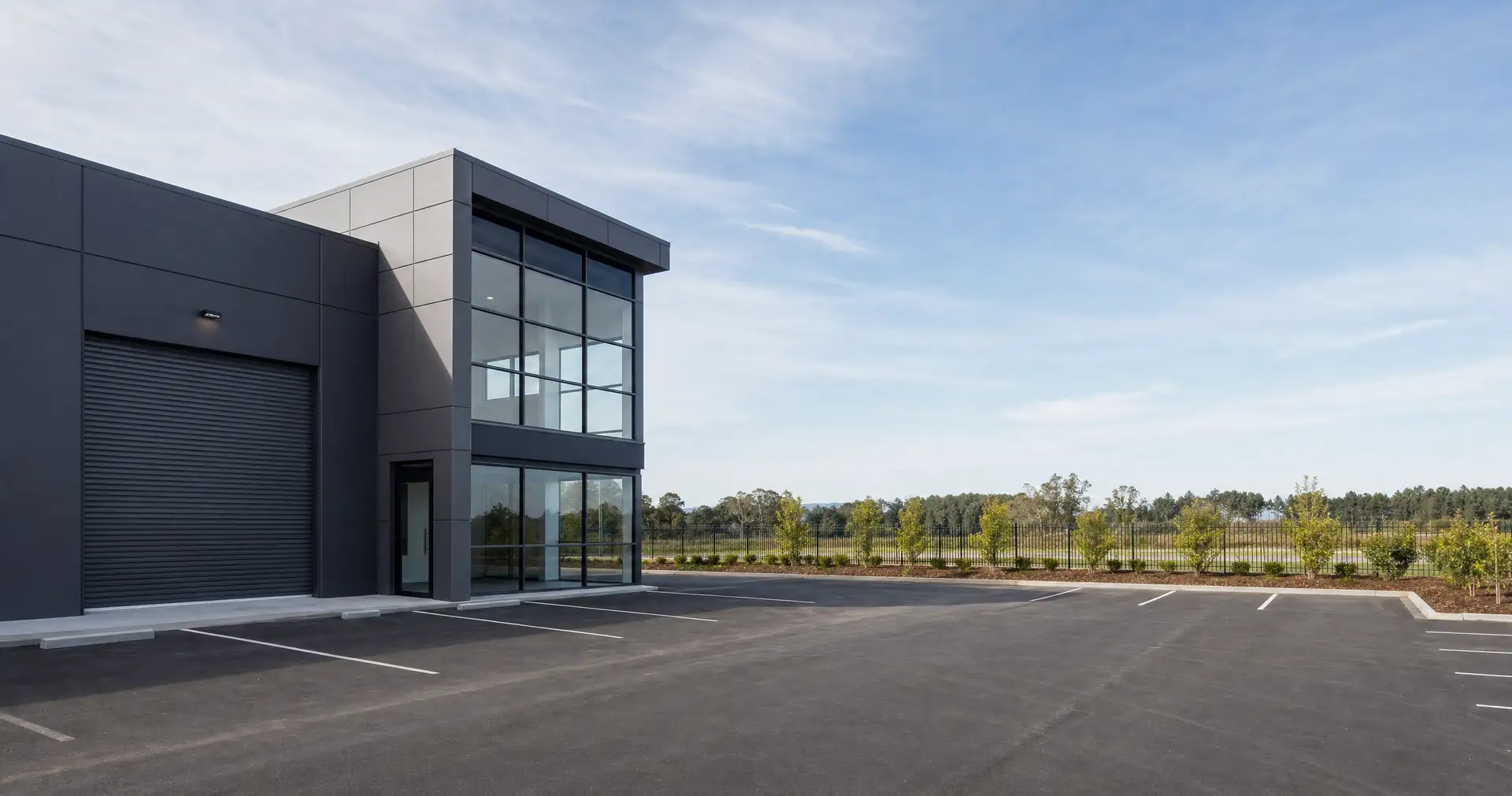
Property-secured term lending for owner-occupier or investor purchases. Indicative 7% to 11% per annum across 5 to 25-year terms. Major-bank dominated.
Last reviewed 5 May 2026
Indicative repayment
Weekly
$2,240/week
Indicative only. Not a quote or offer of credit. Actual rates, fees, and repayments depend on the business profile and the lender's decision.
Sending to Prospa
10 years at 8.00%. Prospa will ask a few quick questions, then provide a firm quote and funding if eligible.
Redirecting…
Indicative only. Why we say this












Quick answer
What it is
A commercial property loan is term lending secured against commercial property: an industrial unit, a retail building, an office, a hospitality site, or a mixed-use building. The structure is the dominant choice for owner-occupier business property purchases and for investor purchases.
Owner-occupier loans are commonly priced lowest because the business itself occupies the property and the lender views the rent-equivalent as the loan service. Investor loans price slightly higher because the income source is a third-party tenant whose lease term may be shorter than the loan term.
NZ commercial property lending is overwhelmingly major-bank (ANZ, ASB, BNZ, Westpac, Kiwibank), with non-bank specialists (Heartland, Avanti, Basecorp) playing in the harder credit and faster-decision niches. Commercial property accounts for a substantial share of the NZ business lending book.
Amount
$200K to $20M+
Term
5 to 25 years
LVR
60% to 70% typical
Rate band
7% to 11% indicative
Property types
Warehousing, light manufacturing, distribution. Strongest LVRs because of stable tenant base and resale market.
High street, suburban centres, large-format. LVRs depend on location strength and tenant covenant.
CBD and suburban offices. Tenant covenant and lease term drive LVR.
Restaurants, cafes, bars, hotels. Specialist underwriting; commonly higher rate band.
Retail-with-residential, office-with-retail. LVRs blend across components.
Childcare, medical, service stations, cold storage. Specialist underwriting and tenant-specific risk.
Owner-occupier vs investor
| Feature | Owner-occupier | Investor | Mixed (property in trust) |
|---|---|---|---|
| Property use | Business occupies | Tenant occupies | Either |
| Income source | Business cash flow | Lease income | Lease income, possibly to related entity |
| Indicative LVR | 65% to 75% | 60% to 70% | 60% to 70% |
| Indicative rate | 7% to 10% | 8% to 11% | 8% to 11% |
| Term | Up to 25 years | Up to 25 years | Up to 25 years |
| Suits | Buying own premises | Investment property | Asset protection structures |
How it works
01
Day 1 to 14
Initial conversation with relationship banker or commercial broker. Define purpose (owner-occupier or investor), property type, requested amount, term, and security position.
02
Day 7 to 21
NZBN, business owner ID, last 12 to 24 months bank statements, P&L (typically 2 to 3 years), cash-flow forecast, lease documentation (if investor), property purchase contract, deposit confirmation.
Documents commonly required
03
Day 14 to 35
Lender commissions a registered valuation. Credit committee assesses against debt-service ratios, security position, tenant covenant (investor), and borrower profile. Conditional approval typically issues at this stage.
04
Day 28 to 60
Loan documents drafted by lender, reviewed by borrower's solicitor. First mortgage registered at LINZ on settlement. Funds disburse to vendor; ownership passes to borrower.
NZ commercial property loan timelines run 4 to 8 weeks from initial conversation to settlement. Smaller, simpler purchases on existing relationships can compress to 3 weeks; harder credit, complex structures, or large transactions can run 8 to 12 weeks.
Worked scenarios
Indicative monthly costs and structures across three different NZ commercial property purchases.
Manufacturing
A Mt Wellington light manufacturer buying its own 800m² industrial unit instead of continuing to rent. Purchase price $1.6M. Trading 12 years, $90K monthly turnover, 30% deposit available.
Structure: 70% LVR commercial mortgage at 8% indicative, P&I across 20 years. Monthly repayment ~$9,400 vs current rent of ~$10,500. Equity builds in the property over the term.
Indicative figures
Property investment
A Wellington-based investor buying a Cuba Street retail unit with an established 6-year lease in place. Purchase $1.1M, lease income $85K p.a. (gross). Rate slightly above owner-occupier reflecting tenant-source income.
Structure: 65% LVR investor commercial mortgage at 9% indicative, interest-only for 5 years then amortising 20 years. Monthly cost interest-only ~$5,360.
Indicative figures
Hospitality
A Christchurch restaurant group buying its current premises (Riccarton, freehold). Purchase $850K. Trading 15 years, $1.2M annual turnover. Lender treats hospitality property as specialist class.
Structure: 60% LVR commercial mortgage at 9.5% indicative, P&I across 15 years. Specialist hospitality underwriting; rate slightly above industrial because of resale specificity.
Indicative figures
Lenders
Best for broad commercial property
Largest NZ commercial property lender. Owner-occupier, investor, and development across all asset classes.
Indicative rate band:7% to 10% p.a.
Read onBest for industrial and rural property
Strong industrial and rural commercial property book. Mid-priced major-bank tier.
Indicative rate band:7% to 10% p.a.
Read onBest for mid-market property
BNZ commercial property across SME and mid-market. Strong on owner-occupier industrial.
Indicative rate band:7% to 10% p.a.
Read onBest for investor and mixed-use
Strong on investor and mixed-use commercial property. Major-bank pricing.
Indicative rate band:7% to 10% p.a.
Read onBest for NZ-owned bank, smaller transactions
NZ-owned bank with SME-focused commercial property; strong on smaller transactions ($200K to $1M).
Indicative rate band:7% to 10% p.a.
Read onBest for speed-sensitive, harder credit
Faster than major banks for commercial property; useful for harder credit profiles or specialist asset classes.
Indicative rate band:8% to 11% p.a.
Read onTrade-offs
When it goes wrong
Commercial property loans default through the same path as residential mortgages: missed payments, formal default, mortgagee sale. The commercial-specific risks are rate resets and tenant-loss on investor property.
Late or missed monthly payments commonly trigger a relationship-banker check-in within the first cycle. The lender will typically work with a borrower whose underlying business is solvent on a payment plan or term extension.
What happens:Late fees apply ($50 to $150 per missed payment). Credit file marks accumulate. Continued non-payment escalates to formal default review (typically 90 days arrears).
On investor commercial property, tenant departure or default removes the income source. Lender may require equity injection or interest-only relief while the property is re-let.
What happens:Borrower temporarily covers debt service from other income. Persistent vacancy can trigger an LVR review and a request to reduce the loan balance.
After 90 days arrears and statutory notice under the Property Law Act 2007, the lender can move to mortgagee sale. The property is sold; sale proceeds are applied to loan balance, sale costs, and any fees.
What happens:Property is sold at potentially below-market values (mortgagee sales commonly clear at 80% to 95% of valuation). Any shortfall is pursued under the personal guarantee. Surplus, if any, returns to the borrower.
Mortgagee sale is typically uncommon on owner-occupier commercial property, because the business itself loses its premises in the process. Lenders strongly prefer payment plans, term extensions, and refinance over enforcement. Investor property defaults more frequently as tenant or rate-reset risks compound.
LVR and pricing by property type
Commercial property lending prices off the property and the income behind it rather than off the borrower alone. Owner-occupier lending, where the business buys its own premises, is generally treated more favourably than investment lending because the occupier and the covenant are the same party. The bands below are observed across NZ trading banks and non-bank commercial lenders as at 2026.
| Property type | Typical LVR | Indicative rate | Typical term | Amortisation |
|---|---|---|---|---|
| Owner-occupied industrial | 65% to 75% | 7% to 9.5% | 5 to 15 years | 15 to 25 years |
| Owner-occupied office or retail | 60% to 70% | 7.5% to 10% | 5 to 15 years | 15 to 20 years |
| Investment industrial, leased | 60% to 70% | 7.5% to 10% | 3 to 10 years | 15 to 25 years |
| Investment retail, leased | 55% to 65% | 8% to 11% | 3 to 10 years | 15 to 20 years |
| Hospitality or specialised | 50% to 60% | 9% to 12% | 3 to 7 years | 10 to 15 years |
| Development or land | 45% to 60% | 10% to 15%+ | 12 to 24 months | Interest only |
Indicative bands only, not a quote or offer of credit. LVR and pricing are set after valuation and credit assessment, and depend materially on the lease covenant, the remaining lease term, the borrower financial position and the property location and condition.
The number that decides the deal
Borrowers commonly arrive focused on deposit and LVR, while commercial property applications are typically decided on interest cover: the ratio of net property income, or business earnings on an owner-occupier deal, to the annual interest cost. New Zealand lenders commonly look for cover somewhere between 1.5 and 2.0 times, and where that test fails the application does not proceed regardless of how much deposit is available. It is also the test most exposed to a rate rise, because interest cost is the denominator. A deal that clears 1.6 times at an indicative 8% falls below 1.3 times at 10%, which is why lenders commonly stress-test at a rate well above the one on offer.
Common pitfalls
Commercial property lending carries costs and review points that residential borrowers do not expect, and the amounts involved make each of them material.
Commercial loans commonly run a 3 to 5 year term against a 20 year amortisation, so the loan matures with a large balance outstanding and has to be refinanced. That refinance is a fresh credit assessment at whatever rates and appetite exist on the day.
Many NZ facilities carry an annual review where the bank can reassess covenants, require updated valuations and adjust pricing. A review is not a formality when the sector has moved.
A registered commercial valuation commonly runs $2,500 to $8,000 and is paid whether the loan proceeds or not. On a declined application it is a sunk cost.
On investment property, a lease expiring before the loan matures shifts the risk onto the borrower. Lenders commonly size the loan against the remaining certain lease term rather than the passing rent.
A New Zealand-specific issue. A building assessed below the NBS threshold can be difficult to finance at all, and strengthening costs are commonly required to be funded alongside the purchase.
Where the family home is taken as additional security to make the numbers work, a problem with the commercial property becomes a problem with the house. It is common, and it is worth pricing the alternative of a lower LVR.
Owner-occupier structuring
The structuring question comes up on almost every owner-occupier purchase in New Zealand, and it is genuinely an accountant and solicitor question rather than a lending one. The common alternatives are buying in the trading company, buying in a separate holding company or trust that leases the premises back to the trading company, or buying personally and leasing to the business.
The separate-entity approach is widely used, and the reasons usually given are that it isolates the property from trading risk, that it makes the business easier to sell later without the property attached, and that it creates a rental arrangement between related parties with its own tax treatment. Each of those has conditions attached and none of them is automatic.
Lenders assess the structure on its substance. Where a holding entity owns the property and leases it to a related trading company, the lender commonly looks through to the trading business for serviceability and takes guarantees from both entities, so the separation is real for asset-protection purposes without being real for credit purposes.
The tax treatment of a related-party lease, including whether the rent is at market and how the interest is treated in each entity, depends entirely on the specific arrangement and is subject to the accountant confirmation. Getting the structure settled before the offer goes unconditional is materially easier than restructuring afterwards, because a transfer between entities later can trigger costs that the original decision would have avoided. Lenders are generally comfortable with any of the common structures provided the serviceability and the guarantees line up, so the constraint here is rarely the bank. It is the tax and asset-protection reasoning, which sits with the professional advisers and takes longer to work through than a lending approval does.
Two different deals
Owner-occupier
Serviceability is assessed on the trading business rather than on a rental stream, so the accounts, the sector and the trading history carry the weight. Lenders commonly treat this favourably, because the occupier cannot vacate without the borrower knowing about it.
The benefit most owners are chasing is the removal of rent review risk. A lease renewal that resets the rent upward is outside the business control; a mortgage repayment on a fixed term is not, and over a long period that predictability is often worth more than the interest saved.
The exposure is concentration. The premises, the business and commonly the guarantees are all attached to the same operation, so a downturn affects the ability to service the loan and the value of the security at the same time.
Investment
Serviceability is assessed on the net rental income, and the quality of the tenant matters more than almost anything else. A national retailer on a ten-year lease with rights of renewal supports materially better terms than an unrelated small business on a two-year term at the same rent.
Lenders look at the remaining certain lease term against the loan term, the rent review mechanism, whether outgoings are recovered from the tenant, and what the property would let for if it fell vacant tomorrow.
Vacancy is the risk the structure carries. Where the tenant leaves, the income stops but the repayment does not, and re-letting a specialised commercial building in a provincial New Zealand market can take considerably longer than the reserves set aside for it.
Costs beyond the deposit
Commercial property carries a set of transaction costs that catch buyers coming from residential experience, and on a purchase of any size they add up to a figure worth budgeting for rather than discovering.
A registered commercial valuation is required by the lender and commonly runs $2,500 to $8,000 depending on the property, and it is payable whether or not the loan proceeds. Legal fees on a commercial purchase are typically several thousand dollars more than a residential equivalent, because the lease review, the title and the due diligence are more involved.
A building condition report and a seismic assessment are commonly required, and on an older building the seismic report can change the deal entirely. Lender establishment fees on commercial facilities are frequently charged as a percentage of the loan rather than a flat amount, and where a broker is involved there may be a separate fee on top.
GST is the item most likely to surprise. Commercial property transactions between GST-registered parties are commonly zero-rated where the requirements are met, but the treatment depends on the registration status of both parties and on whether the property is tenanted at settlement, and getting it wrong is expensive. This is squarely an accountant and solicitor question and the answer should be settled before the agreement goes unconditional, subject to their confirmation on the specific transaction.
The refinance cliff
This is the structural feature that most distinguishes commercial property lending from a residential mortgage, and the one most often not registered at signing. The repayment is calculated as though the loan runs 20 years, but the facility itself matures in three to five, leaving a large balance outstanding that has to be refinanced. That refinance is a fresh application, assessed against the property value, the lease position, the business performance and the lender appetite on the day it falls due rather than the day the loan was written. Where values have fallen or the sector has moved out of favour, a borrower who has never missed a payment can find the terms available at maturity materially worse. The practical response is to know the maturity date, begin the refinance conversation a good six to twelve months ahead of it, and treat the LVR headroom as the buffer that carries the deal through a bad year.
Before the offer goes unconditional
The finance condition is the only real protection in a commercial purchase, and it is commonly written too short. Five things want resolving inside it: the registered valuation, because the lender sizes the loan off that figure rather than the purchase price; the seismic position, because a building below the NBS threshold can be unfinanceable regardless of price; the GST treatment between the parties, which is an accountant and solicitor question with expensive answers if it is wrong; the lease review on a tenanted property, particularly the remaining certain term against the loan term; and the ownership structure, because moving the property between entities afterwards commonly costs more than deciding correctly at the start.
References
Where commercial property mortgages are registered.
IRD guidance on the tax treatment of commercial property income.
NZ commercial property lending volume context.
NZ commercial property market context.
NZ commercial property valuation and yields.
FAQ
A commercial property loan is term lending secured against commercial property: industrial, retail, office, hospitality, or mixed-use buildings. It is the dominant choice for owner-occupier business property purchases (where the business buys its own premises) and for investor purchases (where the borrower buys to lease).
Indicative rates run 7% to 11% per annum across NZ commercial property lending. Major banks price the lowest band on clean owner-occupier applications. Investor property prices slightly higher; specialist asset classes (hospitality, specialised single-tenant) higher again.
NZ commercial property loans typically require 25% to 40% deposit (60% to 75% LVR). Owner-occupier industrial often achieves higher LVR (up to 75%); specialist asset classes commonly require 35% to 50% deposit. Substantial deposit unlocks the lowest rate bands.
Typical timelines run 4 to 8 weeks from initial conversation to settlement. Smaller transactions on existing relationships can compress to 3 weeks; harder credit, complex structures, or large transactions can run 8 to 12 weeks. The timeline is driven by valuation, credit committee, and solicitor work.
Owner-occupier commercial property loans are typically priced 50 to 100 basis points below investor equivalents because the lender views the business cash flow servicing the loan more favourably than third-party rent.
NZ commercial property loans run up to 25 years, the longest term in business lending. Common structures are 15 to 20 year P&I loans, or interest-only periods of 3 to 5 years followed by amortising P&I over the balance of the term.
Interest on a commercial property loan used for business or investment purposes is generally deductible against business income or rental income, subject to the accountant's confirmation. Mixed-use commercial property apportions interest by use.
Yes, commercial property is commonly held in family trusts or look-through companies for asset-protection or tax-planning reasons. The loan is typically held by the trust or company; personal guarantees from beneficiaries or directors are common. The accountant and solicitor are the right people to confirm the structure.
At the end of the interest-only period, the loan converts to P&I across the remaining term. Monthly payments increase materially because principal repayment now starts. Borrowers commonly refinance at this point to extend the IO period or restructure the loan.
A debt-service ratio (DSR) measures the borrower's capacity to service debt from cash flow. NZ commercial property lenders typically require DSR coverage of 1.25x to 1.5x (the cash flow available exceeds the debt service by 25% to 50%). Tighter DSR commonly triggers conditional approval or requested deposit increase.
Yes, the lender almost always commissions a registered valuation by a NZ Institute of Valuers member. The borrower typically pays for the valuation (~$1,500 to $5,000 depending on property complexity). The valuation determines the achievable loan amount.
On clean owner-occupier transactions, major banks are typically the cheapest. On harder credit, faster decisions, or specialist asset classes, non-bank lenders (Heartland, Avanti, Basecorp) often beat the banks on speed and accessibility. The trade-off is rate band; non-banks typically price 1 to 2 percentage points above major-bank pricing.
Related
Secured business loan
The broader category commercial property loans sit inside.
Read onBuy commercial property
Reason-side context for commercial property purchase.
Read onANZ Business
Largest NZ commercial property lender.
Read onAged care and rest home loans
Property-heavy commercial mortgages dominate the segment.
Read onMotel and accommodation loans
Going-concern motel acquisitions usually combine business and property finance.
Read onDisclaimer
A business loan is a commitment that runs for months or years, and repayments come out of the same operating cash flow as everything else. Before committing, it is worth modelling the weekly and monthly cost against the business's working-capital position, which is what this site is built to help with. Borrowing at a level that stays comfortable through a quiet quarter, not just a strong one, is widely regarded as the safer frame.
What this site is
A calculator and information tool. Not a lender, not a broker, not a registered financial adviser. Nothing here is personalised financial advice.
What the figures show
Modelled estimates based on the inputs you enter. Not a quote. Not an offer of credit. Not a guarantee of approval, rate, or fees.
What the lender decides
Final rates, fees, and approval are set by the lender after a CCCFA-appropriate assessment of the applicant's circumstances and credit decision.
Commercial disclosure
Businessloans.org.nz earns a commission from Prospa when a visitor applies through this site and their application is approved. The commission is paid by Prospa, not by the borrower, and it does not influence the rate Prospa offers. Full disclosure on the partner page.
Tax, GST, and accountant framing
Tax-treatment statements (GST claim timing, interest deductibility, depreciation rates) are general in nature and subject to your accountant's confirmation on the specific business position. For material amounts, professional advice from a registered financial adviser or chartered accountant is widely regarded as the safer frame.